







Question: Please help me on this quickly with clear, thorough explanations. R = {(a, b), (a, c), (a, d), (b, a), (c, b), (d, e), (e,
Please help me on this quickly with clear, thorough explanations.
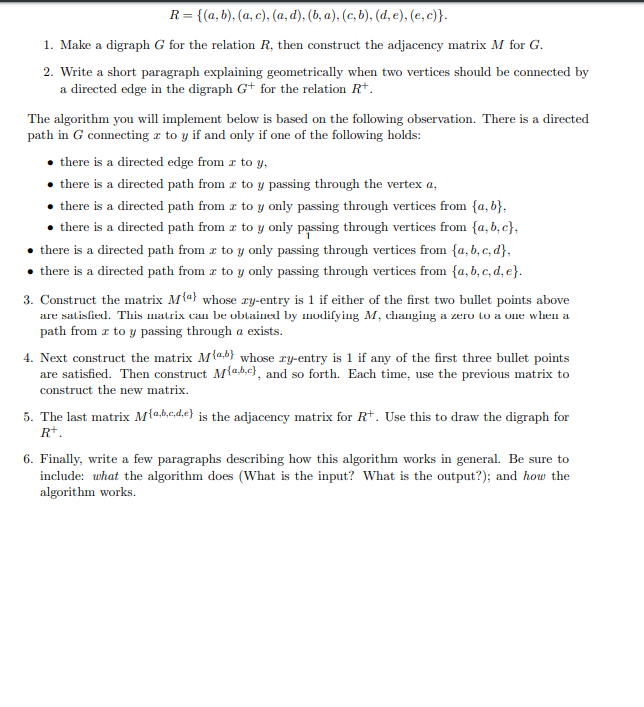
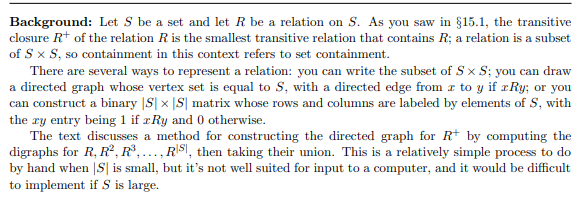
R = {(a, b), (a, c), (a, d), (b, a), (c, b), (d, e), (e, c)}. 1. Make a digraph G for the relation R, then construct the adjacenty matrix M for G. 2. Write a short paragraph explaining geometrically when two vertices should be connected by a directed edge in the digraph G for the relation RT. The algorithm you will implement below is based on the following observation. There is a directed path in G connecting a to y if and only if one of the following holds: . there is a directed edge from a to y. . there is a directed path from a to y passing through the vertex a, . there is a directed path from a to y only passing through vertices from {a, b}, . there is a directed path from a to y only passing through vertices from {a, b, c), . there is a directed path from a to y only passing through vertices from {a, b, c, d}, . there is a directed path from a to y only passing through vertices from {a, b, c, d, e}. 3. Construct the matrix Mi" whose ry-entry is 1 if either of the first two bullet points above are satisfied. This matrix can be obtained by modifying M, changing a zero to a one when a path from a to y passing through a exists. 4. Next construct the matrix Mig whose ry-entry is 1 if any of the first three bullet points are satisfied. Then construct Mabel, and so forth. Each time, use the previous matrix to construct the new matrix. 5. The last matrix Affebeds) is the adjacenty matrix for RT. Use this to draw the digraph for RT. 6. Finally, write a few paragraphs describing how this algorithm works in general. Be sure to include: what the algorithm does (What is the input? What is the output?); and how the algorithm works.\f
Step by Step Solution
There are 3 Steps involved in it

Get step-by-step solutions from verified subject matter experts
 Study Help