







Question: Please help me out here, I have trouble solving these questions (1 point) Consider the series an Where 71 1 an = (-10) 72 (6n2
Please help me out here, I have trouble solving these questions
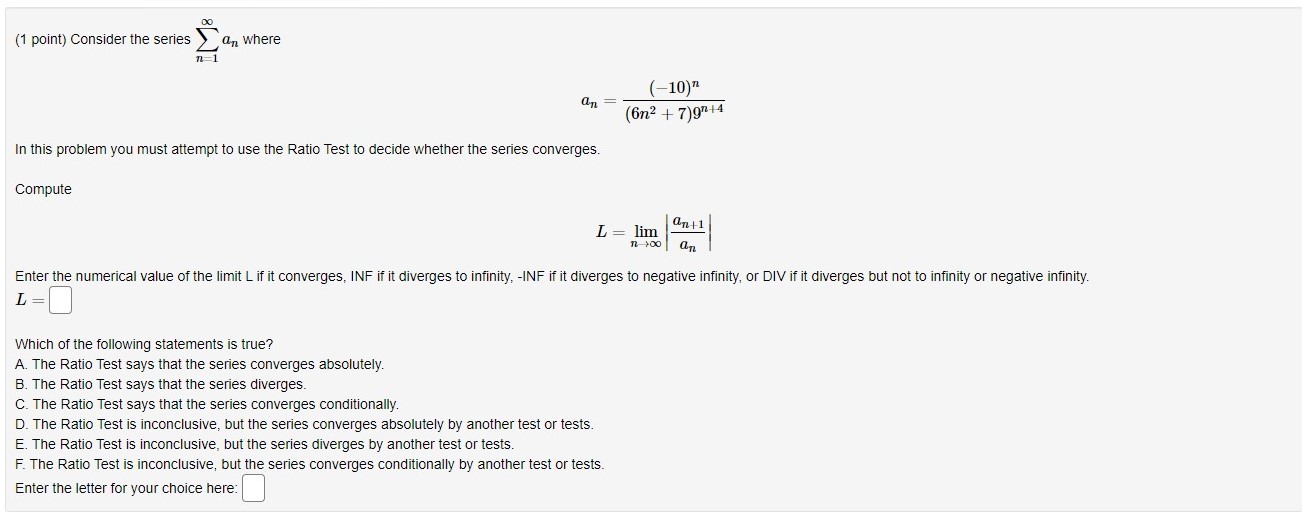
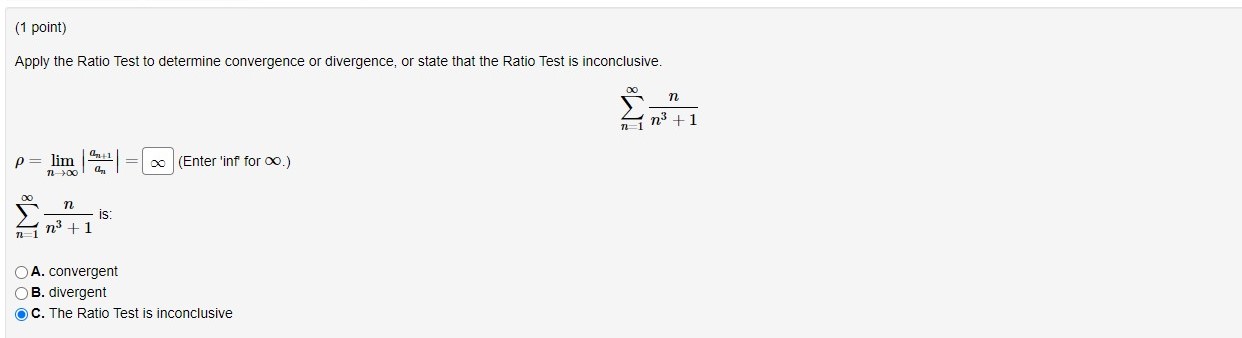
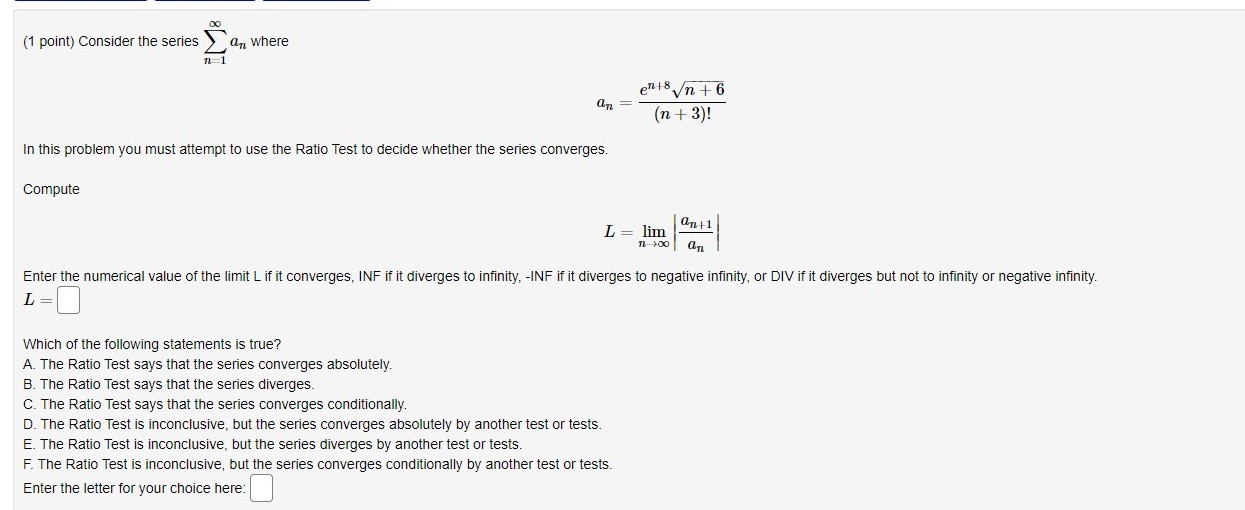
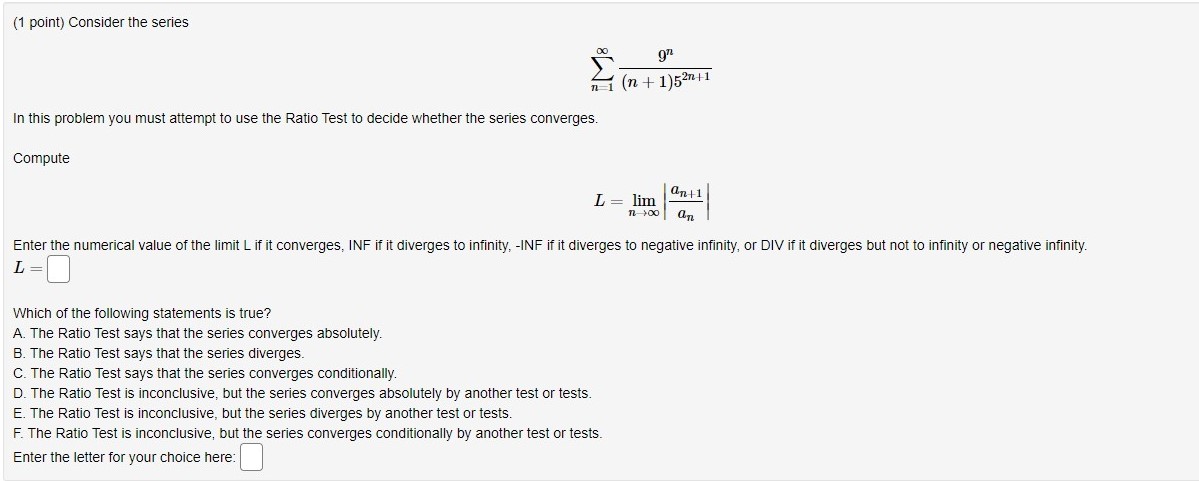
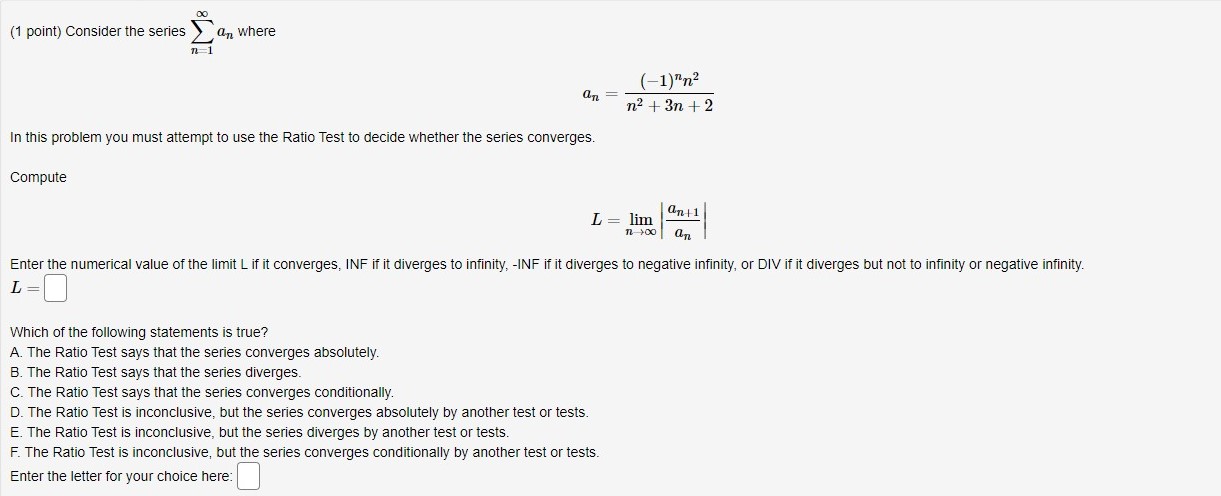
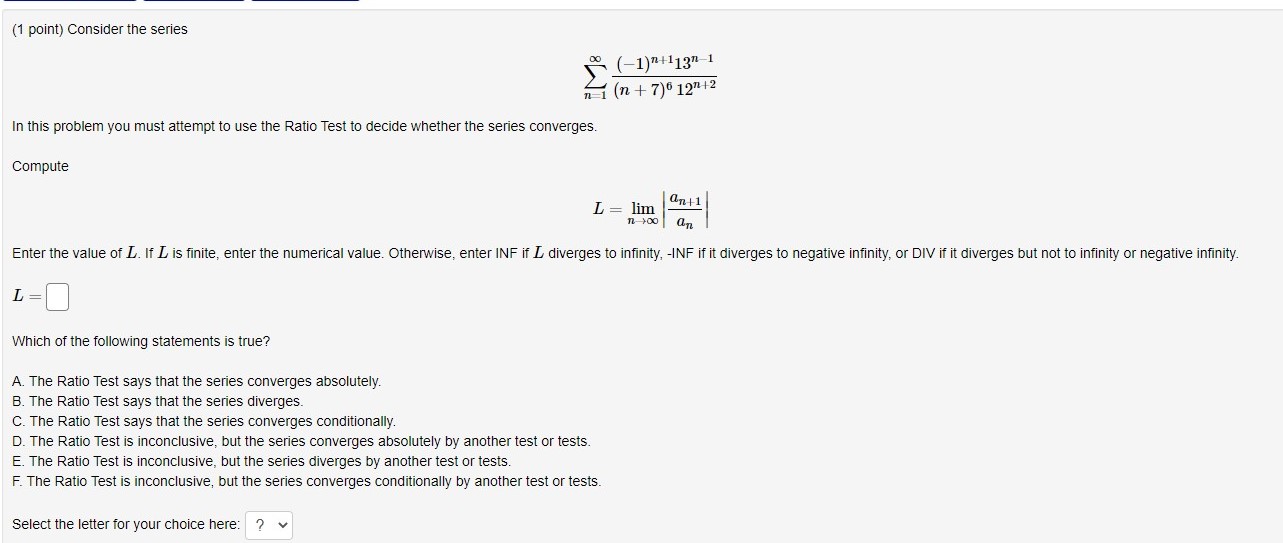
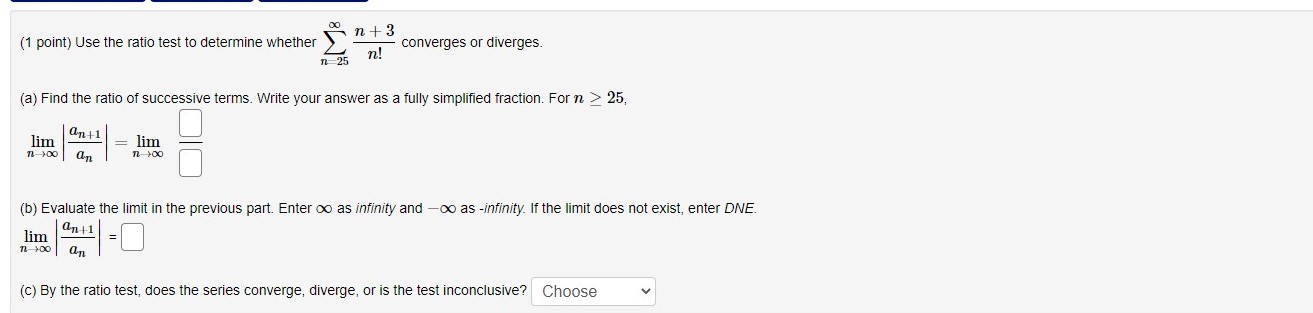
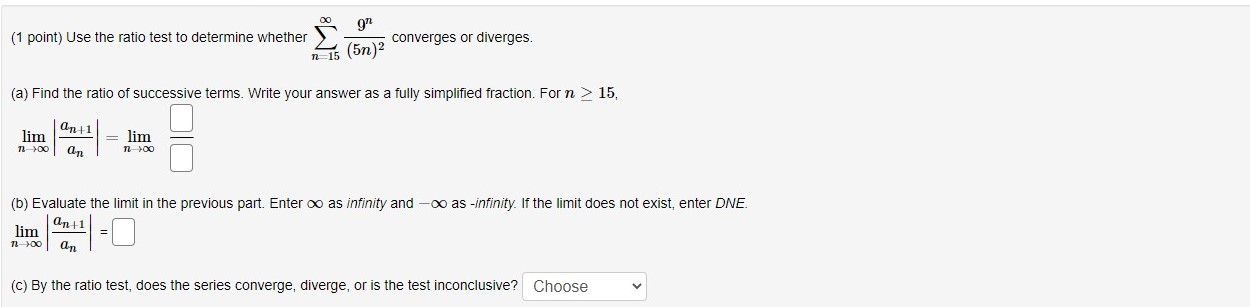
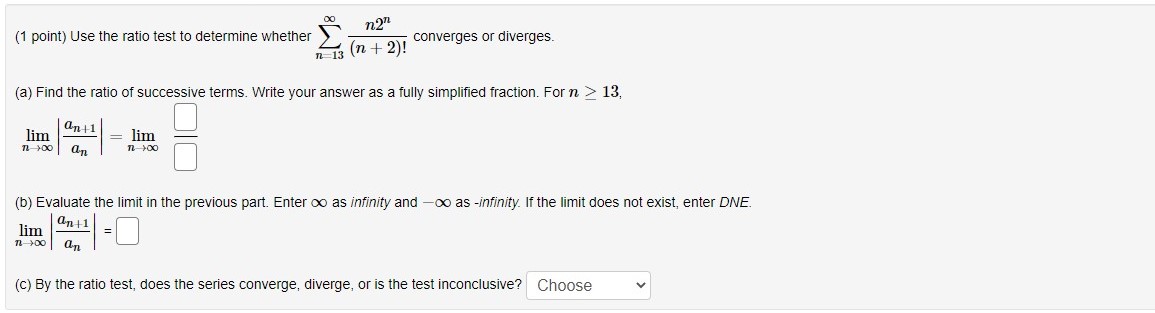
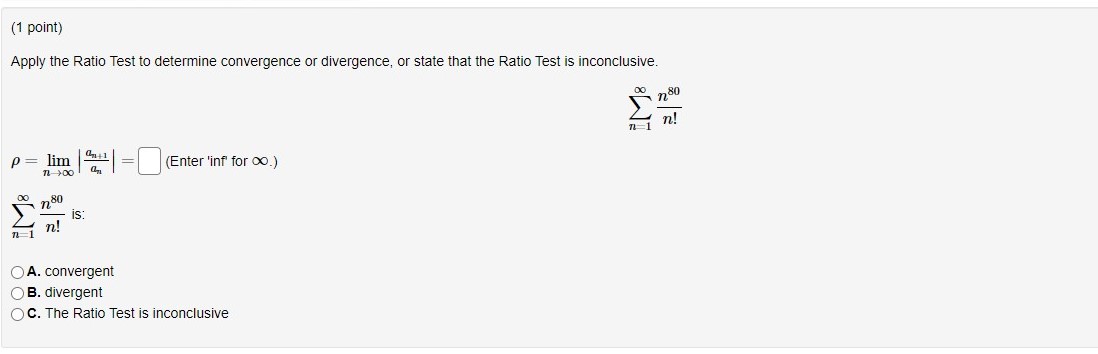
(1 point) Consider the series an Where 71 1 an = (-10) 72 (6n2 + 7)gn+4 In this problem you must attempt to use the Ratio Test to decide whether the series converges. Compute L = lim an+1 n-100 Enter the numerical value of the limit L if it converges, INF if it diverges to infinity, -INF if it diverges to negative infinity, or DIV if it diverges but not to infinity or negative infinity. L = Which of the following statements is true? A. The Ratio Test says that the series converges absolutely. B. The Ratio Test says that the series diverges. C. The Ratio Test says that the series converges conditionally. D. The Ratio Test is inconclusive, but the series converges absolutely by another test or tests. E. The Ratio Test is inconclusive, but the series diverges by another test or tests. F. The Ratio Test is inconclusive, but the series converges conditionally by another test or tests. Enter the letter for your choice here:(1 point) Apply the Ratio Test to determine convergence or divergence, or state that the Ratio Test is inconclusive. n3 +1 p= lim 7-+00 (Enter 'inf for co.) n is: n' + 1 OA. convergent OB. divergent O C. The Ratio Test is inconclusive(1 point) Consider the series an where 7 1 enton + 6 an (n + 3)! In this problem you must attempt to use the Ratio Test to decide whether the series converges. Compute L = lim an+1 n-+00 an Enter the numerical value of the limit L if it converges, INF if it diverges to infinity, -INF if it diverges to negative infinity, or DIV if it diverges but not to infinity or negative infinity. L = Which of the following statements is true? A. The Ratio Test says that the series converges absolutely. B. The Ratio Test says that the series diverges. C. The Ratio Test says that the series converges conditionally. D. The Ratio Test is inconclusive, but the series converges absolutely by another test or tests. E. The Ratio Test is inconclusive, but the series diverges by another test or tests F. The Ratio Test is inconclusive, but the series converges conditionally by another test or tests. Enter the letter for your choice here:(1 point) Consider the series IM: (n + 1)52n+1 In this problem you must attempt to use the Ratio Test to decide whether the series converges. Compute L = lim an+1 n-+00 an Enter the numerical value of the limit L if it converges, INF if it diverges to infinity, -INF if it diverges to negative infinity, or DIV if it diverges but not to infinity or negative infinity. L = Which of the following statements is true? A. The Ratio Test says that the series converges absolutely. B. The Ratio Test says that the series diverges. C. The Ratio Test says that the series converges conditionally. D. The Ratio Test is inconclusive, but the series converges absolutely by another test or tests. E. The Ratio Test is inconclusive, but the series diverges by another test or tests. F. The Ratio Test is inconclusive, but the series converges conditionally by another test or tests. Enter the letter for your choice here:(1 point) Consider the series IM: an where an = (-1)"n2 n2 + 3n + 2 In this problem you must attempt to use the Ratio Test to decide whether the series converges. Compute L = lim an+1 n +00 an Enter the numerical value of the limit L if it converges, INF if it diverges to infinity, -INF if it diverges to negative infinity, or DIV if it diverges but not to infinity or negative infinity. L = Which of the following statements is true? A. The Ratio Test says that the series converges absolutely. B. The Ratio Test says that the series diverges. C. The Ratio Test says that the series converges conditionally. D. The Ratio Test is inconclusive, but the series converges absolutely by another test or tests. E. The Ratio Test is inconclusive, but the series diverges by another test or tests. F. The Ratio Test is inconclusive, but the series converges conditionally by another test or tests. Enter the letter for your choice here:(1 point) Consider the series IM: (-1)n4113 -1 (n + 7)6 12 42 In this problem you must attempt to use the Ratio Test to decide whether the series converges. Compute L = lim an+1 n +00 an Enter the value of L. If I is finite, enter the numerical value. Otherwise, enter INF if _ diverges to infinity, -INF if it diverges to negative infinity, or DIV if it diverges but not to infinity or negative infinity. L = Which of the following statements is true? A. The Ratio Test says that the series converges absolutely. B. The Ratio Test says that the series diverges. C. The Ratio Test says that the series converges conditionally. D. The Ratio Test is inconclusive, but the series converges absolutely by another test or tests. E. The Ratio Test is inconclusive, but the series diverges by another test or tests. F. The Ratio Test is inconclusive, but the series converges conditionally by another test or tests. Select the letter for your choice here: 2n+3 n! on (1 point) Use the ratio test to determine whether 2 converges or diverges, 11:5 (a) Find the ratio of successive terms. Write your answer as a fuliy simplies fraction. For n 2 25. .im f 4\"\" C] (b) Evaluate the limit in the prewaus part. Enter 00 as infinity and 00 as innrry. time limit does not exist enter ENE. 112mm:E] nHX) an (C) By the ratio test, does the series converge, diverge, or is the test inconclusive? Choose v lim ' \"n+1 nM'n at} E on (1 point) Use the ratio test to determine whether converges or diverges. n 15 (5n2) 2 (a) Find the ratio of successive terms. Write your answer as a fully simplified fraction. For n > 15, lim an41 lim n-+00 (b) Evaluate the limit in the previous part. Enter co as infinity and -co as -infinity. If the limit does not exist, enter DNE. lim an +1 an (c) By the ratio test, does the series converge, diverge, or is the test inconclusive? Choose11.2" m converges or diverges. no (1 point) Use the ratio test to determine whether 2 I121}! (a) Find the ratio of successive terms. Write your answer as a fully simplied fraclion. For n 2 13, ljm too E] ([1) Evaluate the limit. in the previous part. Enter 00 as infinity and 00 as infinity It the limit GOES not exist, enter ENE. Jim n+1 =[j nHX] an (1:) By the ratio test, does the series converge, diverge, or is the test inconclusive? 9 Choose v' lim '01:\" m an (1 point) Apply the Ratio Test to determine convergence or divergence, or state that the Ratio Test is inconclusive. p=lim{ 11100 \"in n. =C] (Enter'int' foroo_) O A. convergent O B. divergent O c. The Ratio Testis inconclusive
Step by Step Solution
There are 3 Steps involved in it

Get step-by-step solutions from verified subject matter experts
 Study Help