







Question: Please help me out, thank you! 2. {2f} marks} Consider an economy that consists of consumers, rms, and a government. The representative consumer has preferences
Please help me out, thank you!
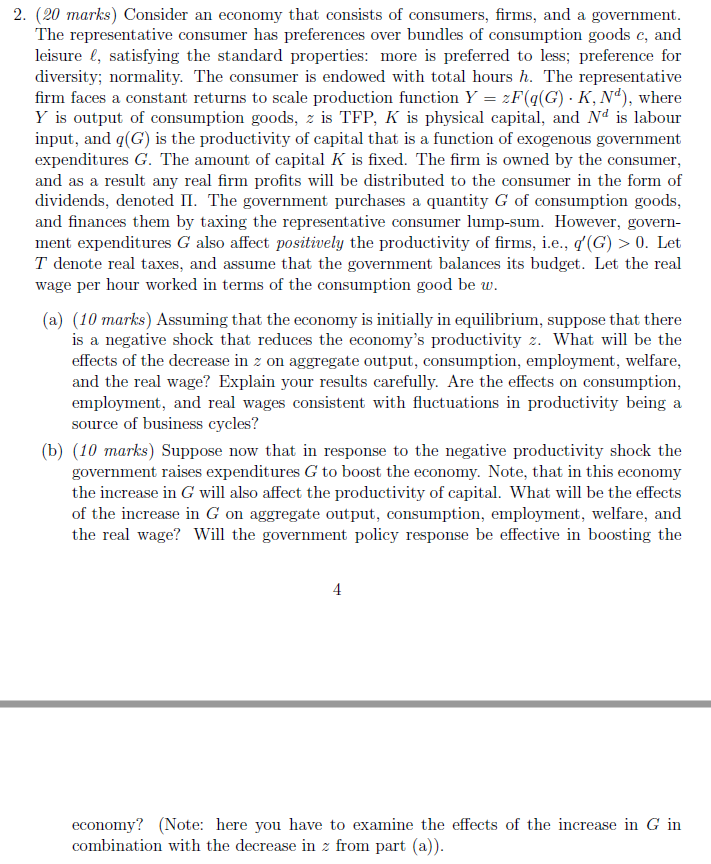
2. {2f} marks} Consider an economy that consists of consumers, rms, and a government. The representative consumer has preferences over bundles of consumption goods e, and leisure E, satisfying the standard properties: more is preferred to less; preference for diversity; normality The consumer is endowed with total hours 31. The representative rm faces a constant returns to scale production function "i" = zF[q{G) - If, Nd}, where Y is output of consumption goods, 3 is TFP, K is physical capital, and N'1 is labour input, and off?) is the productivity of capital that is a function of exogenous government expenditures ('3'. The amount of capital If is xed. The rm is owned by the consumer, and as a result any real rm prots will be distributed to the consumer in the form of dividends, denoted H. The government purchases a quantity (3' of consumption goods, and nances them by taxing the representative consumer lumpsum. However, govern ment expenditures G also affect positively the productivity of rms, i.e., q'fG} 2: D. Let T denote real taxes, and assume that the government balances its budget. Let the real wage per hour worked in terms of the consumption good be to. {a} 1f 1 I? marks) Assuming that the economy is initiale in equilibrium, suppose that there is a negative shock that I'EtilllCE the economy's productivity 3. 'What will be the effects of the decrease in e on aggregate output, consumption, employment, welfare, and the real wage? Explain your results carefully. Are the effects on consumption, employment, and real wages consistent with uctuations in productivity being a source of business cycles? {b} {1!} marks} Suppose now that in response to the negative productivity shock the government raises expenditures G to boost the economy. Note, that in this economy the increase in G will also aect the productivity of capital. What will be the effects of the increase in G on aggregate output, consumption, employment, welfare, and the real wage? Will the government policy response be eective in boosting the economy? (Note: here you have to examine the effects of the increase in G in combination with the decrease in z from part (a)}
Step by Step Solution
There are 3 Steps involved in it

Get step-by-step solutions from verified subject matter experts
 Study Help