Question: please help me!!! please don't coy your answer from other materials. please read through first three photos and solve question 2. I want your opinion.
please help me!!! please don't coy your answer from other materials. please read through first three photos and solve question 2. I want your opinion.
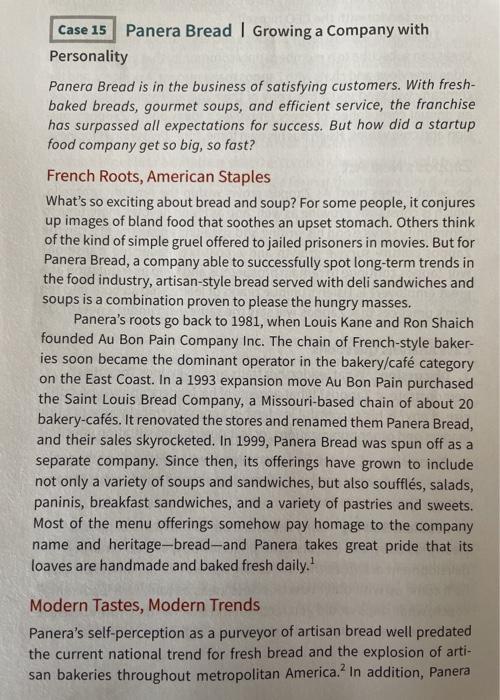
Case 15 Panera Bread I Growing a Company with Personality Panera Bread is in the business of satisfying customers. With fresh- baked breads, gourmet soups, and efficient service, the franchise has surpassed all expectations for success. But how did a startup food company get so big, so fast? French Roots, American Staples What's so exciting about bread and soup? For some people, it conjures up images of bland food that soothes an upset stomach. Others think of the kind of simple gruel offered to jailed prisoners in movies. But for Panera Bread, a company able to successfully spot long-term trends in the food industry, artisan-style bread served with deli sandwiches and soups is a combination proven to please the hungry masses. Panera's roots go back to 1981, when Louis Kane and Ron Shaich founded Au Bon Pain Company Inc. The chain of French-style baker- ies soon became the dominant operator in the bakery/caf category on the East Coast. In a 1993 expansion move Au Bon Pain purchased the Saint Louis Bread Company, a Missouri-based chain of about 20 bakery-cafs. It renovated the stores and renamed them Panera Bread, and their sales skyrocketed. In 1999, Panera Bread was spun off as a separate company. Since then, its offerings have grown to include not only a variety of soups and sandwiches, but also souffls, salads, paninis, breakfast Sandwiches, and a variety of pastries and sweets. Most of the menu offerings somehow pay homage to the company name and heritage-bread-and Panera takes great pride that its loaves are handmade and baked fresh daily. Modern Tastes, Modern Trends Panera's self-perception as a purveyor of artisan bread well predated the current national trend for fresh bread and the explosion of arti- san bakeries throughout metropolitan America. In addition, Panera proactively responded to unease about trans fats by voluntarily remov. ing them from its menu. "Panera recognized that trans fat was a grow- ing concern to our customers and the medical community, therefore we made it a priority to eliminate it from our menu," said Tom Gumpel, former vice-president of bakery development. Panera menu items are free from trans fats, except for small amounts that occur naturally in dairy and meat products as well as in some condiments. According to Ron Shaich, former CEO and now executive chair- man of the board of Panera, "Real success never comes by simply responding to the day-to-day pressures; in fact, most of that is simply noise. The key to leading an organization is understanding the long- term trends at play and getting the organization ready to respond." Stay Fresh Personality Ron Shaich, growing up in Livingston, New Jersey, wasn't focused on being a bread magnate. He wanted to be a public servant, working in government on public policy.As a high school student he even interned for a congressman from his home state. His entrepreneurial spark was ignited during his sophomore year in college at Clark University, when the owner of a local convenience store that didn't cater to students threw him and his friends out. That negative experience lit Shaich's entrepreneurial fire. It was at that point when he had the inspiration for the student government at his college-he was the treasurer--to open a store for students, run by students. The store was a huge success at Clark. He became an impassioned advocate of student governments opening their own stores, speaking on the topic across the country. Shaich's personal transformation from a government public service focus to a retailing-market focus emerged from the recogni- tion that a store for the people, run by the people, could be a success. Following college, he matriculated to Harvard business school, where after graduation he went to work for the Original Cookie Company. With a desire to start his own cookie business, he was ultimately able to find a tiny retail location, opening the Cookie Jar in 1980. This first taste of entrepreneurialism ultimately led to a license agreement with Au Bon Pain, and to the story that has become famous with the explo- sion of Panera Bread Co.5 Sticking It Out All of Panera's attention to monitoring trends paid off handsomely. Sticking It Out All of Panera's attention to monitoring trends paid off handsomely. BusinessWeek recognized Panera as one of its 100 Hot Growth Com- panies." And Forbes named it number 4 on its list of "Top 20 Fran- chises for the Buck." It consistently ranks at the top of Sandleman & Associates' surveys of customer satisfaction. Under Shaich's lead- ership Panera demonstrated that sticking to company ideals while staying in the lead on industry trends pleased customers time and time again. But can this company continue to navigate the chang- ing dietary trends and concerns about fast food in today's unstable market? 2. Discussion Describe how stereotypes about the fast-food industry might positively and negatively affect Panera. Do you think of Panera as a fast-food restaurant, or has the company managed to distinguish itself from this industry segment










 Study Help