Question: Please help me question C and D ! In a hotel reservation system, the Reservations Information System must track hotel rooms, payers, and reservations. Management
Please help me question C and D !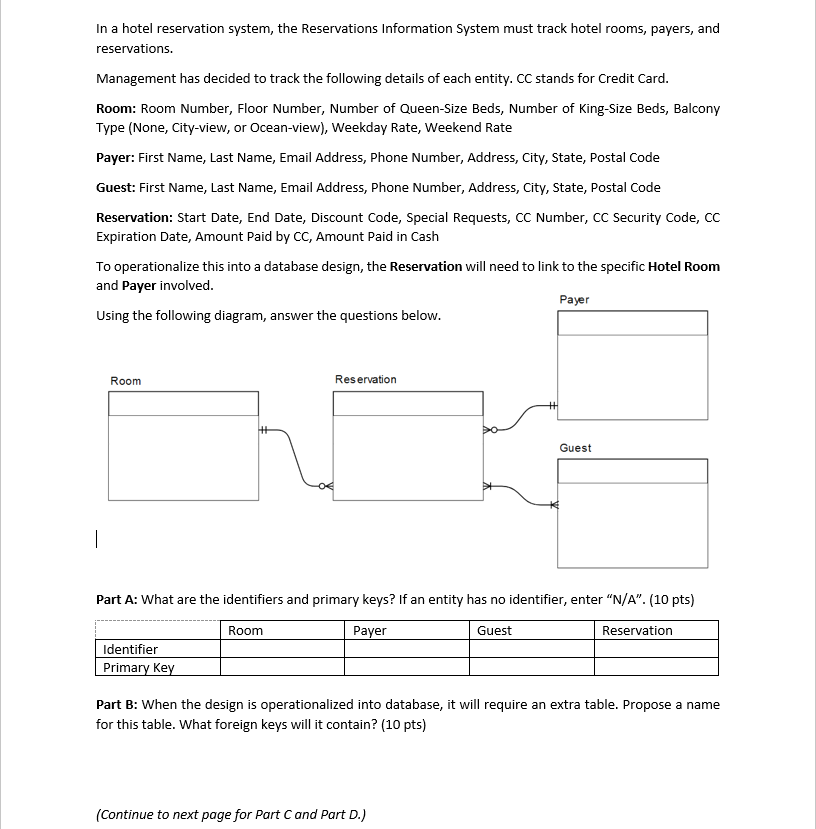
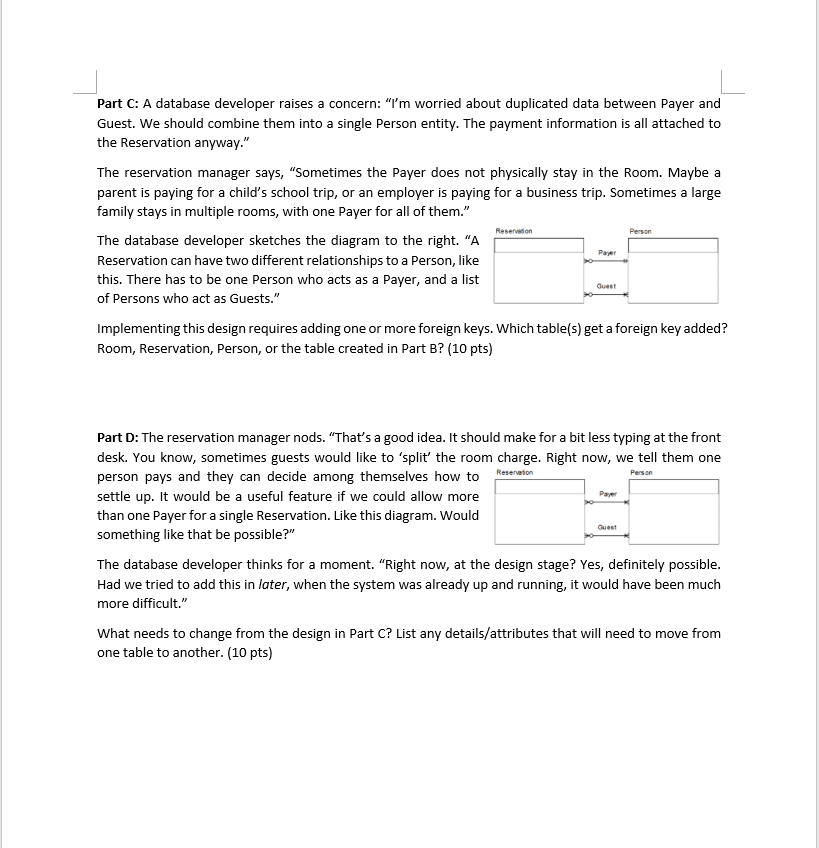
In a hotel reservation system, the Reservations Information System must track hotel rooms, payers, and reservations. Management has decided to track the following details of each entity. CC stands for Credit Card. Room: Room Number, Floor Number, Number of Queen Size Beds, Number of King Size Beds, Balcony Type (None, City-view, or Ocean-view), Weekday Rate, Weekend Rate Payer: First Name, Last Name, Email Address, Phone Number, Address, City, State, Postal Code Guest: First Name, Last Name, Email Address, Phone Number, Address, City, State, Postal Code Reservation: Start Date, End Date, Discount Code, Special Requests, CC Number, CC Security Code, CC Expiration Date, Amount Paid by CC, Amount Paid in Cash To operationalize this into a database design, the Reservation will need to link to the specific Hotel Room and Payer involved. Payer Using the following diagram, answer the questions below. Room Reservation + Guest | Part A: What are the identifiers and primary keys? If an entity has no identifier, enter "N/A". (10 pts) Room Payer Guest Reservation Identifier Primary key Part B: When the design is operationalized into database, it will require an extra table. Propose a name for this table. What foreign keys will it contain? (10 pts) (Continue to next page for Part Cand Part D.) Part C: A database developer raises a concern: "I'm worried about duplicated data between Payer and Guest. We should combine them into a single Person entity. The payment information is all attached to the Reservation anyway." The reservation manager says, "Sometimes the Payer does not physically stay in the Room. Maybe a parent is paying for a child's school trip, or an employer is paying for a business trip. Sometimes a large family stays in multiple rooms, with one Payer for all of them." The database developer sketches the diagram to the right. "A Reservation can have two different relationships to a Person, like this. There has to be one person who acts as a Payer, and a list of Persons who act as Guests." Implementing this design requires adding one or more foreign keys. Which table(s) get a foreign key added? Room, Reservation, Person, or the table created in Part B? (10 pts) Reservation Person Payer Guest Person Payer Guest Part D: The reservation manager nods. "That's a good idea. It should make for a bit less typing at the front desk. You know, sometimes guests would like to 'split the room charge. Right now, we tell them one person pays and they can decide among themselves how to Reservation settle up. It would be a useful feature if we could allow more than one Payer for a single Reservation. Like this diagram. Would something like that be possible?" The database developer thinks for a moment. "Right now, at the design stage? Yes, definitely possible. Had we tried to add this in later, when the system was already up and running, it would have been much more difficult." What needs to change from the design in Part C? List any details/attributes that will need to move from one table to another. (10 pts)









 Study Help