







Question: Please help me solve the question below. An individual took out a loan of (100,000 to purchase a house on 1 January 1980. The loan
Please help me solve the question below.
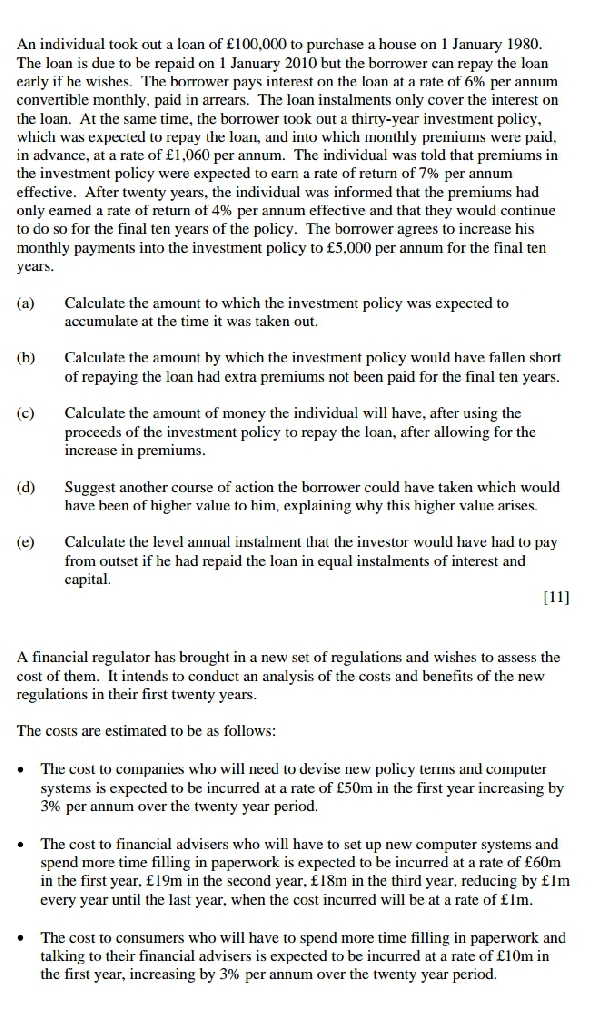
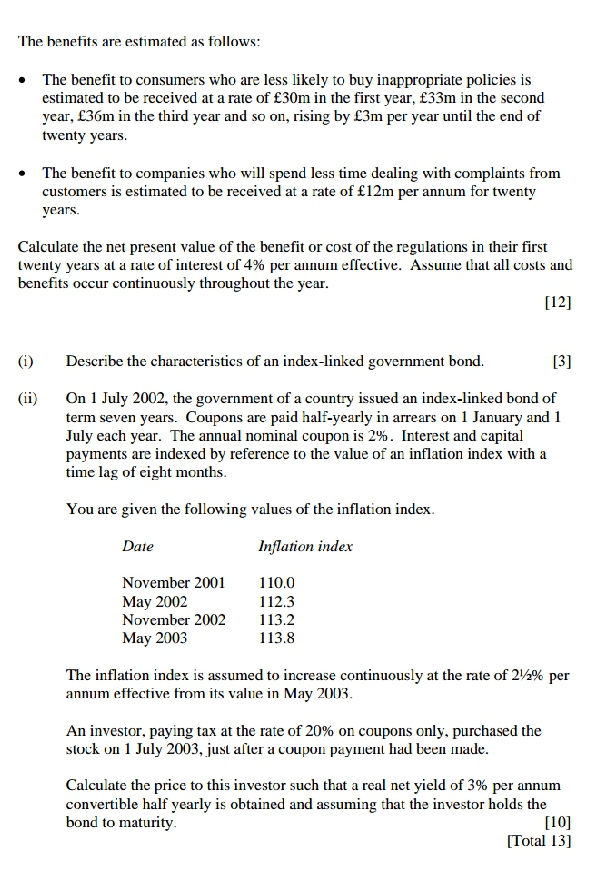
An individual took out a loan of (100,000 to purchase a house on 1 January 1980. The loan is due to be repaid on 1 January 2010 but the borrower can repay the loan early if he wishes. The borrower pays interest on the loan at a rate of 6% per annum convertible monthly, paid in arrears. The loan instalments only cover the interest on the loan. At the same time, the borrower took out a thirty-year investment policy, which was expected to repay the loan, and into which monthly premiums were paid, in advance, at a rate of f1,060 per annum. The individual was told that premiums in the investment policy were expected to earn a rate of return of 7% per annum effective. After twenty years, the individual was informed that the premiums had only earned a rate of return of 4% per annum effective and that they would continue to do so for the final ten years of the policy. The borrower agrees to increase his monthly payments into the investment policy to $5,000 per annum for the final ten years. (a) Calculate the amount to which the investment policy was expected to accumulate at the time it was taken out. (h) Calculate the amount by which the investment policy would have fallen short of repaying the loan had extra premiums not been paid for the final ten years. (c) Calculate the amount of money the individual will have, after using the proceeds of the investment policy to repay the loan, after allowing for the increase in premiums. (d) Suggest another course of action the borrower could have taken which would have been of higher value to him, explaining why this higher value arises. (e) Calculate the level annual instalment that the investor would have had to pay from outset if he had repaid the loan in equal instalments of interest and capital. [11] A financial regulator has brought in a new set of regulations and wishes to assess the cost of them. It intends to conduct an analysis of the costs and benefits of the new regulations in their first twenty years. The costs are estimated to be as follows: The cost to companies who will need to devise new policy terms and computer systems is expected to be incurred at a rate of 650m in the first year increasing by 3% per annum over the twenty year period. . The cost to financial advisers who will have to set up new computer systems and spend more time filling in paperwork is expected to be incurred at a rate of f60m in the first year. E19m in the second year, f18m in the third year, reducing by flm every year until the last year, when the cost incurred will be at a rate of film. The cost to consumers who will have to spend more time filling in paperwork and talking to their financial advisers is expected to be incurred at a rate of $10m in the first year, increasing by 3% per annum over the twenty year period.The benefits are estimated as follows: The benefit to consumers who are less likely to buy inappropriate policies is estimated to be received at a rate of $30m in the first year, $33m in the second year, 636m in the third year and so on, rising by $3m per year until the end of twenty years. . The benefit to companies who will spend less time dealing with complaints from customers is estimated to be received at a rate of f12m per annum for twenty years. Calculate the net present value of the benefit or cost of the regulations in their first twenty years at a rate of interest of 4% per annum effective. Assume that all costs and benefits occur continuously throughout the year. [12] (i) Describe the characteristics of an index-linked government bond. [3] (ii) On 1 July 2002, the government of a country issued an index-linked bond of term seven years. Coupons are paid half-yearly in arrears on 1 January and 1 July each year. The annual nominal coupon is 2%. Interest and capital payments are indexed by reference to the value of an inflation index with a time lag of eight months. You are given the following values of the inflation index. Date Inflation index November 2001 110.0 May 2002 112.3 November 2002 113.2 May 2003 113.8 The inflation index is assumed to increase continuously at the rate of 212% per annum effective from its value in May 2003. An investor, paying tax at the rate of 20% on coupons only. purchased the stock on 1 July 2003, just after a coupon payment had been made. Calculate the price to this investor such that a real net yield of 3% per annum convertible half yearly is obtained and assuming that the investor holds the bond to maturity. [10] [Total 13]
Step by Step Solution
There are 3 Steps involved in it

Get step-by-step solutions from verified subject matter experts
 Study Help