







Question: Please help me solved these problems !! Please provide detailed solutions In 1952, A. Hodgkin and A. Huxley published a series of papers which culminated
Please help me solved these problems !! Please provide detailed solutions
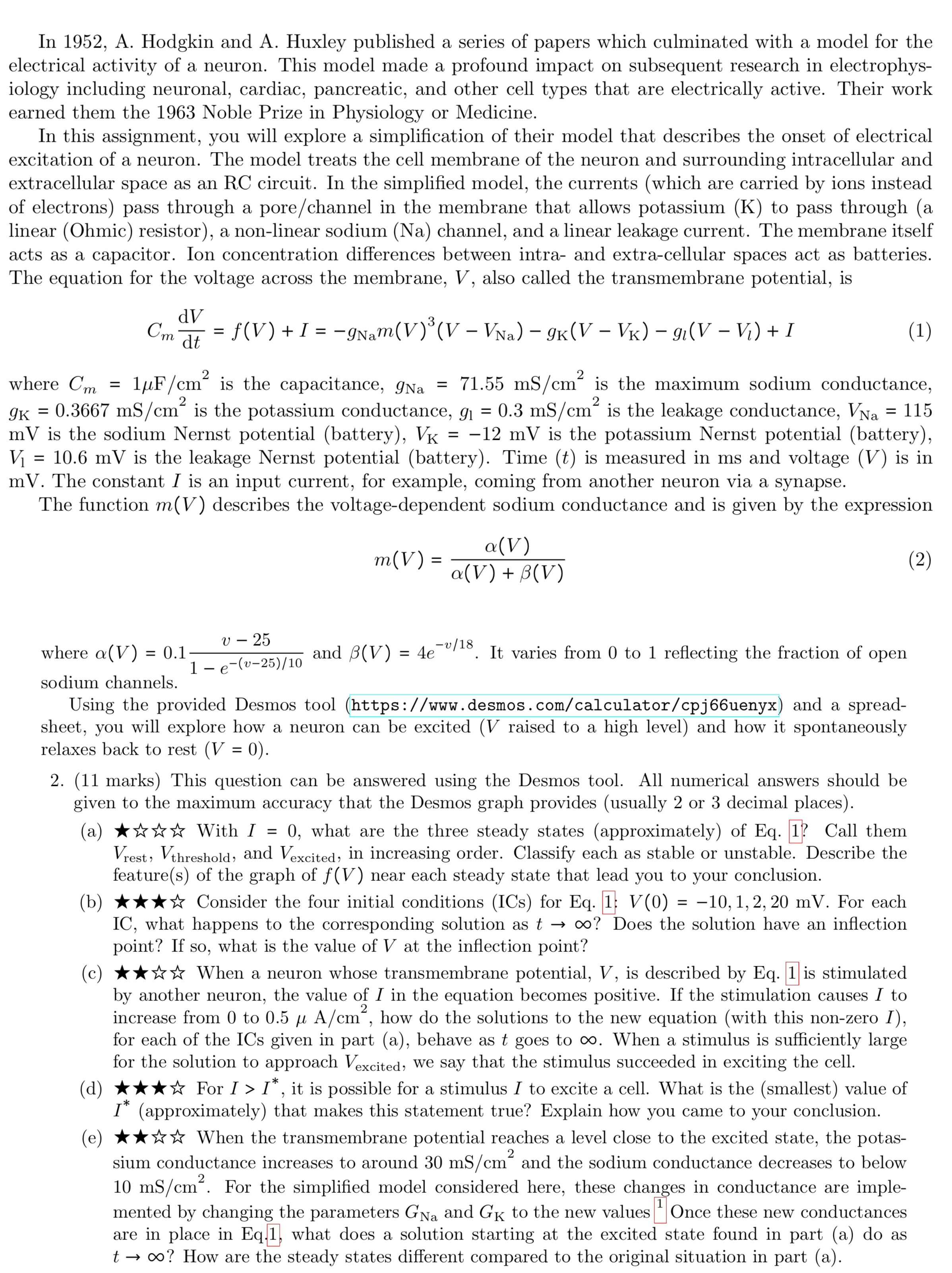
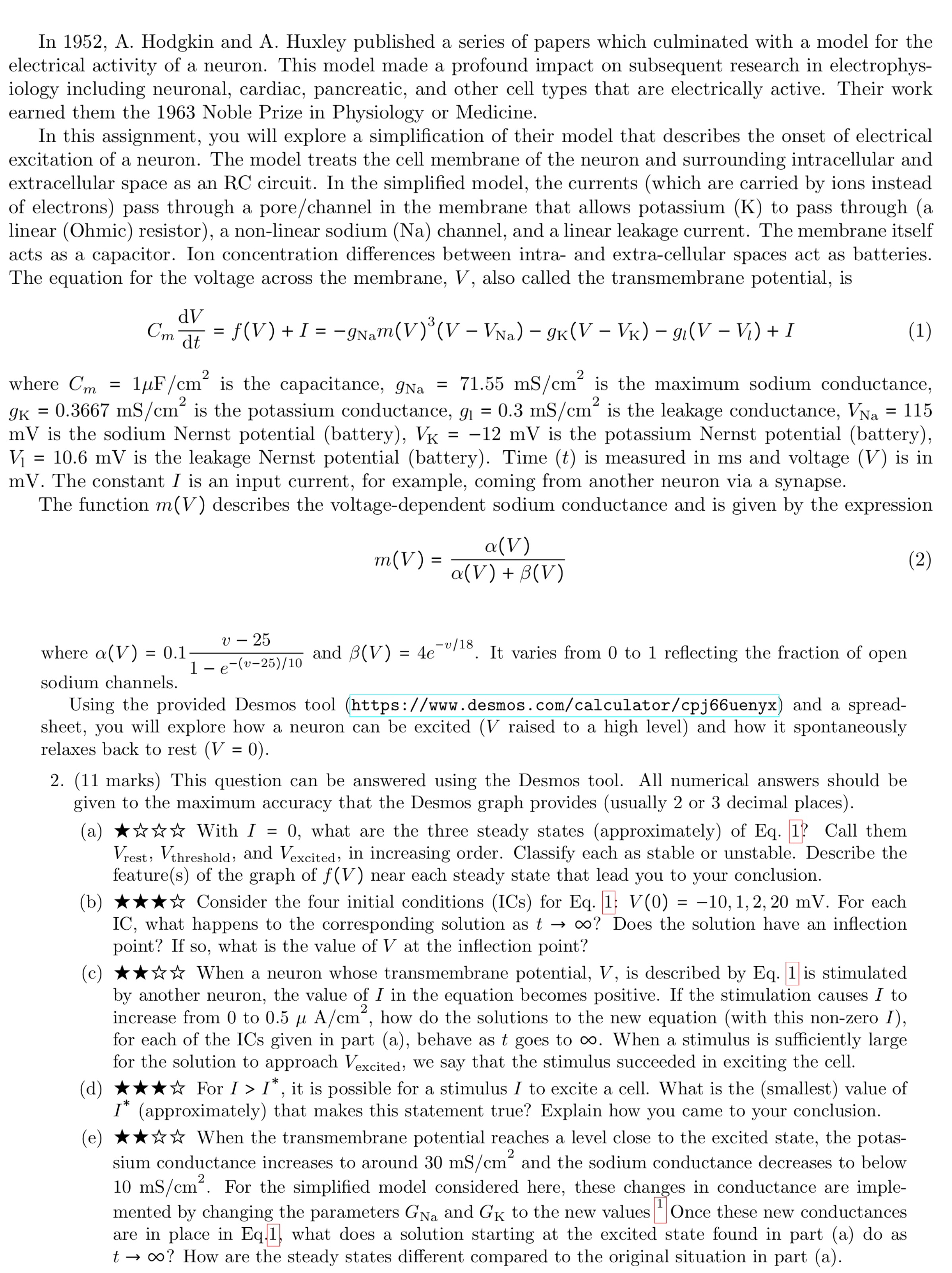
In 1952, A. Hodgkin and A. Huxley published a series of papers which culminated with a model for the electrical activity of a neuron. This model made a profound impact on subsequent research in electrophys- iology including neuronal, cardiac, pancreatic, and other cell types that are electrically active. Their work earned them the 1963 Noble Prize in Physiology or Medicine. In this assignment, you will explore a simplication of their model that describes the onset of electrical excitation of a neuron. The model treats the cell membrane of the neuron and surrounding intracellular and extracellular space as an RC circuit. In the simplied model, the currents (which are carried by ions instead of electrons) pass through a pore/channel in the membrane that allows potassium (K) to pass through (a linear (Ohmic) resistor), a non-linear sodium (Na) channel, and a linear leakage current. The membrane itself acts as a capacitor. Ion concentration differences between intra and extracellular spaces act as batteries. The equation for the voltage across the membrane, V, also called the transmembrane potential, is dV 0mg = f(V) + I = _gNam(V)3(V VNa) gK(V VK) _ 91(V _ W) + I (1) where Cm = 1,11F/cm2 1s the capac1tance, gNa - 71. 55 mS/cm2 is the maximum sodium conductance, 2 9K 0 3667 mS/cm is the potassium conductance, 91: 0.3 mS/cm2 is the leakage conductance, VNa 115 mV is the sodium Nernst potential (battery), VK = 12 mV 18 the potassium Nernst potential (battery), V1 = 10.6 mV is the leakage Nernst potential (battery). Time (t) is measured in ms and voltage (V) is in mV. The constant I is an input current, for example, coming from another neuron via a synapse. The function m(V) describes the voltagedependent sodium conductance and is given by the expression m(V) = (2) where a(V) = 0.11_:_(y%)/10 and 13(V) = 4e_v/18 sodium channels. Using the provided Desmos tool (https://www.desmos.com/calculator/cpj66uenyx) and a spread sheet, you will explore how a neuron can be excited (V raised to a high level) and how it spontaneously relaxes back to rest (V = 0). . It varies from 0 to 1 reecting the fraction of open 2. (11 marks) This question can be answered using the Desmos tool. All numerical answers should be given to the maximum accuracy that the Desmos graph provides (usually 2 or 3 decimal places). (a) *i'n'lrr With I = 0, what are the three steady states (approximately) of Eq. 37 Call them Vrest, Vthreshold, and '/excited7 in increasing order. Classify each as stable or unstable. Describe the feature(s) of the graph of f (V) near each steady state that lead you to your conclusion. (b) *'ki'r Consider the four initial conditions (ICs) for Eq. 11 V(0) = 10, 1, 2, 20 111V. For each 1C, what happens to the corresponding solution as t > 00'? Does the solution have an inection point? If so, what is the value of V at the inection point? (c) *'k'rr When a neuron whose transmembrane potential, V, is described by Eq. 1 is stimulated by another neuron, the value o2f I in the equation becomes positive. If the stimulation causes I to increase from 0 to 0.5 '11 A /cm how do the solutions to the new equation (with this nonzero I), for each of the ICs given in part (a) behave as t goes to 00. When a stimulus lS sufciently large for the solution to approach Lexcited, we say that the stimulus succeeded in exciting the cell. (d) ***755{ For I > 1* , it is possible for a stimulus I to excite a cell. What is the (smallest) value of I * (approximately) that makes this statement true? Explain how you came to your conclusion. (e) *'kri': When the transmembrane potential reaches a level close to the excited state, the potas . . 2 . Slum conductance 1ncreases to around 30 m8 / cm and the sod1um conductance decreases to below 10 mS/cm2. mented by changing the parameters GNa and GK to the new values Once these new conductances are in place in Eq.1 what does a solution starting at the excited state found in part (a) do as t > 00? How are the steady states different compared to the original situation in part (a). For the simplied model considered here, these chan es in conductance are imple- 1
Step by Step Solution
There are 3 Steps involved in it

Get step-by-step solutions from verified subject matter experts
 Study Help