







Question: Please Help me Thank you ' 'CENGAGE I MINDTAP I. Ch 1 1: Assignment - Introduction to Hypothesis Testing Attempts: I I Keep the Highest:
Please Help me Thank you
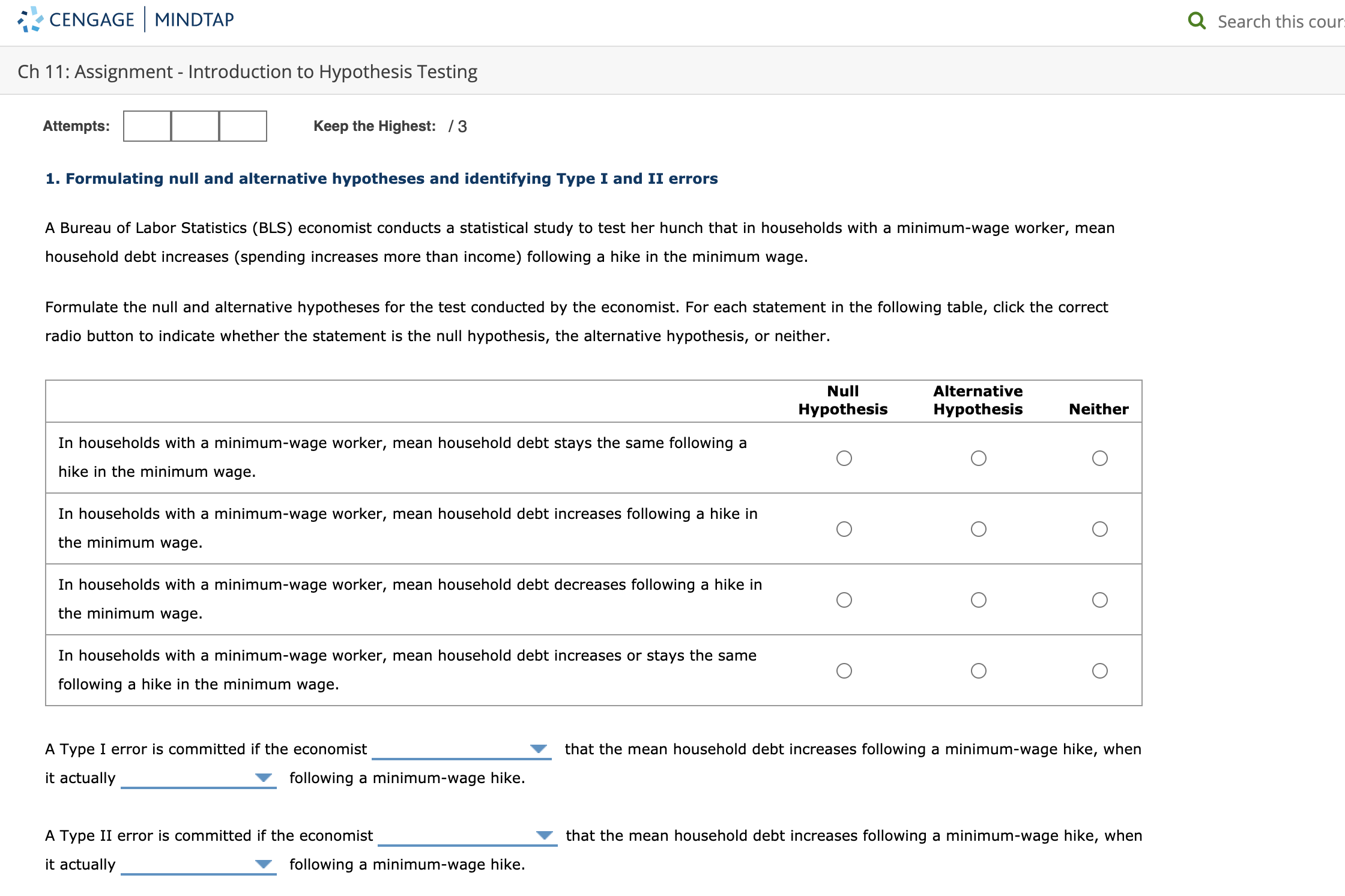
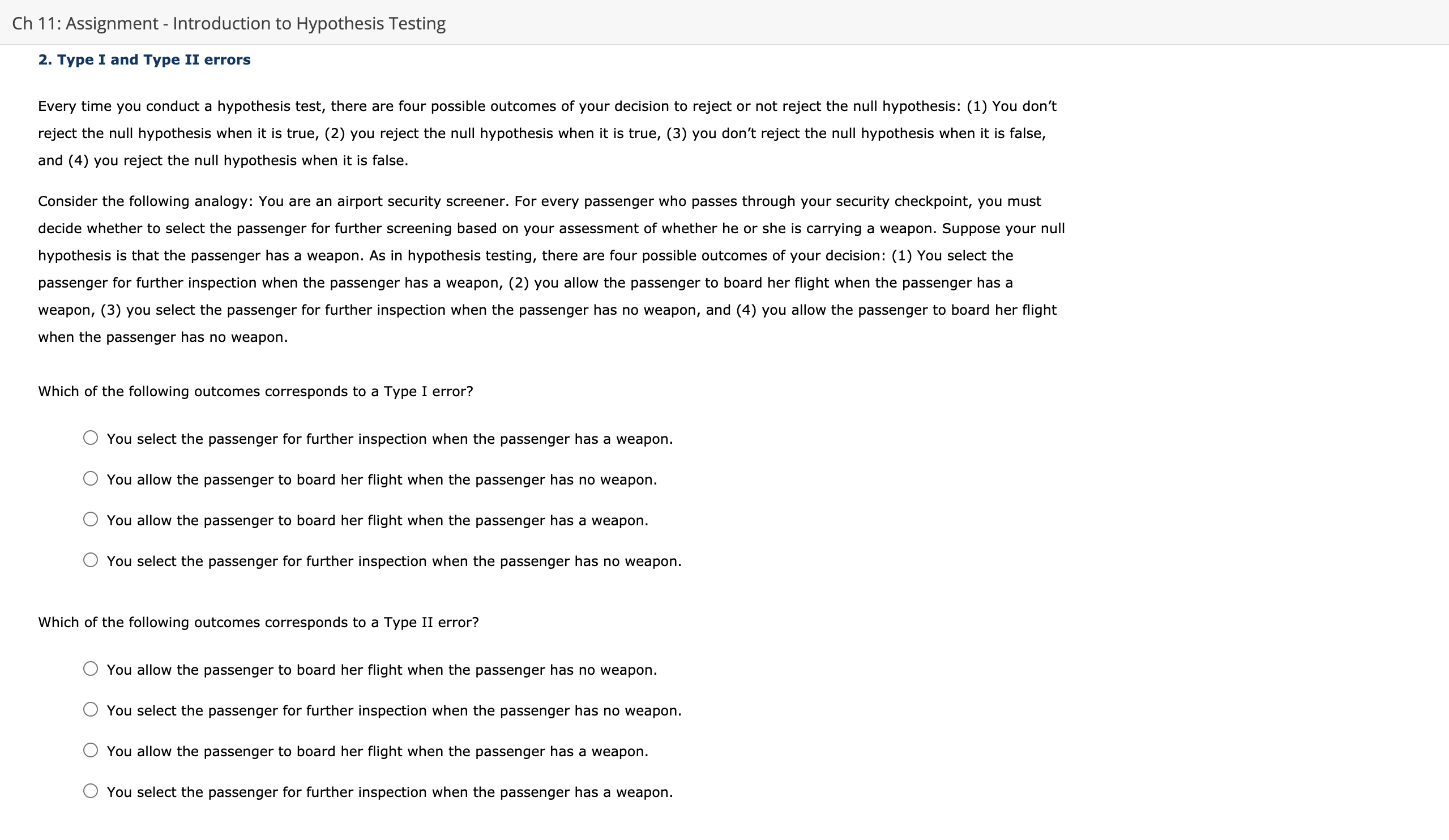
' 'CENGAGE I MINDTAP I. Ch 1 1: Assignment - Introduction to Hypothesis Testing Attempts: I I Keep the Highest: / 3 1. Formulating null and alternative hypotheses and identifying Type I and II errors A Bureau of Labor Statistics (BLS) economist conducts a statistical study to test her hunch that in households with a minimum-wage worker, mean household debt increases (spending increases more than income) following a hike in the minimum wage. Formulate the null and alternative hypotheses for the test conducted by the economist. For each statement in the following table, click the correct radio button to indicate whether the statement is the null hypothesis, the alternative hypothesis, or neither. Null Alternative Hypothesis Hypothesis Neither In households with a minimum-wage worker, mean household debt stays the same following a O O O hike in the minimum wage. In households with a minimum-wage worker, mean household debt increases following a hike in O O O the minimum wage. In households with a minimum-wage worker, mean household debt decreases following a hike in O O O the minimum wage. In households with a minimum-wage worker, mean household debt increases or stays the same 0 O 0 following a hike in the minimum wage. A Type I error is committed if the economist V that the mean household debt increases following a minimum-wage hike, when it actually V following a minimumwage hike. A Type 11 error is committed if the economist V that the mean household debt increases following a minimumwage hike, when it actually V following a minimumwage hike. Q Search this cour Ch 11: Assignment - Introduction to Hypothesis Testing 2. Type I and Wm! II errors Every time you conduct a hypothesis test, there are four possible outcomes of your decision to reject or not reject the null hypothesis: (1) You don't reject the null hypothesis when it is true, (2) you reject the null hypothesis when it is true, (3) you don't reject the null hypothesis when it is false, and (4) you reject the null hypothesis when it is false. Consider the following analogy: You are an airport security screener. For every passenger who passes through your security checkpoint, you must decide whether to select the passenger for further screening based on your assessment of whether he or she is carrying a weapon. Suppose your null hypothesis is that the passenger has a weapon. As in hypothesis testing, there are four possible outcomes of your decision: (1) You select the passenger for further inspection when the passenger has a weapon, (2) you allow the passenger to board her ight when the passenger has a weapon, (3) you select the passenger for further inspection when the passenger has no weapon, and (4) you allow the passenger to board her ight when the passenger has no weapon. Which of the following outcomes corresponds to a Type I error? 0 You select the passenger for further inspection when the passenger has a weapon. 0 You allow the passenger to board her ight when the passenger has no weapon. 0 You allow the passenger to board her flight when the passenger has a weapon. 0 You select the passenger for further inspection when the passenger has no weapon. which of the following outcomes corresponds to a Type II error? 0 You allow the passenger to board her ight when the passenger has no weapon. 0 You select the passenger for further inspection when the passenger has no weapon. 0 You allow the passenger to board her ight when the passenger has a weapon. 0 You select the passenger for further inspection when the passenger has a weapon
Step by Step Solution
There are 3 Steps involved in it

Get step-by-step solutions from verified subject matter experts
 Study Help