







Question: Please help me this calc. question! Please help me this calc. question! Please help me this calc. question! Please help me this calc. question! Please
Please help me this calc. question!
Please help me this calc. question!
Please help me this calc. question!
Please help me this calc. question!
Please help me this calc. question!
Please help me this calc. question!
Please help me this calc. question!
Please help me this calc. question!
Please help me this calc. question!
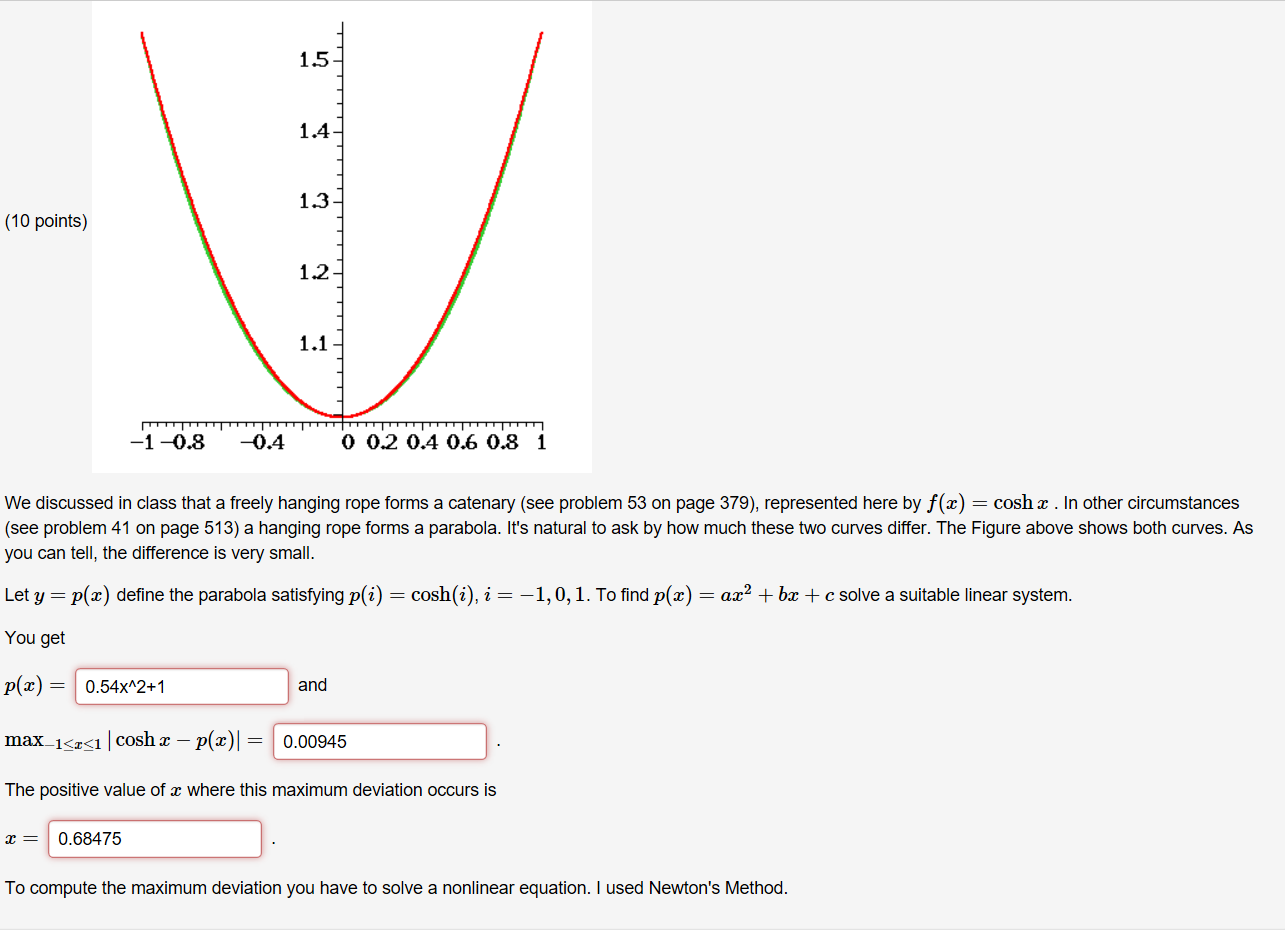
15 1.4 1.3 {10 points) 1.2 1.1 1-0.8 -0.4 0 0.2 0.4 0.6 0.8 1 We discussed in class that a freely hanging rope forms a catenary (see problem 53 on page 379), represented here by Hz) 2 cosh: . In other circumstances {see problem 41 on page 513) a hanging rope forms a parabola. It's natural to ask by how much these two curves differ. The Figure above shows both curves. As you can tell, the difference is very small. Let y 2 p(1') dene the parabola satisfying p[z') = cosh), 2' = 71, 0, 1. To nd 13(2) 2 0.32 + ba: + c solve a suitable linear system. You get 13(2) = 0.54x"2+1 and maxASzgl |cosha= p[a:)l = 0.00945 - The positive value of z where this maximum deviation occurs is .1: = 0.66475 . To compute the maximum deviation you have to solve a nonlinear equation. I used Newton's Method
Step by Step Solution
There are 3 Steps involved in it

Get step-by-step solutions from verified subject matter experts
 Study Help