Please help me to do the 5.Sociocultural and step 5
Step -1 The problem identified in this step faced by the organisation is the reducing number of beer consumer as due to the increasing health awareness and their well being and also the reason is the changing taste and preference of the consumer over time.
Step-2 The five external environmental factor that may negatively or psitively affect the identified problem in step -1 The external factors are the factors that are uncontallable by the company and is present outside the company internal environment.
1- Economic- The economic factor is the change in the income factor of the people living in the society and their rise in the standard of living which impacts the problem being identified earlier in step 1 in a negative way.
2- Technical- As the growing economy is coming up with various technical changes that may impact the changing taste and preference of the consumer and the product used by consumer f the existing organisation as now-a-days consumer are always wanting something new and different from that of the available one.
3- Political- The political factor that may affect the identified problem is the add-on rules or any other new regulation thatmay proves to negatively impact the organisation and this identified problem their in.
4- Competitive- As with the increasing competition various organisation is coming up with different product and with substitutes of the available one whic posses a great threat on the existing product and organisation dealing in that product and this may negatively impact the problem identified by suring opportunity of theconsumer with changing tastes.
5- Sociocultural (How might consumers react to the problem? How do domestic and global cultures affect the decision?)
Step-3 The following are the two possible alternatives or solution of te problem identified in step 1-
1- Consumer preference- An organisation may first focus on the tastes and preference of their consumers so that they can produce accordingly which is possible only by knowing their consumer better and also by knowing the tastes and preference of its consumer.
2- Change and Innovation - An organisation may overcome the stated problem in step 1 by growing with the changing time and also by bringing in the changing technology with the innovative design and techniques as the consumer love to adopt change.
Step-4 The choosen solution from Step 3 is consumer preference and the reason behind choosing this option is because consumer are the pillar of any business on which the business is based if the consumer of an organisation will not be happy and satisfied than their is not chance for an organisation to grow and earn profit as a result the consumer may choose over other available product in the market that are making their taste and preference.
Step 5. Give a detailed explanation on how the organization could implement the solution you chose in Step 4.
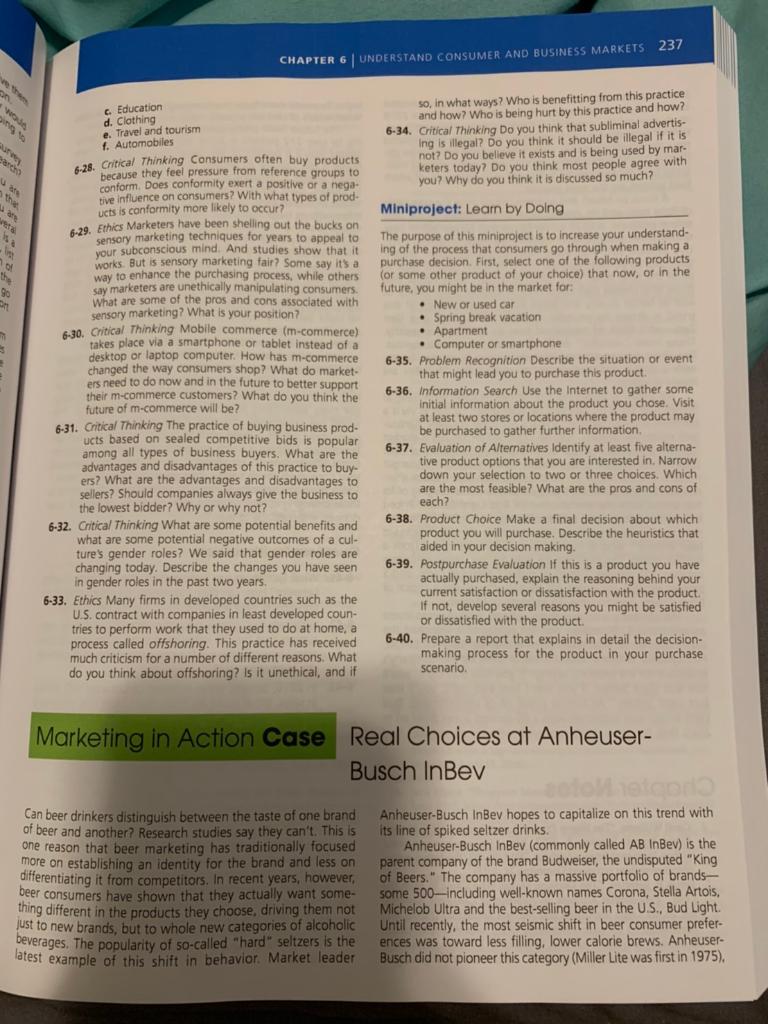
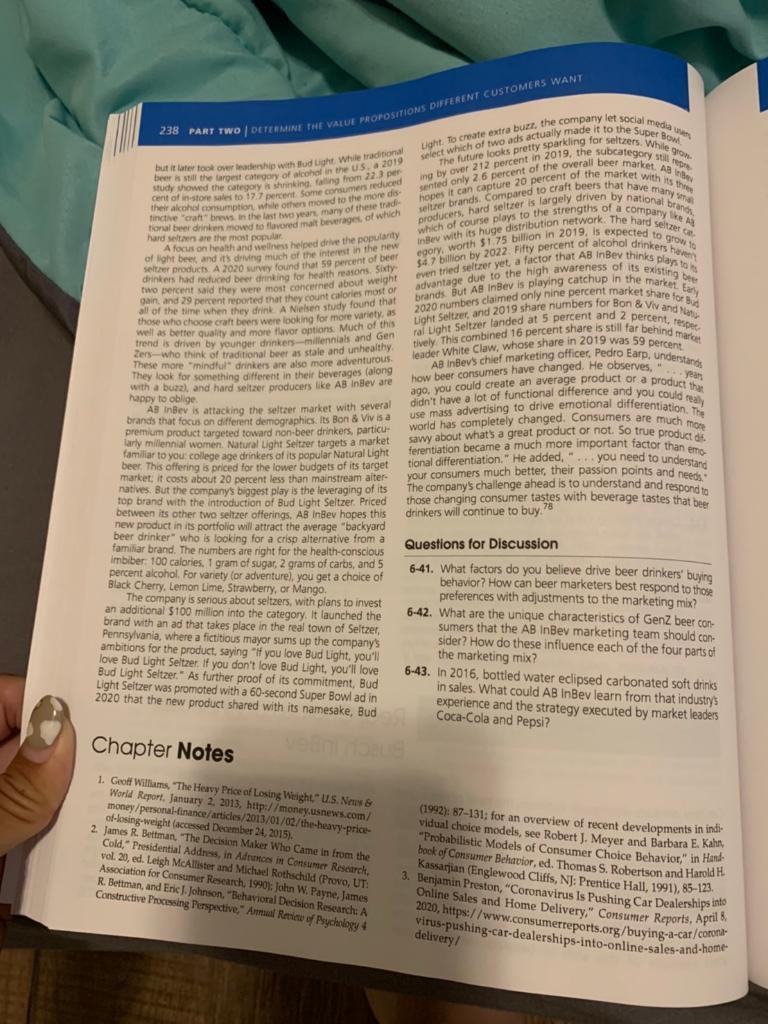
CHAPTER 6 | UNDERSTAND CONSUMER AND BUSINESS MARKETS 237 so, in what ways? Who is benefitting from this practice and how? Who is being hurt by this practice and how? 6-34. Critical Thinking Do you think that subliminal advertis- Ing is illegal? Do you think it should be illegal if it is not? Do you believe it exists and is being used by mar- keters today? Do you think most people agree with you? Why do you think it is discussed so much? earch Education d. Clothing e. Travel and tourism 1. Automobiles 6-28. Critical Thinking Consumers often buy products because they feel pressure from reference groups to conform Does conformity exert a positive or a nega tive influence on consumers? With what types of prod- ucts is conformity more likely to occur? 6-29. Ethics Marketers have been shelling out the bucks on sensory marketing techniques for years to appeal to your subconscious mind. And studies show that it works. But is sensory marketing fair? Some say it's a way to enhance the purchasing process, while others say marketers are unethically manipulating consumers. What are some of the pros and cons associated with sensory marketing? What is your position? 6.30. Critical Thinking Mobile commerce (m-commerce) takes place via a smartphone or tablet instead of a desktop or laptop computer. How has m-commerce changed the way consumers shop? What do market- ers need to do now and in the future to better support their m-commerce customers? What do you think the future of m-commerce will be? 6-31. Critical Thinking The practice of buying business prod- ucts based on sealed competitive bids is popular among all types of business buyers. What are the advantages and disadvantages of this practice to buy- ers? What are the advantages and disadvantages to sellers? Should companies always give the business to the lowest bidder? Why or why not? 6-32. Critical Thinking What are some potential benefits and what are some potential negative outcomes of a cul- ture's gender roles? We said that gender roles are changing today. Describe the changes you have seen in gender roles in the past two years. 6-33. Ethics Many firms in developed countries such as the U.S. contract with companies in least developed coun- tries to perform work that they used to do at home, a process called offshoring. This practice has received much criticism for a number of different reasons. What do you think about offshoring? Is it unethical, and if Miniproject: Learn by Doing The purpose of this miniproject is to increase your understand- ing of the process that consumers go through when making a purchase decision. First, select one of the following products (or some other product of your choice) that now, or in the future, you might be in the market for: New or used car Spring break vacation Apartment Computer or smartphone 6-35. Problem Recognition Describe the situation or event that might lead you to purchase this product 6-36. Information Search Use the Internet to gather some initial information about the product you chose. Visit at least two stores or locations where the product may be purchased to gather further information 6-37. Evaluation of Alternatives Identify at least five alterna- tive product that you are interested in Narrow down your selection to two or three choices. Which are the most feasible? What are the pros and cons of each? 6-38. Product Choice Make a final decision about which product you will purchase. Describe the heuristics that aided in your decision making. 6-39. Postpurchase Evaluation if this is a product you have actually purchased, explain the reasoning behind your current satisfaction or dissatisfaction with the product If not, develop several reasons you might be satisfied or dissatisfied with the product. 6-40. Prepare a report that explains in detail the decision- making process for the product in your purchase scenario Marketing in Action Case Real Choices at Anheuser- Busch InBev Can beer drinkers distinguish between the taste of one brand of beer and another? Research studies say they can't. This is one reason that beer marketing has traditionally focused more on establishing an identity for the brand and less on differentiating it from competitors. In recent years, however, beer consumers have shown that they actually want some- thing different in the products they choose, driving them not just to new brands, but to whole new categories of alcoholic beverages. The popularity of so-called "hard" seltzers is the latest example of this shift in behavior. Market leader Anheuser-Busch InBev hopes to capitalize on this trend with its line of spiked seltzer drinks Anheuser-Busch InBev (commonly called AB InBev) is the parent company of the brand Budweiser, the undisputed "King of Beers." The company has a massive portfolio of brands- some 500- including well-known names Corona, Stella Artois, Michelob Ultra and the best-selling beer in the U.S., Bud Light. Until recently, the most seismic shift in beer consumer prefer- ences was toward less filling, lower calorie brews. Anheuser- Busch did not pioneer this category (Miller Lite was first in 1975). Bow The future looks pretty to the more in the detection de the money In the last two years, many of these tradi which ori 238 PART TWO DETERMINE THE VALUE PROPOSITIONS DIFFERENT CUSTOMERS WANT made it to the Super Light to create extra buer, the company let social media which of two ads actudying for seltzers. While on butter took over with fudge while traditional bers the largest category of alcohol in the US a 2019 study showed the category shrinking fang from 22.3 per sented only 26 percent of the overall beer market AB cent of in-store sa to 17 e consumers reduced ng by over 212 percent in 2019, the subcategory hope it can capture 20 percent of the market with its the strer brands. Compared to craft beers that have many tinctive "craft odchand seltzer is largely driven by national brand tional beer drinkenmowd to flavored malt beverage of which course plays to the strengths of a company hard selters are the most popular InBev with its huge distribution network. The hard setzt A focus on health and Winess helped drive the popularity egory, worth $1.75 billion in 2019. is expected to grow to selter products. A 2020 survey found that 59 percent of beer even tried setzer yet a factor that AB InBev thinks play to 54.7 billion by 2022 Fifty percent of alcohol drinkers drinkers had reduced beer drinking for health reasons Sixty two percent said they were most concerned about weight advantage due to the high awareness of its existing brands But AB InBev is playing catchup in the market. Early all of the time when they drink A Nielsen study found that 2020 numbers claimed only nine percent market share in those who choose craft beers were looking for more variety, as well as better Quality and more favor options. Much of this ral Light Seltzer landed at 5 percent and 2 percent, respe Light Seitzer, and 2019 share numbers for Bon & Viwanda trend is driven by younger drinkers-millennials and Gen ve White Claw, whose share in 2019 was 59 percent This combined 16 percent share is still far behind mari Zers-who think of traditional beer as state and unhealthy These more mindful drinkers are also more adventurous AB InBevs chief marketing officer, Pedro Earp, understands They look for something different in their beverages (along how beer consumers have changed. He observes, with a buzz), and hard seltzer producers like AB InBev are happy to oblige didn't have a lot of functional difference and you could really ago, you could create an average product or a product that AB InBev is attacking the seltzer market with several brands that focus on different demographics, its Bon & Vivisa use mass advertising to drive emotional differentiation. The world has completely changed. Consumers are much more premium product targeted toward non-beer drinkers, particu- arly millennial women. Natural Light Seitzer targets a market Savvy about what's a great product or not. So true product ot. familiar to your college age drinkers of its popular Natural Light ferentiation became a much more important factor than mo beer This offering is priced for the lower budgets of its target tional differentiation." He added," market. It costs about 20 percent less than mainstream alter- your consumers much better, their passion points and needs natives. But the company's biggest play is the leveraging of its The company's challenge ahead is to understand and respond to top brand with the introduction of Bud Light Seltzer. Priced those changing consumer tastes with beverage tastes that beer between its other two seltzer offerings. AB InBev hopes this drinkers will continue to buy new product in its portfolio will attract the average "backyard beer drinker" who is looking for a crisp alternative from a familiar brand. The numbers are right for the health-conscious Questions for Discussion Imbiber 100 calories, 1 gram of sugar, 2 grams of carbs, and 5 percent alcohol, for variety (or adventure), you get a choice of 6-41. What factors do you believe drive beer drinkers' buying Black Cherry, Lemon Lime, Strawberry, or Mango. behavior? How can beer marketers best respond to those The company is serious about seltzers, with plans to invest preferences with adjustments to the marketing mix? an additional $100 million into the category. It launched the brand with an ad that takes place in the real town of Seltzer, 6-42. What are the unique characteristics of Genz beer con Pennsylvania, where a fictitious mayor sums up the company's sumers that the AB InBev marketing team should con- ambitions for the product, saying if you love Bud Light, you'll sider? How do these influence each of the four parts of love Bud Light Seltzer. If you don't love Bud Light, you'll love the marketing mix? Bud Light Seltzer. As further proof of its commitment, Bud 6-43. In 2016, bottled water eclipsed carbonated soft drinks Light Seitzer was promoted with a 60-second Super Bowl ad in in sales. What could AB InBev learn from that industry's experience and the strategy executed by market leaders you need to understand 2020 that the new product shared with its namesake, Bud Coca-Cola and Pepsi? Chapter Notes 1. Geoff Williams, The Heavy Price of Losing Weight- u.S. Nrus & World Report, January 2, 2013, http://money.asnews.com/ money/personal finance/articles/2013/01/02/the-heavy-price- of-losing weight (accessed December 24, 2015). 2. James R. Bettman, "The Decision Maker Who Came in from the Cold," Presidential Address, in Adruces in Consumer Research, vol. 20, ed. Leigh McAllister and Michael Rothschild (Provo, UT: Association for Consumer Research, 1990): John W. Payne, James R.Bettman, and Eric J. Johnson Behavioral Decision Research: A Constructive Processing Perspective." Annual Review of Psychology 4 (1992); 87-131: for an overview of recent developments in indir vidual choice models, see Robert J. Meyer and Barbara E. Kahe "Probabilistic Models of Consumer Choice Behavior," in Hand book of Consumer Behavior, ed. Thomas S. Robertson and Harold IL Kassarjian (Englewood Cliffs, NJ: Prentice Hall, 1991), 85-123 3. Benjamin Preston, "Coronavirus Is Pushing Car Dealerships into Online Sales and Home Delivery." Consumer Reports, April 8, 2020, https://www.consumerreports.org/buying-a-car/corona- delivery home




