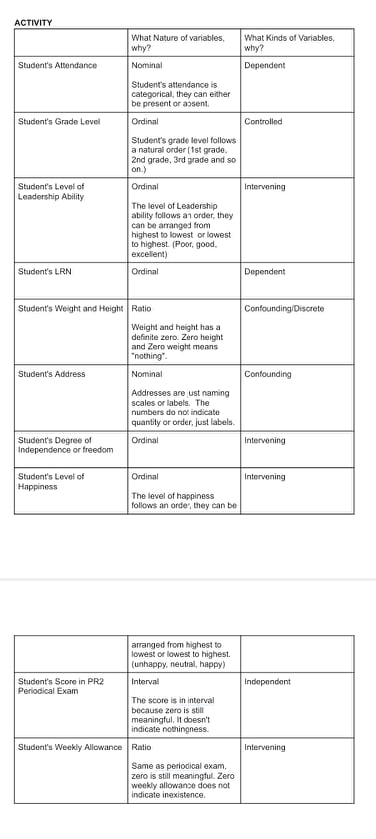
Question: please help me to explain HOW it became INDEPENDENT, DEPENDENT OR ETC, if you think the answer is wrong you can provide yours and please
please help me to explain HOW it became INDEPENDENT, DEPENDENT OR ETC, if you think the answer is wrong you can provide yours and please provide also explanation how it became
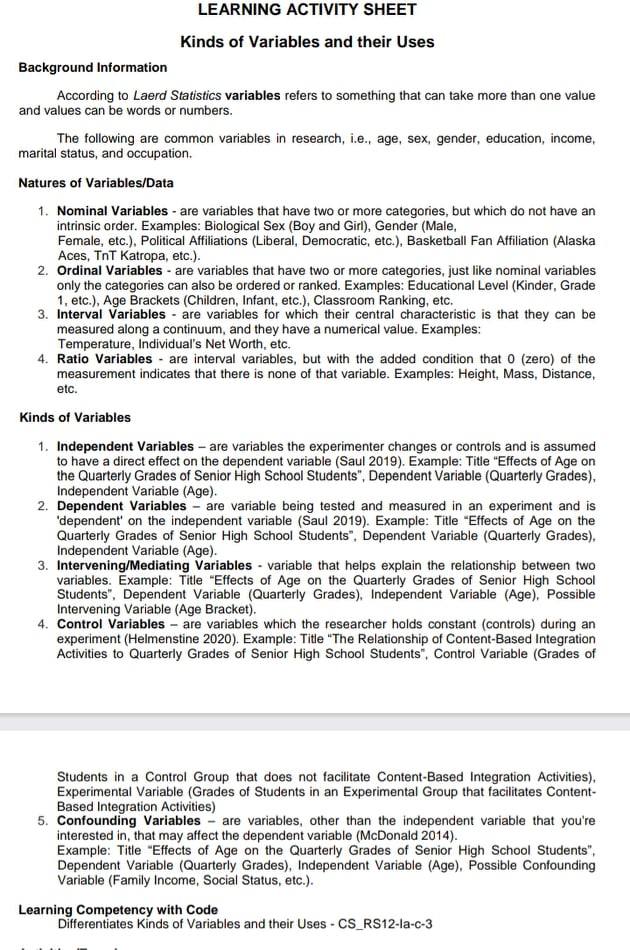
ACTIVITY What Nature of variables, What Kinds of Variables, why? why? Student's Attendance Nominal Dependent Student's attendance is categorical, they can either be present or assent. Student's Grade Level Ordinal Controlled Student's grade level follows a natural order [ ist grade. 2nd grade. 3rd grade and so on) Student's Level of Ordinal Intervening Lendership Ability The level of Leadership ability follows an order, they can be arranged from highest to lowest or lowest to highest (Poor, good. excellent) Student's LRN Ordinal Dependent Student's Weight and Height | Ratio Confounding/Discrete Weight and height has a definite zero. Zero haight and Zero weight monns "nothing". Student's Address Nominal Confounding Addresses are ust naming scales or labels. The numbers do not indicate quantity or order, just labels. Student's Degree of Ordinal Intervening Independence or freedom Student's Level of Ordinal Intervoning Happiness The level of happiness follows an order, they can be anranged from highest to lowest or lowest to highest. (unhappy, neutral, happy) Student's Score in PR2 Interval Independent Periodical Exam The score is in interval because zero is sull meaningful, It doesn't indicate nothingness. Student's Weakly Allowance Ratio Intervening Same as periodical exam, zero is still meaningful. Zero weekly allowance does not indicate inexistenceLEARNING ACTIVITY SHEET Kinds of Variables and their Uses Background Information According to Laerd Statistics variables refers to something that can take more than one value and values can be words or numbers. The following are common variables in research, i.e., age, sex, gender, education, income, marital status, and occupation. Natures of Variables/Data 1. Nominal Variables - are variables that have two or more categories, but which do not have an intrinsic order. Examples: Biological Sex (Boy and Girl), Gender (Male, Female, etc.), Political Affiliations (Liberal, Democratic, etc.), Basketball Fan Affiliation (Alaska Aces, TnT Katropa, etc.). 2. Ordinal Variables - are variables that have two or more categories, just like nominal variables only the categories can also be ordered or ranked. Examples: Educational Level (Kinder, Grade 1, etc.), Age Brackets (Children, Infant, etc.), Classroom Ranking, etc. 3. Interval Variables - are variables for which their central characteristic is that they can be measured along a continuum, and they have a numerical value. Examples: Temperature, Individual's Net Worth, etc. 4. Ratio Variables - are interval variables, but with the added condition that 0 (zero) of the measurement indicates that there is none of that variable. Examples: Height, Mass, Distance, etc. Kinds of Variables 1. Independent Variables - are variables the experimenter changes or controls and is assumed to have a direct effect on the dependent variable (Saul 2019). Example: Title "Effects of Age on the Quarterly Grades of Senior High School Students", Dependent Variable (Quarterly Grades), Independent Variable (Age). 2. Dependent Variables - are variable being tested and measured in an experiment and is 'dependent' on the independent variable (Saul 2019). Example: Title "Effects of Age on the Quarterly Grades of Senior High School Students", Dependent Variable (Quarterly Grades), Independent Variable (Age). . Intervening/Mediating Variables - variable that helps explain the relationship between two variables. Example: Title "Effects of Age on the Quarterly Grades of Senior High School Students", Dependent Variable (Quarterly Grades), Independent Variable (Age), Possible Intervening Variable (Age Bracket). 4. Control Variables - are variables which the researcher holds constant (controls) during an experiment (Helmenstine 2020). Example: Title "The Relationship of Content-Based Integration Activities to Quarterly Grades of Senior High School Students", Control Variable (Grades of Students in a Control Group that does not facilitate Content-Based Integration Activities), Experimental Variable (Grades of Students in an Experimental Group that facilitates Content- Based Integration Activities) 5. Confounding Variables - are variables, other than the independent variable that you're interested in, that may affect the dependent variable (McDonald 2014). Example: Title "Effects of Age on the Quarterly Grades of Senior High School Students" Dependent Variable (Quarterly Grades), Independent Variable (Age), Possible Confounding Variable (Family Income, Social Status, etc.). Learning Competency with Code Differentiates Kinds of Variables and their Uses - CS_RS12-la-c-3
Step by Step Solution
There are 3 Steps involved in it
1 Expert Approved Answer
Step: 1 Unlock
Question Has Been Solved by an Expert!
Get step-by-step solutions from verified subject matter experts
Step: 2 Unlock
Step: 3 Unlock
Students Have Also Explored These Related Mathematics Questions!