







Question: Please, help me to solve these questions with step by step explanations. ( The coupon collecter problem example in 44th problem is attached below as
Please, help me to solve these questions with step by step explanations. (The coupon collecter problem example in 44th problem is attached below as well)
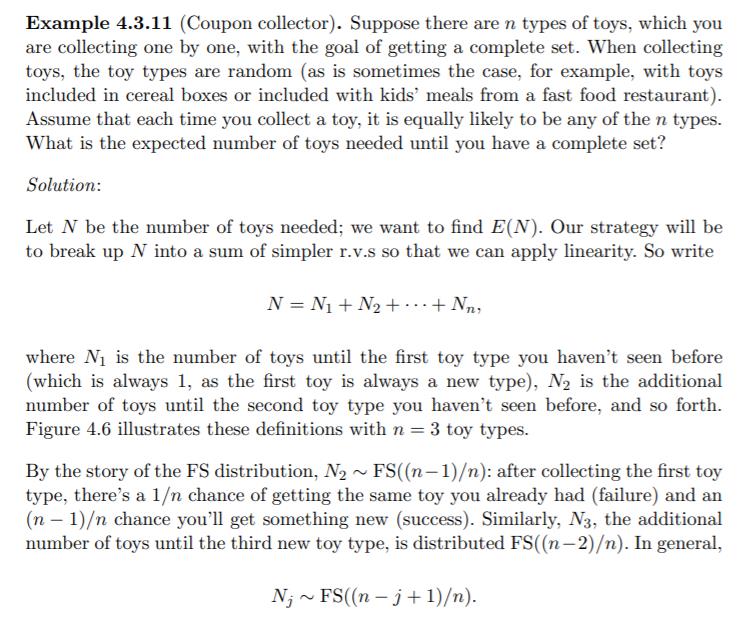
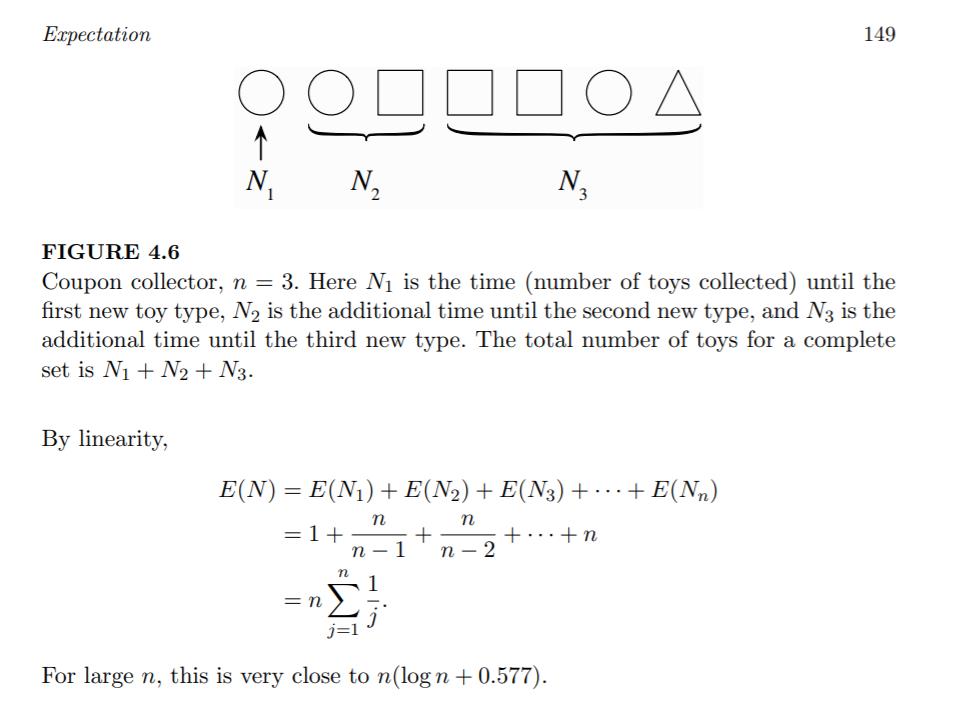

Example 4.3.11 (Coupon collector). Suppose there are n types of toys, which you are collecting one by one, with the goal of getting a complete set. When collecting toys, the toy types are random (as is sometimes the case, for example, with toys included in cereal boxes or included with kids' meals from a fast food restaurant). Assume that each time you collect a toy, it is equally likely to be any of the n types. What is the expected number of toys needed until you have a complete set? Solution: Let N be the number of toys needed; we want to find E(N). Our strategy will be to break up / into a sum of simpler r.v.s so that we can apply linearity. So write N = M1 + N2+ . . . + Nn, where M is the number of toys until the first toy type you haven't seen before (which is always 1, as the first toy is always a new type), N2 is the additional number of toys until the second toy type you haven't seen before, and so forth. Figure 4.6 illustrates these definitions with n = 3 toy types. By the story of the FS distribution, N2 ~ FS((n-1)): after collecting the first toy type, there's a 1 chance of getting the same toy you already had (failure) and an (n - 1) chance you'll get something new (success). Similarly, N3, the additional number of toys until the third new toy type, is distributed FS((n -2)). In general, Nj ~ FS((n - j + 1)).Emctation 149 CTDODDDOA x.__,__.2 N 2 N 3 FIGURE 4.6 Coupon collector, n = 3. Here N1 is the time (number of toys collected) until the rst new toy type, N2 is the additional time until the second new type, and N3 is the additional time until the third new type. The total number of toys for a complete set is N1 + N2 + N3. By linearity, E(N) = E(N1) + E(N2) + E(N3) + ' ' ' + E(Nn) For large n, this is very close to n(logn + 0.577). \f
Step by Step Solution
There are 3 Steps involved in it

Get step-by-step solutions from verified subject matter experts
 Study Help