







Question: please help me to solve this question 5. Automatic stabilizers In Chapter 3 we have assumed that the scal policy variables G and T are
please help me to solve this question
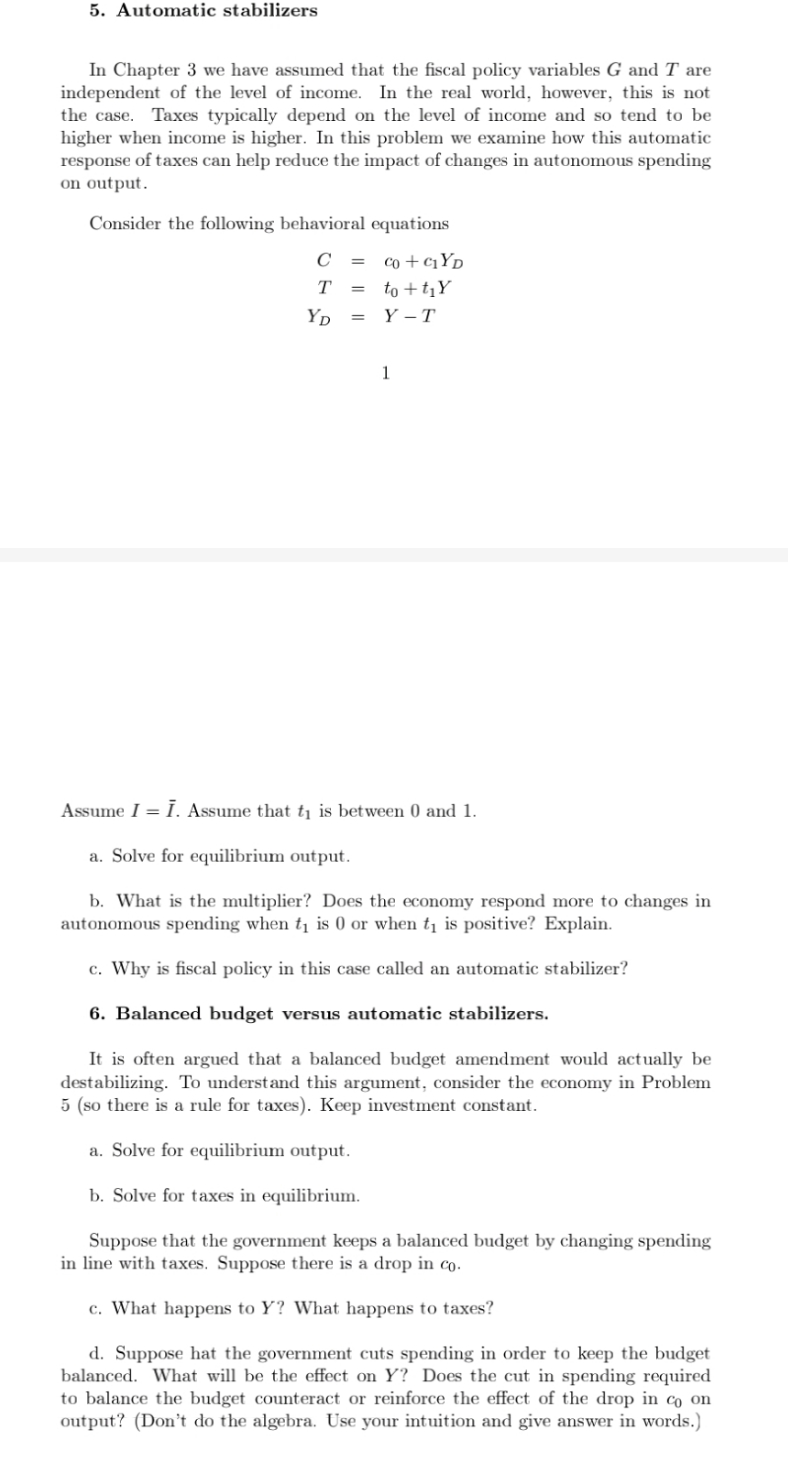
5. Automatic stabilizers In Chapter 3 we have assumed that the scal policy variables G and T are indePEndent of the lethal of incarne. In the real world, however, this is not the case. Taxes typically depend on the level of income and so tend to be higher when Income is higher. In this problem we examine how this automatic response of taxes can help reduce the impact of changes" an autonomous spending on output. Consider the following behavioral equations 0 = 00+CIYD YD = YT 1 Assume I = f. Assume that t] is between I] and 1. a. Solve for equilibrium output. b. What is the multiplier? Does the economy respond more to changes in autonomous spending when (I is I] or when t; is positive? Explain. c. Why is scal policy in this case called an automatic stabilizer? 6. Balanced budget versus automatic stabilizers. It is often argued that a balanced budget amendment would actually be destabilizing. To understand this argument, consider the economy in Problem 5 (so there is a rule for taxu). Keep investment constant. a. Solve for equilibrium output. b. Solve for taxes in equilibrium. Suppose that the government keeps a balanced budget by changing spending in line with taxes. Suppose there is a drop in ea. c. What happens to Y? What happens to taxes? d. Suppose hat the govermnent cuts spending in order to keep the budget balanced. What will be the effect on Y? Does the cut in spending required to balance the budget counteract or reinforce the effect of the drop in Co on output? (Don't do the algebra. Use your intuition and give answer in words.)
Step by Step Solution
There are 3 Steps involved in it

Get step-by-step solutions from verified subject matter experts
 Study Help