



Question: Please help me to understand and answer on Discussion Questions 1 and 2. 390 PRACTICES and bounded their activities. Subsequently, the growing diversity of corporate
Please help me to understand and answer on Discussion Questions 1 and 2.
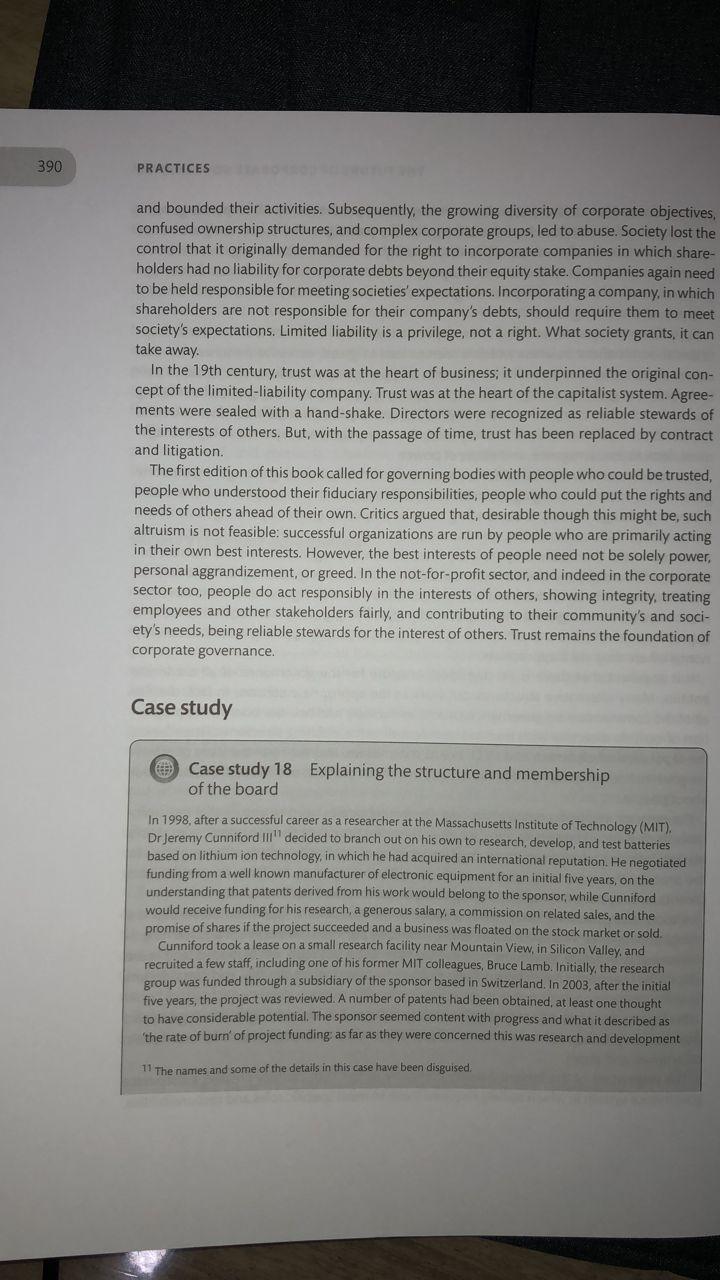
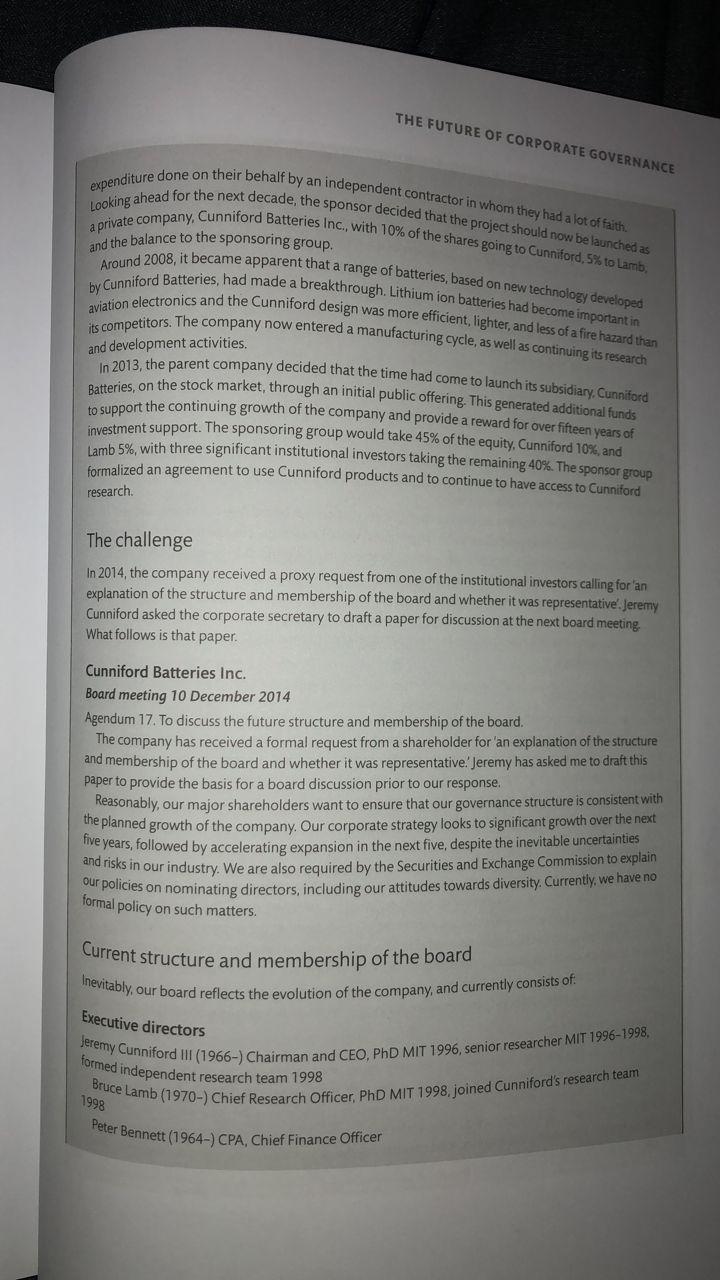
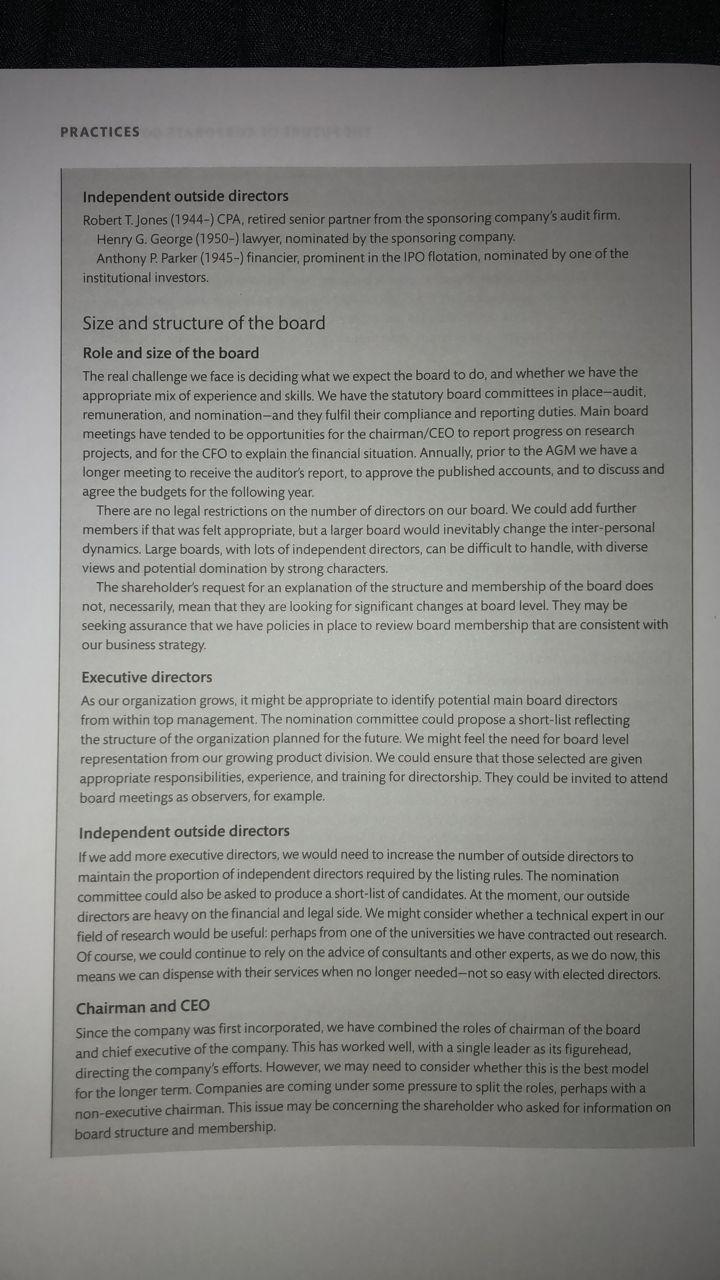
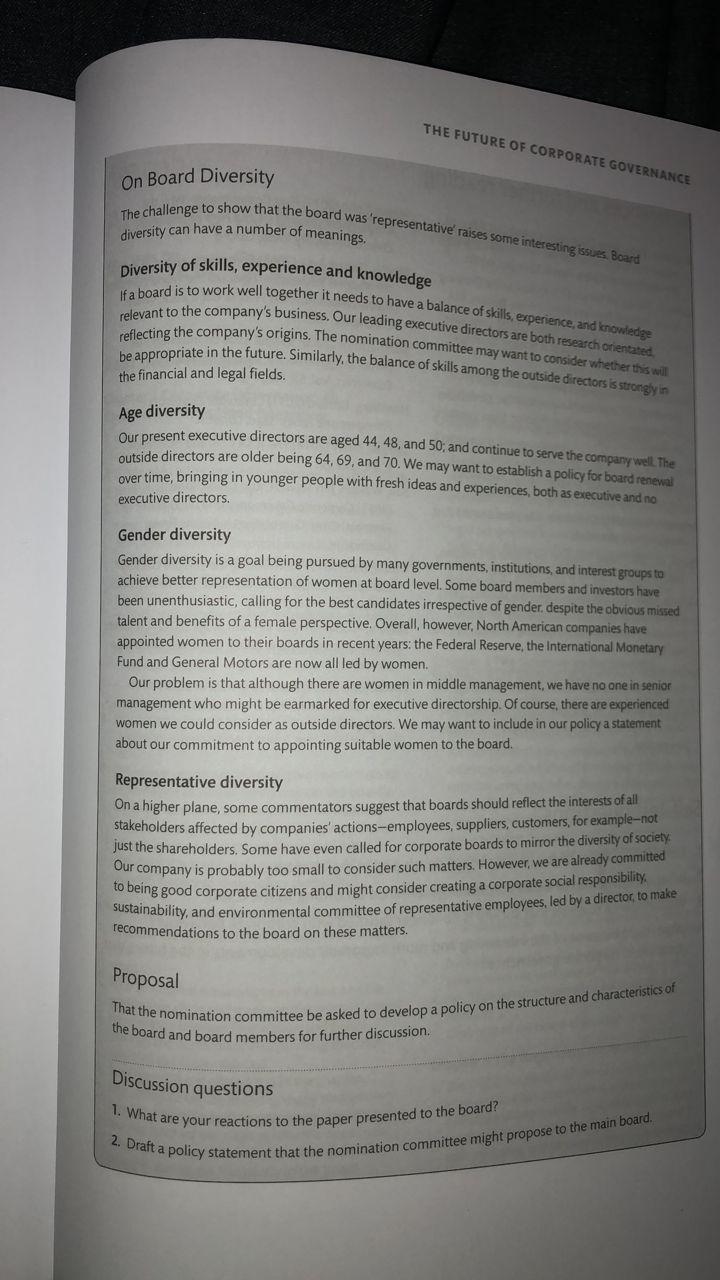
390 PRACTICES and bounded their activities. Subsequently, the growing diversity of corporate objectives, confused ownership structures, and complex corporate groups, led to abuse. Society lost the control that it originally demanded for the right to incorporate companies in which share- holders had no liability for corporate debts beyond their equity stake. Companies again need to be held responsible for meeting societies' expectations. Incorporating a company, in which shareholders are not responsible for their company's debts, should require them to meet society's expectations. Limited liability is a privilege, not a right. What society grants, it can take away In the 19th century, trust was at the heart of business; it underpinned the original con- cept of the limited liability company. Trust was at the heart of the capitalist system. Agree- ments were sealed with a hand-shake. Directors were recognized as reliable stewards of the interests of others. But, with the passage of time, trust has been replaced by contract and litigation The first edition of this book called for governing bodies with people who could be trusted, people who understood their fiduciary responsibilities, people who could put the rights and needs of others ahead of their own. Critics argued that, desirable though this might be, such altruism is not feasible: successful organizations are run by people who are primarily acting in their own best interests. However, the best interests of people need not be solely power, personal aggrandizement, or greed. In the not-for-profit sector, and indeed in the corporate sector too, people do act responsibly in the interests of others, showing integrity, treating employees and other stakeholders fairly, and contributing to their community's and soci- ety's needs, being reliable stewards for the interest of others. Trust remains the foundation of corporate governance. Case study Case study 18 Explaining the structure and membership of the board In 1998, after a successful career as a researcher at the Massachusetts Institute of Technology (MIT). Dr Jeremy Cunniford III" decided to branch out on his own to research, develop, and test batteries based on lithium ion technology, in which he had acquired an international reputation. He negotiated funding from a well known manufacturer of electronic equipment for an initial five years, on the understanding that patents derived from his work would belong to the sponsor, while Cunniford would receive funding for his research, a generous salary, a commission on related sales, and the promise of shares if the project succeeded and a business was floated on the stock market or sold. Cunniford took a lease on a small research facility near Mountain View, in Silicon Valley, and recruited a few staff, including one of his former MIT colleagues, Bruce Lamb. Initially, the research group was funded through a subsidiary of the sponsor based in Switzerland. In 2003, after the initial five years, the project was reviewed. A number of patents had been obtained, at least one thought to have considerable potential. The sponsor seemed content with progress and what it described as the rate of burn' of project funding as far as they were concerned this was research and development 11 The names and some of the details in this case have been disguised: THE FUTURE OF CORPORATE GOVERNANCE expenditure done on their behalf by an independent contractor in whom they had a lot of faith Looking ahead for the next decade, the sponsor decided that the project should now be launched as a private company, Cunniford Batteries Inc., with 10% of the shares going to Cunniford, 5% to Lamb, and the balance to the sponsoring group. Around 2008, it became apparent that a range of batteries, based on new technology developed aviation electronics and the Cunniford design was more efficient, lighter, and less of a fire hazard than by Cunniford Batteries, had made a breakthrough. Lithium ion batteries had become important in its competitors. The company now entered a manufacturing cycle, as well as continuing its research and development activities. In 2013, the parent company decided that the time had come to launch its subsidiary. Cunniford Batteries, on the stock market, through an initial public offering. This generated additional funds to support the continuing growth of the company and provide a reward for over fifteen years of investment support. The sponsoring group would take 45% of the equity, Cunniford 10%, and Lamb 5%, with three significant institutional investors taking the remaining 40%. The sponsor group formalized an agreement to use Cunniford products and to continue to have access to Cunniford research The challenge In 2014, the company received a proxy request from one of the institutional investors calling for an explanation of the structure and membership of the board and whether it was representative'. Jeremy Cunniford asked the corporate secretary to draft a paper for discussion at the next board meeting. What follows is that paper. Cunniford Batteries Inc. Board meeting 10 December 2014 Agendum 17. To discuss the future structure and membership of the board. The company has received a formal request from a shareholder for an explanation of the structure and membership of the board and whether it was representative. Jeremy has asked me to draft this paper to provide the basis for a board discussion prior to our response. Reasonably, our major shareholders want to ensure that our governance structure is consistent with the planned growth of the company. Our corporate strategy looks to significant growth over the next five years , followed by accelerating expansion in the next five, despite the inevitable uncertainties and risks in our industry. We are also required by the Securities and Exchange Commission to explain our policies on nominating directors, including our attitudes towards diversity. Currently, we have no formal policy on such matters. Current structure and membership of the board Inevitably, our board reflects the evolution of the company, and currently consists of Executive directors Jeremy Cunniford Ill (1966-) Chairman and CEO, PhD MIT 1996, senior researcher MIT 1996-1998, formed independent research team 1998 Bruce Lamb (1970-) Chief Research Officer, PhD MIT 1998, joined Cunniford's research team 1998 Peter Bennett (1964-) CPA, Chief Finance Officer PRACTICES Independent outside directors Robert T. Jones (1944-) CPA retired senior partner from the sponsoring company's audit firm. Henry G. George (1950-) lawyer, nominated by the sponsoring company. Anthony P.Parker (1945-) financier, prominent in the IPO flotation, nominated by one of the institutional investors. Size and structure of the board Role and size of the board The real challenge we face is deciding what we expect the board to do, and whether we have the appropriate mix of experience and skills. We have the statutory board committees in place-audit, remuneration, and nomination-and they fulfil their compliance and reporting duties. Main board meetings have tended to be opportunities for the chairman/CEO to report progress on research projects, and for the CFO to explain the financial situation. Annually, prior to the AGM we have a longer meeting to receive the auditor's report, to approve the published accounts, and to discuss and agree the budgets for the following year. There are no legal restrictions on the number of directors on our board. We could add further members if that was felt appropriate, but a larger board would inevitably change the inter-personal dynamics. Large boards, with lots of independent directors, can be difficult to handle, with diverse views and potential domination by strong characters, The shareholder's request for an explanation of the structure and membership of the board does not necessarily, mean that they are looking for significant changes at board level. They may be seeking assurance that we have policies in place to review board membership that are consistent with our business strategy. Executive directors As our organization grows, it might be appropriate to identify potential main board directors from within top management. The nomination committee could propose a short-list reflecting the structure of the organization planned for the future. We might feel the need for board level representation from our growing product division. We could ensure that those selected are given appropriate responsibilities, experience, and training for directorship. They could be invited to attend board meetings as observers, for example. Independent outside directors If we add more executive directors, we would need to increase the number of outside directors to maintain the proportion of independent directors required by the listing rules. The nomination committee could also be asked to produce a short-list of candidates. At the moment, our outside directors are heavy on the financial and legal side. We might consider whether a technical expert in our field of research would be useful: perhaps from one of the universities we have contracted out research. Of course, we could continue to rely on the advice of consultants and other experts, as we do now, this means we can dispense with their services when no longer needed-not so easy with elected directors. Chairman and CEO Since the company was first incorporated, we have combined the roles of chairman of the board and chief executive of the company. This has worked well with a single leader as its figurehead, directing the company's efforts. However, we may need to consider whether this is the best model for the longer term. Companies are coming under some pressure to split the roles, perhaps with a non-executive chairman. This issue may be concerning the shareholder who asked for information on board structure and membership. THE FUTURE OF CORPORATE GOVERNANCE On Board Diversity The challenge to show that the board was representative raises some interesting issues Board diversity can have a number of meanings. Diversity of skills, experience and knowledge relevant to the company's business. Our leading executive directors are both research orientated If a board is to work well together it needs to have a balance of skills, experience, and knowledge reflecting the company's origins. The nomination committee may want to consider whether this will be appropriate in the future. Similarly, the balance of skills among the outside directors is strongly in the financial and legal fields. Age diversity Our present executive directors are aged 44,48, and 50; and continue to serve the company well. The outside directors are older being 64,69, and 70. We may want to establish a policy for board renewal over time, bringing in younger people with fresh ideas and experiences, both as executive and no executive directors. Gender diversity Gender diversity is a goal being pursued by many governments, institutions, and interest groups to achieve better representation of women at board level. Some board members and investors have been unenthusiastic, calling for the best candidates irrespective of gender, despite the obvious missed talent and benefits of a female perspective. Overall, however, North American companies have appointed women to their boards in recent years: the Federal Reserve, the International Monetary Fund and General Motors are now all led by women. Our problem is that although there are women in middle management, we have no one in senior management who might be earmarked for executive directorship. Of course, there are experienced women we could consider as outside directors. We may want to include in our policy a statement about our commitment to appointing suitable women to the board. Representative diversity On a higher plane, some commentators suggest that boards should reflect the interests of all stakeholders affected by companies' actions-employees, suppliers, customers, for examplenot just the shareholders. Some have even called for corporate boards to mirror the diversity of society Our company is probably too small to consider such matters. However, we are already committed to being good corporate citizens and might consider creating a corporate social responsibility. sustainability, and environmental committee of representative employees, led by a director, to make recommendations to the board on these matters. Proposal That the nomination committee be asked to develop a policy on the structure and characteristics of the board and board members for further discussion. Discussion questions 1. What are your reactions to the paper presented to the board? 2. Draft a policy statement that the nomination committee might propose to the main boardStep by Step Solution
There are 3 Steps involved in it
1 Expert Approved Answer
Step: 1 Unlock

Question Has Been Solved by an Expert!
Get step-by-step solutions from verified subject matter experts
Step: 2 Unlock
Step: 3 Unlock