





Question: Please help me with linear Algebra question. 3. According to Theorem 18, when P is stochastic and regular, and v is any probability vector, the

Please help me with linear Algebra question.
Please help me with linear Algebra question. 3.
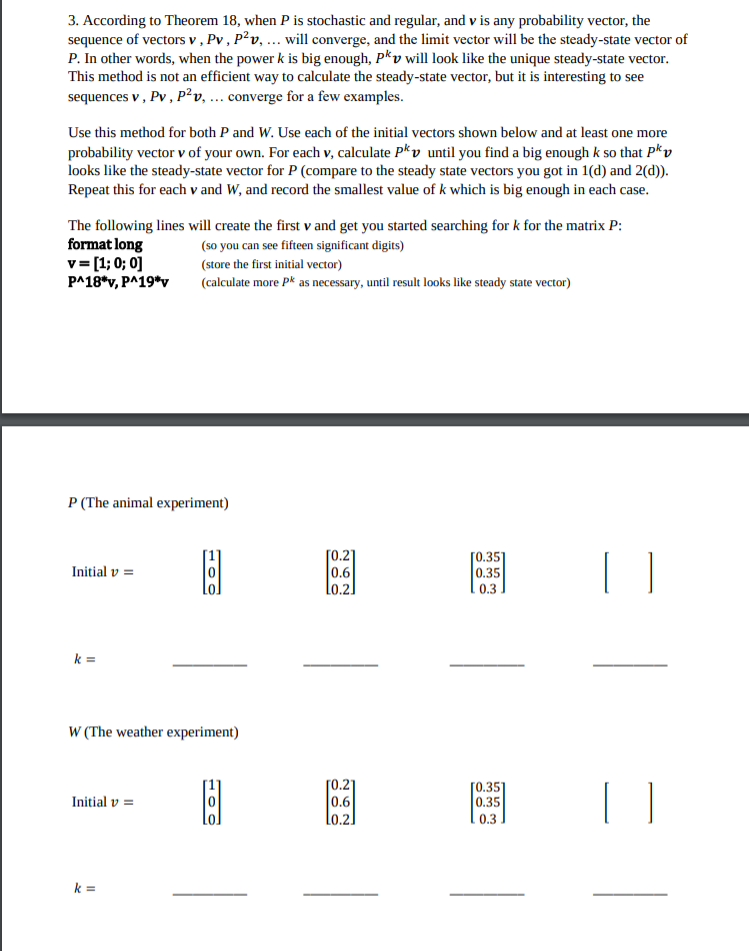
3. According to Theorem 18, when P is stochastic and regular, and v is any probability vector, the sequence of vectors v , Pv , Pav, ... will converge, and the limit vector will be the steady-state vector of P. In other words, when the power k is big enough, P"v will look like the unique steady-state vector. This method is not an efficient way to calculate the steady-state vector, but it is interesting to see sequences v , Pv , Pav, ... converge for a few examples. Use this method for both P and W. Use each of the initial vectors shown below and at least one more probability vector v of your own. For each v, calculate P" v until you find a big enough k so that p* v looks like the steady-state vector for P (compare to the steady state vectors you got in 1(d) and 2(d)). Repeat this for each v and W, and record the smallest value of k which is big enough in each case. The following lines will create the first v and get you started searching for k for the matrix P: format long (so you can see fifteen significant digits) v = [1; 0; 0] (store the first initial vector) P^18*v, P^19*v (calculate more p* as necessary, until result looks like steady state vector) P (The animal experiment) Initial v = 0.2 0.6 [0.35 0.35 [ 0.3 ] 1 1 K = W (The weather experiment) Initial v = 0.21 0.6 0.35] 0.35 10.3 K=

Step by Step Solution

There are 3 Steps involved in it

1 Expert Approved Answer
Step: 1 Unlock blur-text-image

Question Has Been Solved by an Expert!

Get step-by-step solutions from verified subject matter experts

Step: 2 Unlock
Step: 3 Unlock

Students Have Also Explored These Related Mathematics Questions!