







Question: Please help me with my project, thank you!! Due NOTE: PUT ALL FINAL WORK ON YOUR PROJECT_NO SCRATCH ATTACHED! 1. Credit Cards Charges and Payments
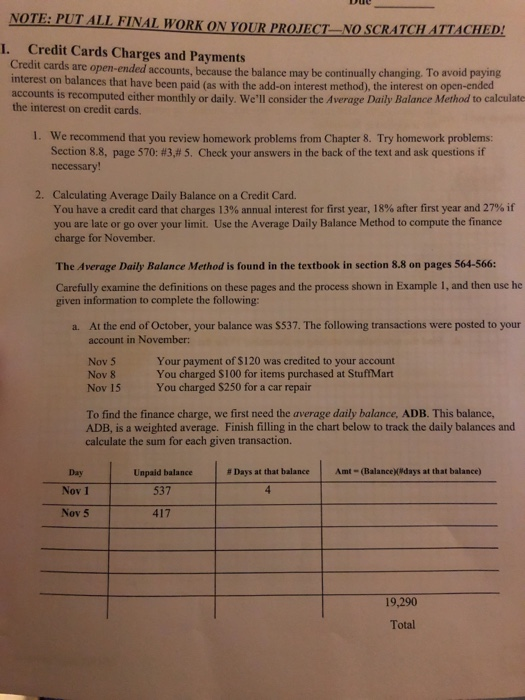
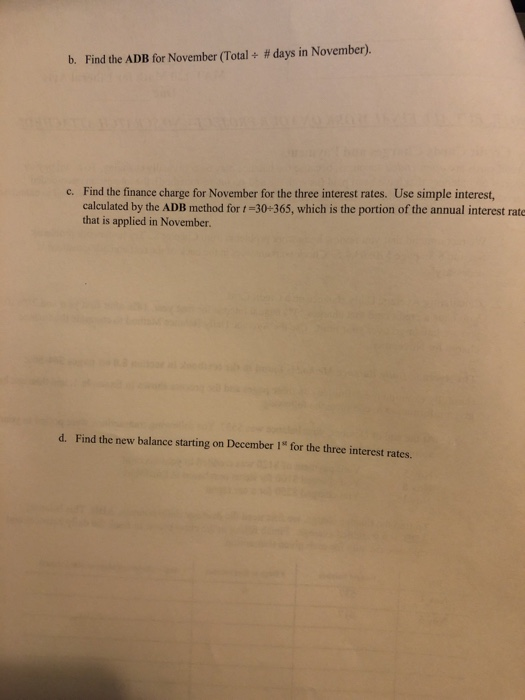
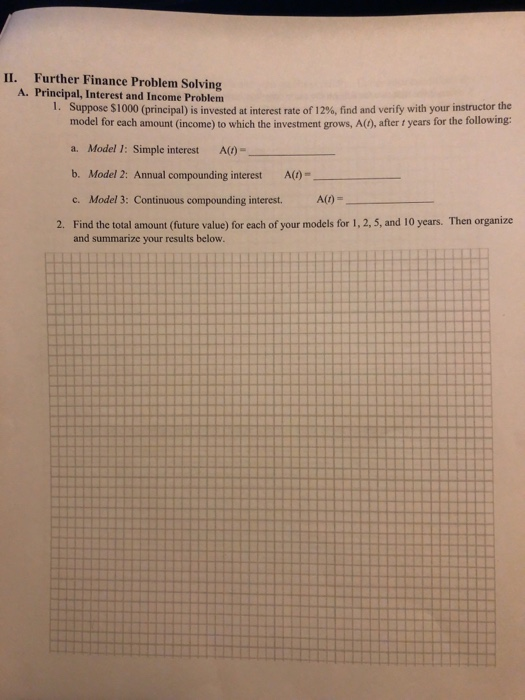
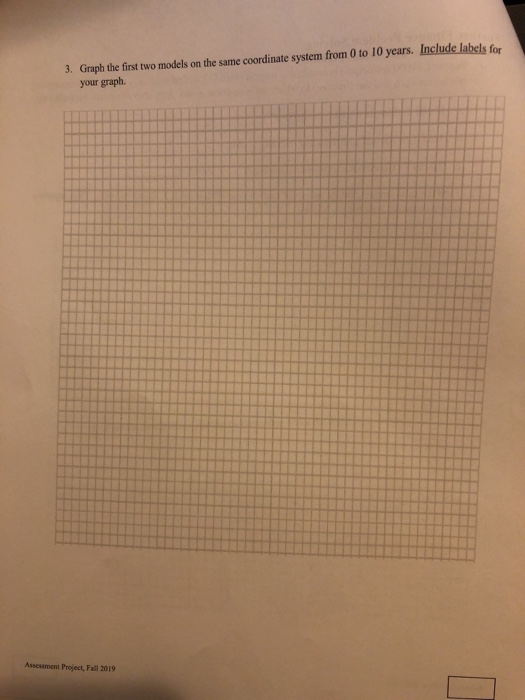
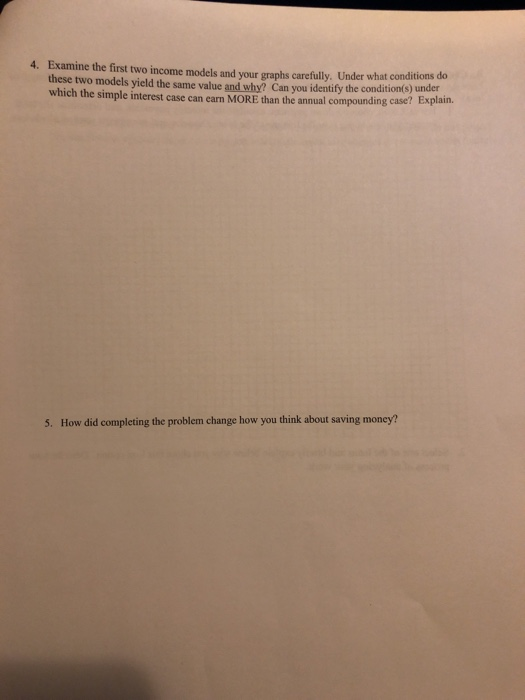
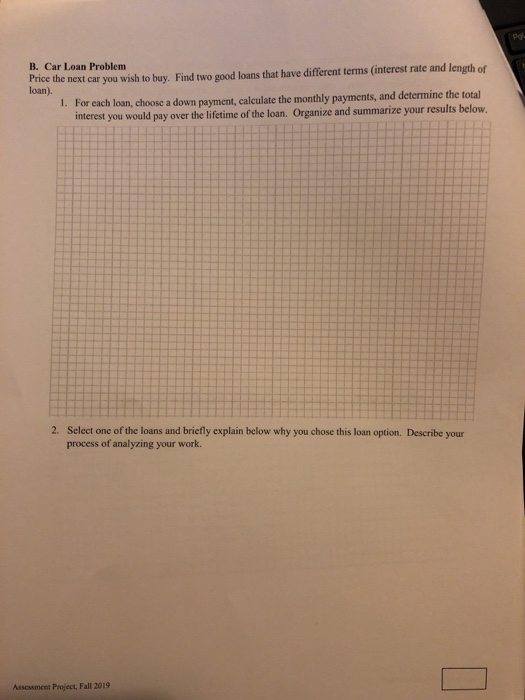
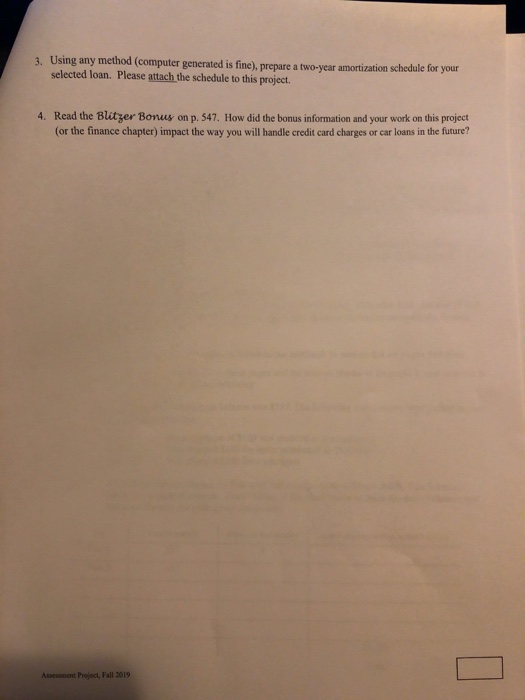
Due NOTE: PUT ALL FINAL WORK ON YOUR PROJECT_NO SCRATCH ATTACHED! 1. Credit Cards Charges and Payments Credit cards are open-ended accounts, because the balance may be continually changing. To avoid paying interest on balances that have been paid (as with the add-on interest method), the interest on open-ended accounts is recomputed either monthly or daily. We'll consider the Average Daily Balance Method to calculate the interest on credit cards. 1. We recommend that you review homework problems from Chapter 8. Try homework problems Section 8.8, page 570: #3,#5. Check your answers in the back of the text and ask questions if necessary! 2. Calculating Average Daily Balance on a Credit Card. You have a credit card that charges 13% annual interest for first year, 18% after first year and 27% if you are late or go over your limit. Use the Average Daily Balance Method to compute the finance charge for November The Average Daily Balance Method is found in the textbook in section 8.8 on pages 564-566: Carefully examine the definitions on these pages and the process shown in Example 1, and then use he given information to complete the following: a. At the end of October, your balance was $537. The following transactions were posted to your account in November: Nov 5 Nov 8 Nov 15 Your payment of $120 was credited to your account You charged S100 for items purchased at Stuft Mart You charged S250 for a car repair To find the finance charge, we first need the average daily balance, ADB. This balance, ADB, is a weighted average. Finish filling in the chart below to track the daily balances and calculate the sum for each given transaction. # Days at that balance Amt - (Balance Ndays at that balance) Day Nov 1 Nov 5 Unpaid balance 537 417 19,290 Total b. Find the ADB for November (Total = #days in November). c. Find the finance charge for November for the three interest rates. Use simple interest, calculated by the ADB method for 1-30+365, which is the portion of the annual interest rate that is applied in November d. Find the new balance starting on December 1" for the three interest rates. II. Further Finance Problem Solving A. Principal, Interest and Income Problem 1. Suppose $1000 (principal) is invested at interest rate of 12%. find and verify with your instructor the model for each amount (income) to which the investment grows, AC, after years for the following: a. Model 1: Simple interest A(1) - b. Model 2: Annual compounding interest A(1) = c. Model 3: Continuous compounding interest A(1) = 2. Find the total amount (future value) for each of your models for 1, 2, 5, and 10 years. Then organize and summarize your results below. 3. Graph the first two models on the same coordinate system from 0 to 10 years. Include labels for your graph Assessment Project, 2019 B. Car Loan Problem Price the next car you wish to buy. Find two good loans that have different terms interest rate and length of loan). 1. For each loan, choose a down payment, calculate the monthly payments, and determine the total interest you would pay over the lifetime of the loan. Organize and summarize your results below. 2. Select one of the loans and briefly explain below why you chose this loan option. Describe your process of analyzing your work. Assessment Project, Fall 2019 1. Using any method (computer generated is fine), prepare a two-year amortization schedule for your selected loan. Please attach the schedule to this project. 4. Read the Blitzer Bonus on p. 547. How did the bonus information and your work on this project (or the finance chapter) impact the way you will handle credit card charges or car loans in the future? A t Project Fall 2019 Due NOTE: PUT ALL FINAL WORK ON YOUR PROJECT_NO SCRATCH ATTACHED! 1. Credit Cards Charges and Payments Credit cards are open-ended accounts, because the balance may be continually changing. To avoid paying interest on balances that have been paid (as with the add-on interest method), the interest on open-ended accounts is recomputed either monthly or daily. We'll consider the Average Daily Balance Method to calculate the interest on credit cards. 1. We recommend that you review homework problems from Chapter 8. Try homework problems Section 8.8, page 570: #3,#5. Check your answers in the back of the text and ask questions if necessary! 2. Calculating Average Daily Balance on a Credit Card. You have a credit card that charges 13% annual interest for first year, 18% after first year and 27% if you are late or go over your limit. Use the Average Daily Balance Method to compute the finance charge for November The Average Daily Balance Method is found in the textbook in section 8.8 on pages 564-566: Carefully examine the definitions on these pages and the process shown in Example 1, and then use he given information to complete the following: a. At the end of October, your balance was $537. The following transactions were posted to your account in November: Nov 5 Nov 8 Nov 15 Your payment of $120 was credited to your account You charged S100 for items purchased at Stuft Mart You charged S250 for a car repair To find the finance charge, we first need the average daily balance, ADB. This balance, ADB, is a weighted average. Finish filling in the chart below to track the daily balances and calculate the sum for each given transaction. # Days at that balance Amt - (Balance Ndays at that balance) Day Nov 1 Nov 5 Unpaid balance 537 417 19,290 Total b. Find the ADB for November (Total = #days in November). c. Find the finance charge for November for the three interest rates. Use simple interest, calculated by the ADB method for 1-30+365, which is the portion of the annual interest rate that is applied in November d. Find the new balance starting on December 1" for the three interest rates. II. Further Finance Problem Solving A. Principal, Interest and Income Problem 1. Suppose $1000 (principal) is invested at interest rate of 12%. find and verify with your instructor the model for each amount (income) to which the investment grows, AC, after years for the following: a. Model 1: Simple interest A(1) - b. Model 2: Annual compounding interest A(1) = c. Model 3: Continuous compounding interest A(1) = 2. Find the total amount (future value) for each of your models for 1, 2, 5, and 10 years. Then organize and summarize your results below. 3. Graph the first two models on the same coordinate system from 0 to 10 years. Include labels for your graph Assessment Project, 2019 B. Car Loan Problem Price the next car you wish to buy. Find two good loans that have different terms interest rate and length of loan). 1. For each loan, choose a down payment, calculate the monthly payments, and determine the total interest you would pay over the lifetime of the loan. Organize and summarize your results below. 2. Select one of the loans and briefly explain below why you chose this loan option. Describe your process of analyzing your work. Assessment Project, Fall 2019 1. Using any method (computer generated is fine), prepare a two-year amortization schedule for your selected loan. Please attach the schedule to this project. 4. Read the Blitzer Bonus on p. 547. How did the bonus information and your work on this project (or the finance chapter) impact the way you will handle credit card charges or car loans in the future? A t Project Fall 2019
Step by Step Solution
There are 3 Steps involved in it

Get step-by-step solutions from verified subject matter experts
 Study Help