







Question: Please help me with Q6 by identifying Issue, Rule, Application or analysis , and Conclusion the subdivision, filed suit against Worthington, assert- ing that her
Please help me with Q6 by identifying Issue, Rule, Application or analysis , and Conclusion 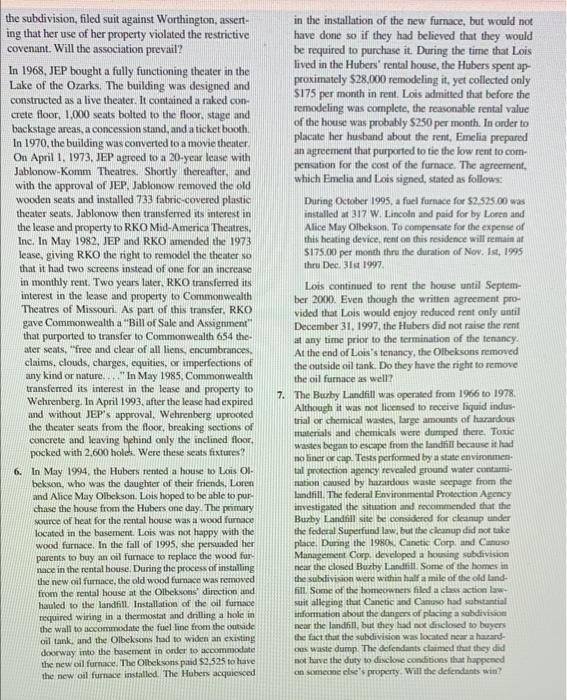
the subdivision, filed suit against Worthington, assert- ing that her use of her property violated the restrictive covenant. Will the association prevail? In 1968, JEP bought a fully functioning theater in the Lake of the Ozarks. The building was designed and constructed as a live theater. It contained a raked con crete floor, 1.000 seats bolted to the floor, stage and backstage areas, a concession stand, and a ticket booth, In 1970, the building was converted to a movie theater On April 1, 1973. JEP agreed to a 20-year lease with Jablonow-Komm Theatres. Shortly thereafter, and with the approval of JEP. Jablonow removed the old wooden seats and installed 733 fabric covered plastic theater seats. Jablonow then transferred its interest in the lease and property to RKO Mid-America Theatres. Inc. In May 1982, JEP and RKO amended the 1973 lease, giving RKO the right to remodel the theater so that it had two screens instead of one for an increase in monthly rent. Two years later. RKO transferred its interest in the lease and property to Commonwealth Theatres of Missouri. As part of this transfer. RKO gave Commonwealth a "Bill of Sale and Assignment" that purported to transfer to Commonwealth 654 the ater seats, free and clear of all liens encumbrances, claims, clouds, charges, equities, or imperfections of any kind or nature...." In May 1985. Commonwealth transferred its interest in the lease and property to Wehrenberg. In April 1993. after the lease had expired and without JEP's approvalWehrenberg uprooted the theater seats from the floor, breaking sections of concrete and leaving behind only the inclined floor. packed with 2.600 hole. Were these seats fixtures! 6. In May 1994, the Hubers rented a house to Los Ol bekwon, who was the daughter of their friends, Loren and Alice May Olbekson. Lots hoped to be able to pur- chase the house from the Hubers one day. The pomary source of heat for the rental house was a wood furnace located in the basement. Lois was not happy with the wood furnace. In the fall of 1995, she persuaded her parents to buy an oil furnace to replace the wood for nace in the rental house. During the process of installing the new oil furnace, the old wood furnace was removed from the rental house at the Olbeksons direction and hauled to the landfill Installation of the oil fumace required wiring in a thermostat and drilling a hole in the wall to accommodate the fuel line from the outside oil tank, and the Olbeksons had to widen an existing doorway into the basement in order to accommodatie the new oil furnace. The Otheksons paid $2.525 to have the new oil furnace installed. The Hubers acquiesced in the installation of the new furnace, but would not have done so if they had believed that they would be required to purchase it. During the time that Lois lived in the Hubers' rental house, the Hubers spent ap proximately $28.000 remodeling it, yet collected only $175 per month in rent. Lois admitted that before the remodeling was complete, the reasonable rental value of the house was probably $250 per month. In order to placate her husband about the rent, Emelia prepared an agreement that purported to tie the low rent to com pensation for the cost of the furnace. The agreement which Emelia and Lois signed, stated as follows: During October 1995, a fuel furnace for $2,525.00 was installed at 317 W. Lincoln and paid for by Loren and Alice May Othekson. To compensate for the expense of this heating device, rent on this residence will remain at $175.00 per month thru the duration of Nov. Ist, 1995 thru Dec 31 1997 Lois continued to rent the house until Septem- ber 2000. Even though the written agreement pro- vided that Lois would enjoy reduced rent only until December 31, 1997, the Hubers did not raise the rent at any time prior to the termination of the tenancy At the end of Lois's tenancy, the Olbeksons removed the outside oil tank. Do they have the right to remove the oil fumace as well? 7. The Burby Landfill was operated from 1966 to 1978 Although it was not licensed to receive liquid indus trial or chemical wastes, large amounts of hazardous materials and chemicals were dumped there. Toxic wastes began to escape from the Landhill because it had no liner or cap. Tests performed by a state environmen: tal protection agency revealed ground water contami ration caused by hazardous waste seepage from the landfill. The federal Environmental Protection Agency investigated the situation and recommended that the Buzby Landfill site be considered for cleanup under the federal Superfund law, but the cleanup did not take place. During the 1980. Canetic Corp. and Case Management Corp developed a housing subdivision near the closed Buzby Landfill. Some of the homes in the subdivision were within half a mile of the old land- fill. Some of the homeowners filed a class action Law suit alleging that Canetic and Camso had substantial information about the dangers of placing a subdivision near the landhill, but they had not disclosed to buyers the fact that the subdivision was located near a hand- cus waste dump. The defendants claimed that they did not have the duty to disclone conditions that happened on someone else's property. Will the defendants win Step by Step Solution
There are 3 Steps involved in it
1 Expert Approved Answer
Step: 1 Unlock

Question Has Been Solved by an Expert!
Get step-by-step solutions from verified subject matter experts
Step: 2 Unlock
Step: 3 Unlock
 Study Help