







Question: Please help me with question 2. I really need help question 2. I will thumbs up if you can give me answer for the question
Please help me with question 2. I really need help question 2. I will thumbs up if you can give me answer for the question 2.
PLEASE ANSWER IT ON YOUR OWN WORD. PLEASE DO NOT COPY FROM OTHER CHEGG PERSON. PLEASE ANSWER IT ON YOUR OWN ANSWER.
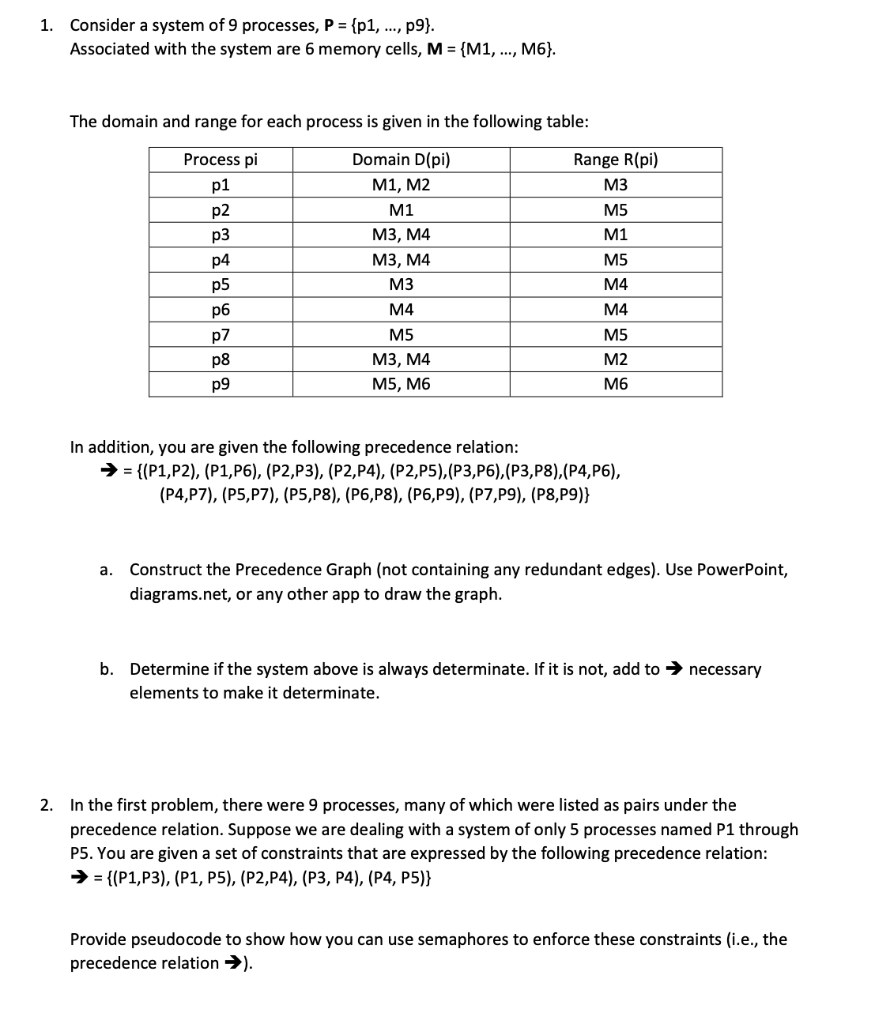
1. Consider a system of 9 processes, P = {p1, ..., p9}. Associated with the system are 6 memory cells, M = {M1, ..., M6}. The domain and range for each process is given in the following table: Range R(pi) Process pi p1 M3 M5 p2 p3 M1 p4 Domain D(pi) M1, M2 M1 M3, M4 M3, M4 M3 M4 M5 M3, M4 M5, M6 M5 M4 p5 M4 p6 p7 M5 M2 p8 p9 M6 In addition, you are given the following precedence relation: = {(P1,P2), (P1,P6), (P2,P3), (P2,P4), (P2,P5),(P3,P6),(P3,P8),(P4,P6), (P4,P7), (P5,P7), (P5,P8), (P6,P8), (P6,P9), (P7,P9), (P8,P9)} a. Construct the Precedence Graph (not containing any redundant edges). Use PowerPoint, diagrams.net, or any other app to draw the graph. b. Determine if the system above is always determinate. If it is not, add to necessary elements to make it determinate. 2. In the first problem, there were 9 processes, many of which were listed as pairs under the precedence relation. Suppose we are dealing with a system of only 5 processes named P1 through P5. You are given a set of constraints that are expressed by the following precedence relation: = {(P1,P3), (P1, P5), (P2,P4), (P3, P4), (P4, P5)} Provide pseudocode to show how you can use semaphores to enforce these constraints (i.e., the precedence relation )
Step by Step Solution
There are 3 Steps involved in it

Get step-by-step solutions from verified subject matter experts
 Study Help