







Question: please help me with question d LO 1, 2, 3, 5, 6, 9 6-33 Time-driven activity-based costing, activity-based management Midwest Office Products John Malone, general
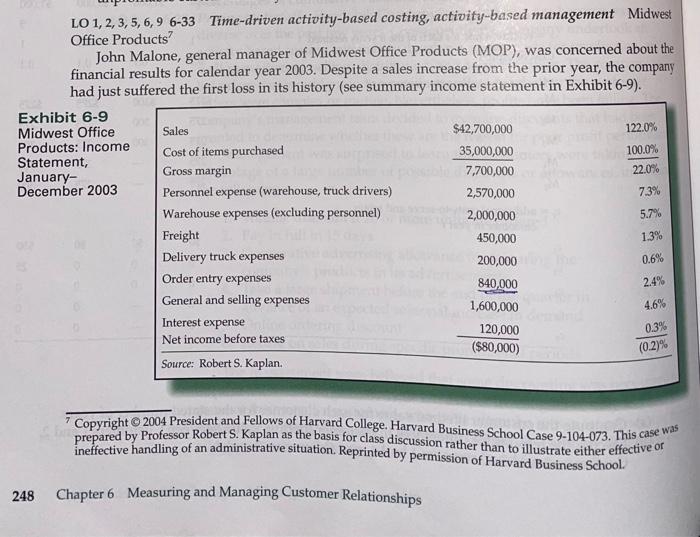
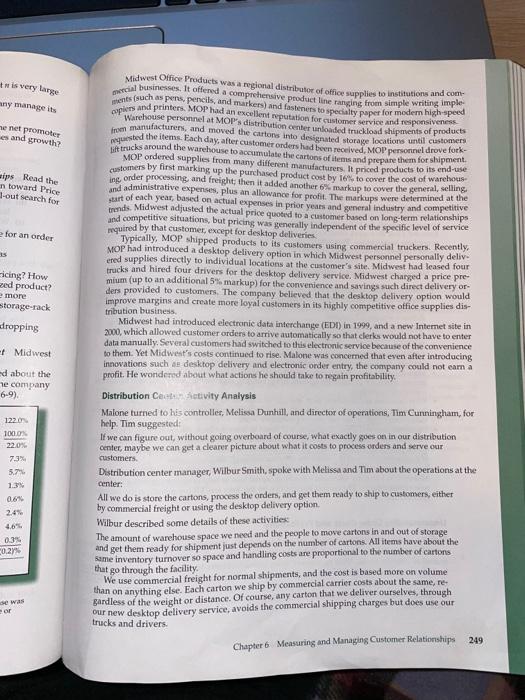
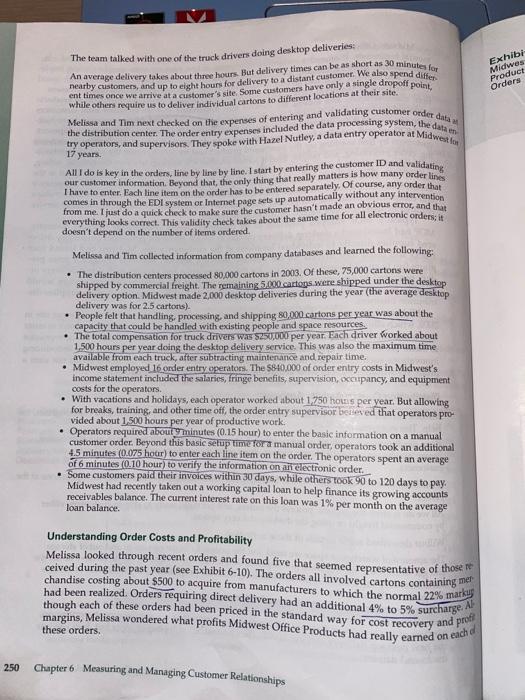
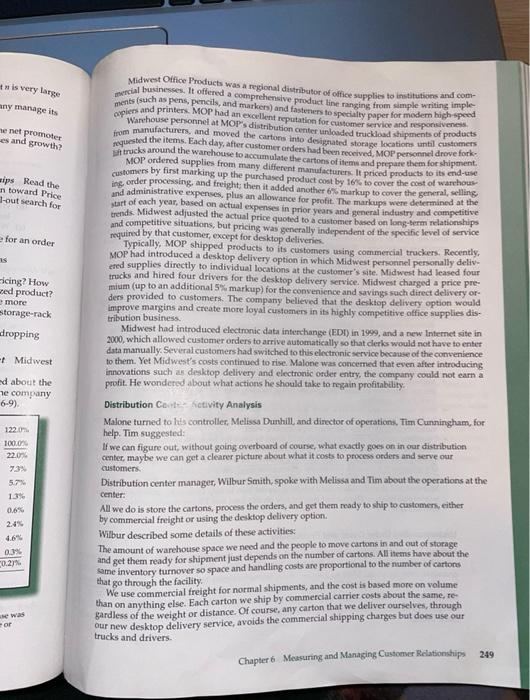
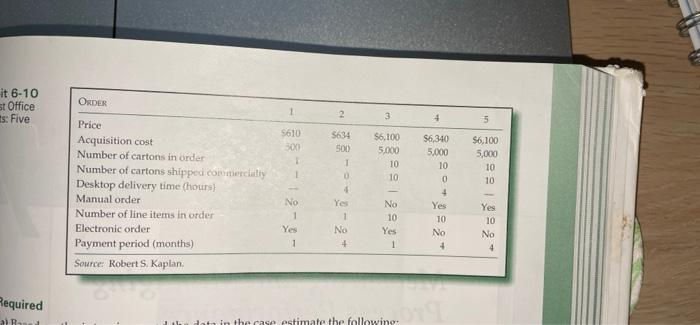
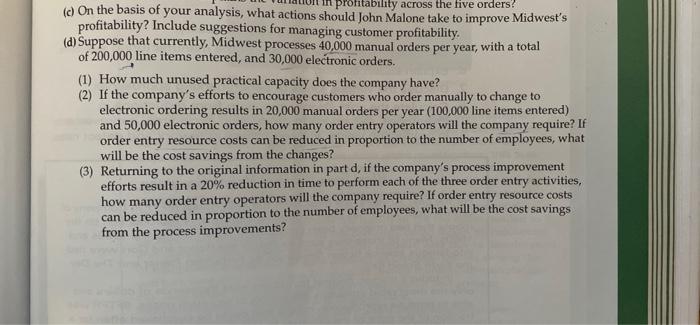
LO 1, 2, 3, 5, 6, 9 6-33 Time-driven activity-based costing, activity-based management Midwest Office Products John Malone, general manager of Midwest Office Products (MOP), was concerned about the financial results for calendar year 2003. Despite a sales increase from the prior year, the company had just suffered the first loss in its history (see summary income statement in Exhibit 6-9). Exhibit 6-9 Midwest Office Sales $42,700,000 122.0% Products: Income Cost of items purchased 35,000,000 100.0% Statement, January- Gross margin 7,700,000 22.0% December 2003 Personnel expense (warehouse, truck drivers) 2,570,000 Warehouse expenses (excluding personnel) 2,000,000 5.7% Freight 450,000 Delivery truck expenses 200,000 Order entry expenses 840,000 General and selling expenses 1,600,000 Interest expense 120,000 Net income before taxes ($80,000) Source: Robert S. Kaplan 73% 1.3% 0.6% 2.4% 4.6% 0.3% (0.2)% preffective handling of an administrative situation. Reprinted by permission of Harvard Business School. prepared by Professor Robert S. Kaplan as the basis for class discussion rather than to illustrate either effective of Copyright 2004 President and Fellows of Harvard College. Harvard Business School Case 9-104-073. This case was 248 Chapter 6 Measuring and Managing Customer Relationships is very large any manage its net promoter es and growth? ips Read the toward Price -out search for for an order 13 icing? How ed product? more storage-rack dropping Midwest Midwest Office Products was a regional distributor of office supplies to institutions and come mercial businesses. It offered a comprehensive product line ranging from simple writing imple a ments (such as pens, pencils, and markets and fasteners to specialty paper for modern high-speed copies and printers MOP had an excellent reputation for customer service and responsiveness Warehouse personnel at MOP distribution center unloaded truckload shipments of products from manufacturers and moved the cartons Into designated storage locations until customers Aquested the items. Each day, after customer orders had been received, MOP personnel drove fork Det tracks around the warehouse to accumulate the cartons of items and prepare them for shipment MOP ordered supplies from many different manufacturers. It priced products to its end-use customers by first marking up the purchased product cost by 16. to cover the cost of warehous ng order processing and freight, then it added another 6 markup to cover the general, sine and administrative expenses plus an allowance for profit. The markups were determined at the start of each year, based on actual expenses in prior years and general industry and competitive rends. Midwest adjusted the actual price quoted to a customer based on long-term relationships and competitive situations, but pricing was generally independent of the specific level of service required by that customer, except for desktop deliveries Typically, MOP shipped products to its customers using commercial truckers. Recently MOP had introduced a desktop delivery option in which Midwest personnel personally deliv ered supplies directly to individual locations at the customer's site. Midwest had leased four trucks and hired four drivers for the desktop delivery service. Midwest charged a price pre mium (up to an additional markup) for the convenience and savings such direct delivery or ders provided to customers. The company believed that the desktop delivery option would improve margins and create more loyal customers in its highly competitive office supplies dis- tribution business Midwest had introduced electronic data interchange (EDI) in 1999, and a new Internet site in 2000, which allowed customer orders to arrive automatically so that clerks would not have to enter data manually. Several customers had switched to this electronic service because of the convenience to them. Yet Midwest's costs continued to rise. Malone was concerned that even after introducing innovations such as desktop delivery and electronic order entry, the company could not earn a profit. He wondered about what actions he should take to regain profitability Distribution Certivity Analysis Malone turned to his controller, Melissa Dunhill, and director of operations, Tim Cunningham, for help. Tim suggested: If we can figure out, without going overboard of course, what exactly goes on in our distribution center, maybe we can get a clearer picture about what it costs to process orders and serve our customers Distribution center manager, Wilbur Smith, spoke with Melissa and Tim about the operations at the center: All we do is store the cartons, process the orders, and get them ready to ship to customers, either by commercial freight or using the desktop delivery option Wilbur described some details of these activities The amount of warehouse space we need and the people to move cartons in and out of storage and get them ready for shipment just depends on the number of cartons. All items have about the Some inventory turnover so space and handling costs are proportional to the number of cartons that go through the facility. We use commercial freight for normal shipments, and the cost is based more on volume than on anything else. Each carton we ship by commercial carrier costs about the same, re. Bardless of the weight or distance. Of course, any carton that we deliver ourselves, through our new desktop delivery service, avoids the commercial shipping charges but does use our trucks and drivers Chapter 6 Measuring and Managing Customer Relationships 249 ed about the he company 6-9). 1220 100.0 22.0% 7.3% 5.7 1.3% 0.6% 4.6'5. 0.3% 0.21% Exhibi Midwes Product Orders nearby customers, and up to eight hours for delivery to a distant customer. We also spend differ The team talked with one of the truck drivers doing desktop deliveries: for sht times once we arrive at a customer's site. Some customers have only a single dropoff point, while others require us to deliver individual cartons to different locations at their site. Melissa and Tim next checked on the expenses of entering and validating customer order da the distribution center. The order entry expenses included the data processing system, the data en try operators, and supervisors. They spoke with Hazel Nutley, a data entry operator at Midwest 17 years All I do is key in the orders, line by line by line. I start by entering the customer ID and validating our customer information Beyond that, the only thing that really matters is how many order lines Thave to enter. Each line item on the order has to be entered separately. Of course, any order that comes in through the EDI system or Internet page sets up automatically without any intervention from me. I just do a quick check to make sure the customer hasn't made an obvious error, and that everything looks correct. This validity check takes about the same time for all electronic orders; it doesn't depend on the number of items ordered Melissa and Tim collected information from company databases and learned the following: The distribution centers processed 80.000 cartons in 2003. Of these, 75,000 cartons were shipped by commercial freight. The remaining 5.000 cartops were shipped under the desktop delivery option. Midwest made 2,000 desktop deliveries during the year the average desktop delivery was for 2.5 cartons). People felt that handling processing, and shipping 80,000 cartons per year was about the capacity that could be handled with existing people and space resources. The total compensation for truck drivers was 250,000 per year. Each driver worked about 1,500 hours per year doing the desktop delivery service. This was also the maximum time available from each truck, after subtracting maintenance and repair time. Midwest employed 16 order entry operators. The 5840,000 of order entry costs in Midwest's income statement included the salaries, fringe benefits, supervision, occupancy, and equipment costs for the operators. . With vacations and holidays, each operator worked about 1,250 hours per year. But allowing for breaks, training, and other time off the order entry supervisor belesed that operators pro- vided about 1,500 hours per year of productive work. Operators required about minutes (0.15 hour) to enter the basic information on a manual customer order. Beyond this basic setup time for a manual order, operators took an additional 4.5 minutes (0.075 hour) to enter each line item on the order. The operators spent an average of 6 minutes (0.10 hour) to verify the information on an electronic order. Some customers paid their invoices within 30 days, while others took 90 to 120 days to pay. Midwest had recently taken out a working capital loan to help finance its growing accounts receivables balance. The current interest rate on this loan was 1% per month on the average loan balance Understanding Order Costs and Profitability Melissa looked through recent orders and found five that seemed representative of those me ceived during the past year (see Exhibit 6-10). The orders all involved cartons containing mer chandise costing about S500 to acquire from manufacturers to which the normal 22% markus had been realized Orders requiring direct delivery had an additional 4% to 5% surcharge though each of these orders had been priced in the standard way for cost recovery and proff margins, Melissa wondered what profits Midwest Office Products had really eamed on each these orders. 250 Chapter 6 Measuring and Managing Customer Relationships is very large any manage its e net promoter es and growth? tips Read the an toward Price -out search for for an order is ling? How eed product? more storage rack dropping - Midwest mercial businesses. It offered a comprehensive product line manging from simple writing imple ments such as pens, pencils, and markers) and fasteners to specialty paper for modern high speed apiers and printers. MOP had an excellent reputation for customer service and responsiveness Warehouse personnel at MOP's distribution center unloaded truckload shipments of products from manufacturers, and moved the cartone into designated storage locations until customers mypasted the items. Each day, after customer orders had been received, MOP personnel drowe fileht in tracks around the warehouse to accumulate the cartons of items and prepare them for shipment MOP ordered supplies from many different manufacturers. It priced products to its end-use customers by first marking up the purchased product cost by 16% to cover the cost of warchou ing order processing, and freight, then it added another 6% markup to cover the general, selling and administrative expenses, plus an allowance for profit. The markups were determined at the part of each year, based on actual expenses in prior years and general industry and competitive trends Midwest adjusted the actual price quoted to a customer based on long-term relationship and competitive situations, but pricing was generally independent of the specific level of service required by that customer, except for desktop deliveries. Typically. MOP shipped products to its customers using commercial truckers. Recently, MOP had introduced a desktop delivery option in which Midwest personnel personally deliv ered supplies directly to individual locations at the customer's site. Midwest had leased four tracks and hired four drivers for the desktop delivery service. Midwest charged a price pre mium (up to an additional 5% markup) for the convenience and savings such direct delivery or ders provided to customers. The company believed that the desktop delivery option would improve margins and create more loyal customers in its highly competitive office supplies dis- tribution business Midwest had introduced electronic data interchange (EDI) in 1999, and a new Internet site in 2000, which allowed customer orders to arrive automatically so that clerks would not have to enter data manually. Several customers had switched to this electronic service because of the convenience to them. Yet Midwest's costs continued to rise. Malone was concerned that even after introducing innovations such as desktop delivery and electronic order entry, the company could not earn a profit. He wondered about what actions he should take to regain profitability Distribution Cote Activity Analysis Malone turned to his controller, Melissa Dunhill, and director of operations. Tim Cunningham, for help. Tim suggested: If we can figure out without going overboard of course, what exactly goes on in our distribution center, maybe we can get a clearer picture about what it costs to process orders and serve our customers Distribution center manager, Wilbur Smith, spoke with Melissa and Tim about the operations at the center: All we do is store the cartons, process the orders , and get them ready to ship to customers, either by commercial freight or using the desktop delivery option. Wilbur described some details of these activities: The amount of warehouse space we need and the people to move cartons in and out of storage and get them ready for shipment just depends on the number of cartons. All items have about the Same inventory turnover so space and handling costs are proportional to the number of cartons that go through the facility. We use commercial freight for normal shipments, and the cost is based more on volume than on anything else. Each carton we ship by commercial carrier costs about the same, te gardless of the weight or distance. Of course, any carton that we deliver ourselves, through our new desktop delivery service, avoids the commercial shipping charges but does use our trucks and drivers 249 Chapter 6 Measuring and Managing Customer Relationships ad about the he company 6-9) 122.0 1000 22.0 73 57% 0.6% 4.6% 00 0.23% ORDER it 6-10 st Office is: Five 1 2 3 4 5 S610 500 $6.100 5.000 10 10 $6,100 5,000 10 10 Price Acquisition cost Number of cartons in order Number of cartons shipped commerciali Desktop delivery time (hours) Manual order Number of line items in order Electronic order Payment period (months) Source: Robert S. Kaplan 5634 500 1 0 1 Yes 1 No + $6,340 5,000 10 0 4 Yes 10 No 4 No No 10 Yes Yes 1 Yes 10 No 4 1 Required al a data in the case estimate the following: (c) On the basis of your analysis, what actions should John Malone take to improve Midwest's profitability across the five orders! profitability? Include suggestions for managing customer profitability. (d) Suppose that currently, Midwest processes 40,000 manual orders per year, with a total of 200,000 line items entered, and 30,000 electronic orders. (1) How much unused practical capacity does the company have? (2) If the company's efforts to encourage customers who order manually to change to electronic ordering results in 20,000 manual orders per year (100,000 line items entered) and 50,000 electronic orders, how many order entry operators will the company require? If order entry resource costs can be reduced in proportion to the number of employees, what will be the cost savings from the changes? (3) Returning to the original information in part d, if the company's process improvement efforts result in a 20% reduction in time to perform each of the three order entry activities, how many order entry operators will the company require? If order entry resource costs can be reduced in proportion to the number of employees, what will be the cost savings from the process improvements
Step by Step Solution
There are 3 Steps involved in it

Get step-by-step solutions from verified subject matter experts
 Study Help