







Question: Please help me with solving questions (a), ( b) and ( c ). Provide the steps to get to the final solution. THANKS a lot!
Please help me with solving questions (a), (b) and (c). Provide the steps to get to the final solution. THANKS a lot!
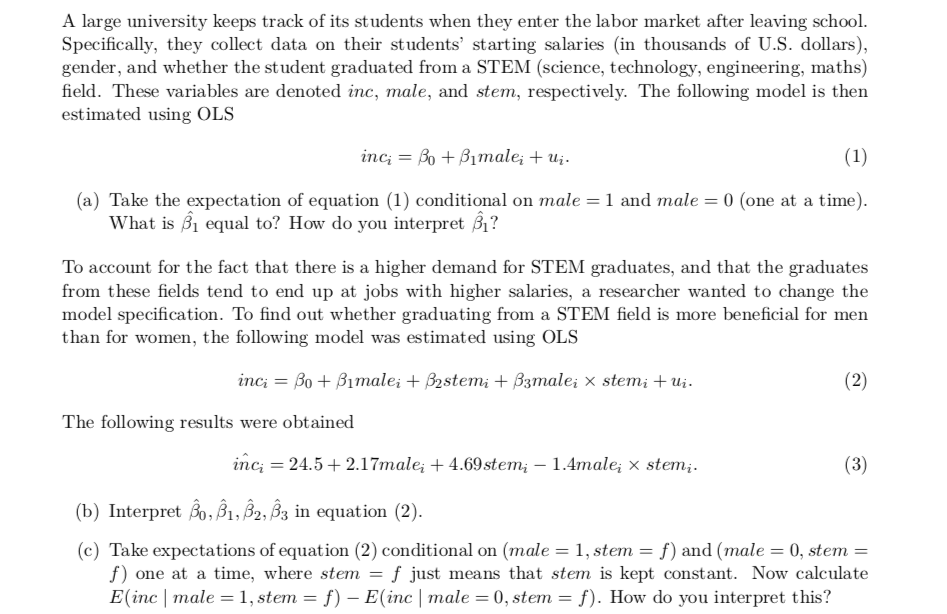
A large university keeps track of its students when they enter the labor market after leaving school. Specifically, they collect data on their students' starting salaries (in thousands of U.S. dollars), gender, and whether the student graduated from a STEM (science, technology, engineering, maths) field. These variables are denoted inc, male, and stem, respectively. The following model is then estimated using OLS inci = Bo + Bimale; + ui. (1) (a) Take the expectation of equation (1) conditional on male = 1 and male = 0 (one at a time). What is 31 equal to? How do you interpret B1? To account for the fact that there is a higher demand for STEM graduates, and that the graduates from these fields tend to end up at jobs with higher salaries, a researcher wanted to change the model specification. To find out whether graduating from a STEM field is more beneficial for men than for women, the following model was estimated using OLS inci = Bo + Bimalei + Bystemi + Bamale; X stemi + ui. (2) The following results were obtained inc; = 24.5 + 2.17male; + 4.69stem; - 1.4male; x stemi. (3) (b) Interpret Bo, B1, 32, B3 in equation (2). (c) Take expectations of equation (2) conditional on (male = 1, stem = f) and (male = 0, stem = f) one at a time, where stem = f just means that stem is kept constant. Now calculate E(inc | male = 1, stem = f) - E(inc | male = 0, stem = f). How do you interpret this
Step by Step Solution
There are 3 Steps involved in it

Get step-by-step solutions from verified subject matter experts
 Study Help