







Question: Please help me with step 3 4 5 Thank you! The goal of this quiz is to prove that (2) (5) in Wedderburn's Theorem. In
Please help me with step 3 4 5 Thank you!
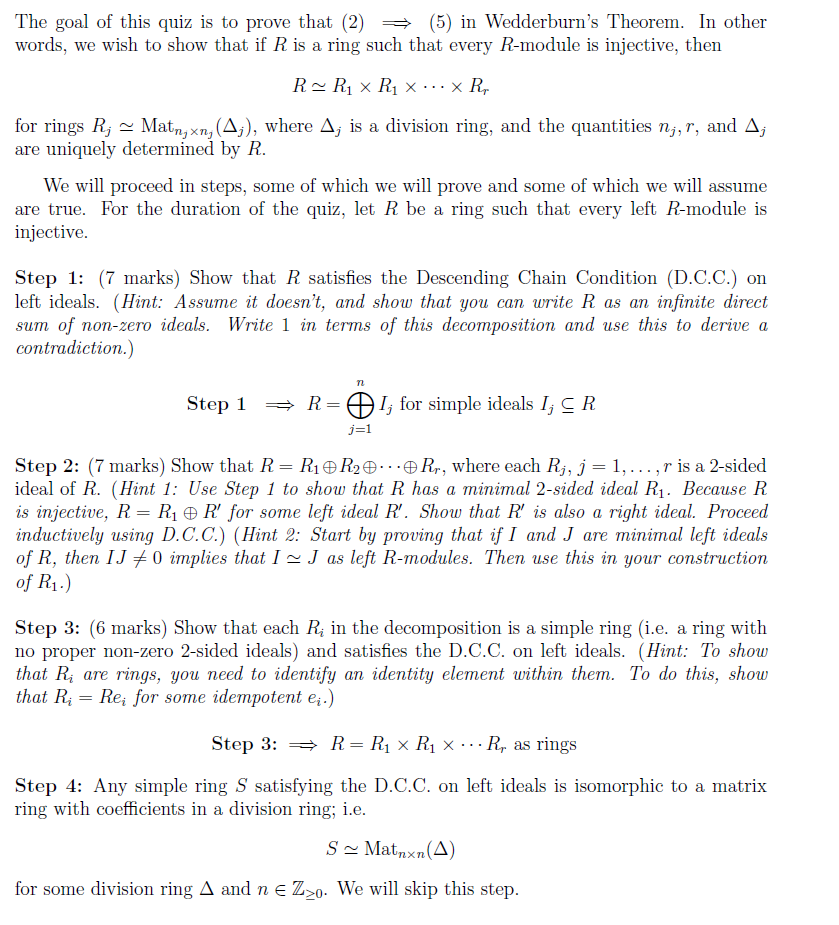
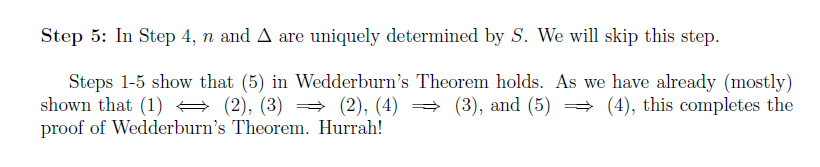
The goal of this quiz is to prove that (2) (5) in Wedderburn's Theorem. In other words, we wish to show that if R is a ring such that every R-module is injective, then R_R1 x R1 X... XR, a for rings R; Matn, xn, (4;), where A; is a division ring, and the quantities nj, P, and A; are uniquely determined by R. We will proceed in steps, some of which we will prove and some of which we will assume are true. For the duration of the quiz, let R be a ring such that every left R-module is injective. Step 1: (7 marks) Show that R satisfies the Descending Chain Condition (D.C.C.) on left ideals. (Hint: Assume it doesn't, and show that you can write R as an infinite direct sum of non-zero ideals. Write 1 in terms of this decomposition and use this to derive a contradiction.) 72 Step 1 = R=1; for simple ideals I; CR ; j=1 Step 2: (7 marks) Show that R= R1 R2...Rr, where each Rj, j = 1, ..., r is a 2-sided ideal of R. (Hint 1: Use Step 1 to show that R has a minimal 2-sided deal R. Because R is injective, R= R1 e R' for some left ideal R'. Show that R' is also a right ideal. Proceed inductively using D.C.C.) (Hint 2: Start by proving that if I and I are minimal left ideals of R, then IJ #0 implies that I - J as left R-modules. Then use this in your construction of R1.) Step 3: (6 marks) Show that each R; in the decomposition is a simple ring (i.e. a ring with no proper non-zero 2-sided ideals) and satisfies the D.C.C. on left ideals. (Hint: To show that Ri are rings, you need to identify an identity element within them. To do this, show that Ri = Re; for some idempotent e.) Step 3: > R= R1 x R1 X ... R, as rings Step 4: Any simple ring S satisfying the D.C.C. on left ideals is isomorphic to a matrix ring with coefficients in a division ring; i.e. S ~ Matnxn(A) for some division ring A and n e Zyo. We will skip this step. Step 5: In Step 4, n and A are uniquely determined by S. We will skip this step. Steps 1-5 show that (5) in Wedderburn's Theorem holds. As we have already (mostly) shown that (1) 9 (2), (3) 5 (2), (4) + (3), and (5) (4), this completes the proof of Wedderburn's Theorem. Hurrah! The goal of this quiz is to prove that (2) (5) in Wedderburn's Theorem. In other words, we wish to show that if R is a ring such that every R-module is injective, then R_R1 x R1 X... XR, a for rings R; Matn, xn, (4;), where A; is a division ring, and the quantities nj, P, and A; are uniquely determined by R. We will proceed in steps, some of which we will prove and some of which we will assume are true. For the duration of the quiz, let R be a ring such that every left R-module is injective. Step 1: (7 marks) Show that R satisfies the Descending Chain Condition (D.C.C.) on left ideals. (Hint: Assume it doesn't, and show that you can write R as an infinite direct sum of non-zero ideals. Write 1 in terms of this decomposition and use this to derive a contradiction.) 72 Step 1 = R=1; for simple ideals I; CR ; j=1 Step 2: (7 marks) Show that R= R1 R2...Rr, where each Rj, j = 1, ..., r is a 2-sided ideal of R. (Hint 1: Use Step 1 to show that R has a minimal 2-sided deal R. Because R is injective, R= R1 e R' for some left ideal R'. Show that R' is also a right ideal. Proceed inductively using D.C.C.) (Hint 2: Start by proving that if I and I are minimal left ideals of R, then IJ #0 implies that I - J as left R-modules. Then use this in your construction of R1.) Step 3: (6 marks) Show that each R; in the decomposition is a simple ring (i.e. a ring with no proper non-zero 2-sided ideals) and satisfies the D.C.C. on left ideals. (Hint: To show that Ri are rings, you need to identify an identity element within them. To do this, show that Ri = Re; for some idempotent e.) Step 3: > R= R1 x R1 X ... R, as rings Step 4: Any simple ring S satisfying the D.C.C. on left ideals is isomorphic to a matrix ring with coefficients in a division ring; i.e. S ~ Matnxn(A) for some division ring A and n e Zyo. We will skip this step. Step 5: In Step 4, n and A are uniquely determined by S. We will skip this step. Steps 1-5 show that (5) in Wedderburn's Theorem holds. As we have already (mostly) shown that (1) 9 (2), (3) 5 (2), (4) + (3), and (5) (4), this completes the proof of Wedderburn's Theorem. Hurrah
Step by Step Solution
There are 3 Steps involved in it

Get step-by-step solutions from verified subject matter experts
 Study Help