







Question: Please help me with the attached question. In this question, we consider a version of the stealing model with a bonus-only incentive scheme, and where
Please help me with the attached question.
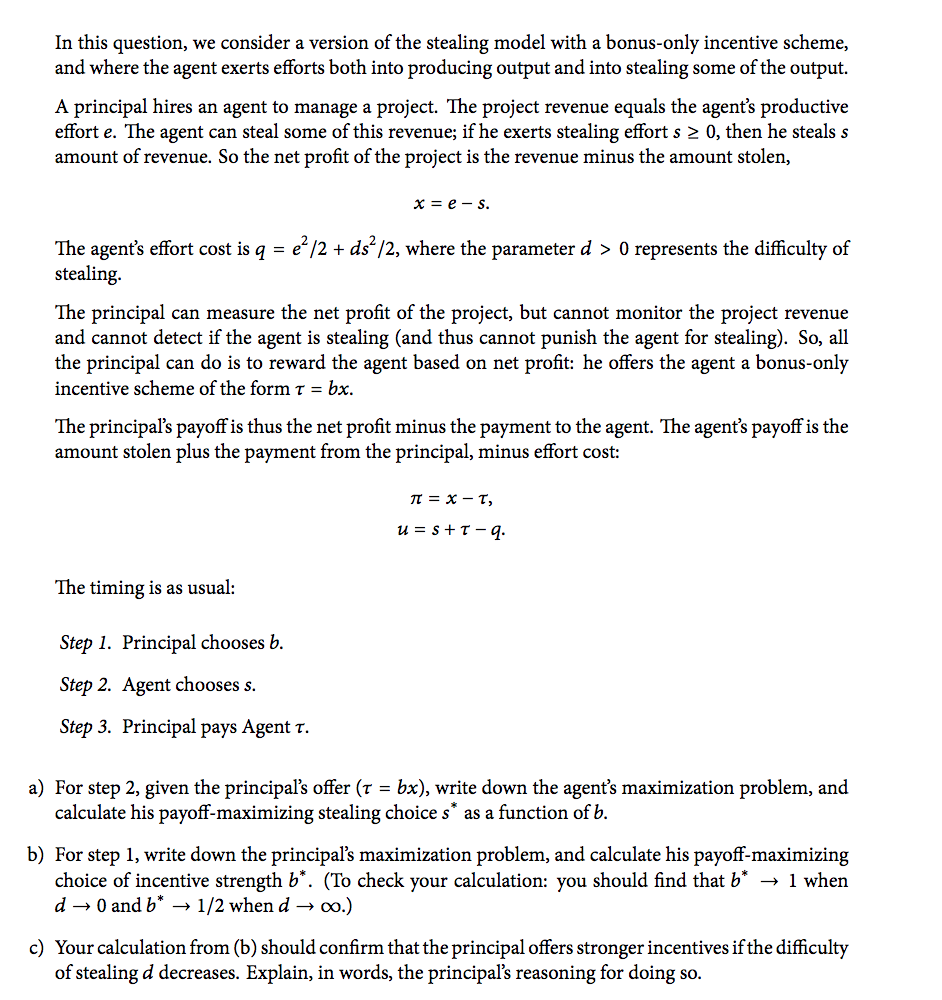
In this question, we consider a version of the stealing model with a bonus-only incentive scheme, and where the agent exerts efforts both into producing output and into stealing some of the output. A principal hires an agent to manage a project. The project revenue equals the agent's productive effort e. The agent can steal some of this revenue; if he exerts stealing effort s 2 0, then he steals s amount of revenue. So the net profit of the project is the revenue minus the amount stolen, x = e -s. The agent's effort cost is q = e /2 + ds /2, where the parameter d > 0 represents the difficulty of stealing. The principal can measure the net profit of the project, but cannot monitor the project revenue and cannot detect if the agent is stealing (and thus cannot punish the agent for stealing). So, all the principal can do is to reward the agent based on net profit: he offers the agent a bonus-only incentive scheme of the form r = bx. The principal's payoff is thus the net profit minus the payment to the agent. The agent's payoff is the amount stolen plus the payment from the principal, minus effort cost: J = X -I, u=S+T - q. The timing is as usual: Step 1. Principal chooses b. Step 2. Agent chooses s. Step 3. Principal pays Agent T. a) For step 2, given the principal's offer (r = bx), write down the agent's maximization problem, and calculate his payoff-maximizing stealing choice s* as a function of b. b) For step 1, write down the principal's maximization problem, and calculate his payoff-maximizing choice of incentive strength b". (To check your calculation: you should find that b* - 1 when d - 0 and b* - 1/2 when d - co.) c) Your calculation from (b) should confirm that the principal offers stronger incentives if the difficulty of stealing d decreases. Explain, in words, the principal's reasoning for doing so
Step by Step Solution
There are 3 Steps involved in it

Get step-by-step solutions from verified subject matter experts
 Study Help