







Question: please help me with the correct answer to 3.1, 3.2 and 3.3. The answer below is wrong Question 3 (30 marks) Okapuka Tannery in Windhoek
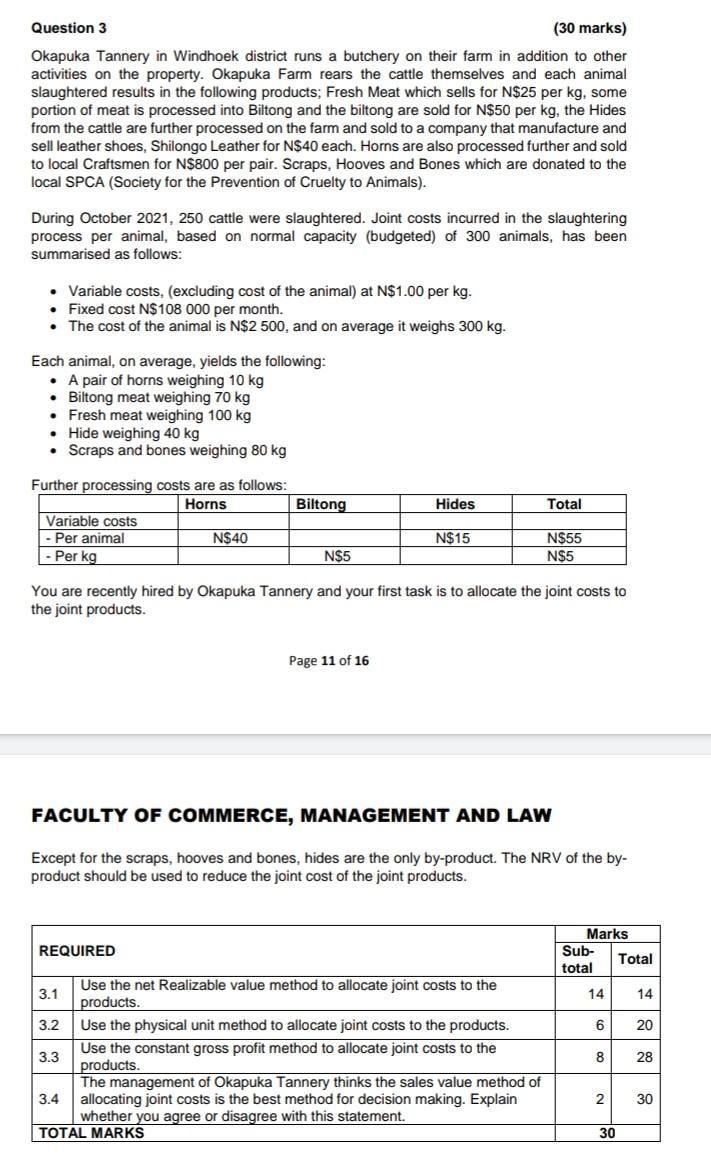
please help me with the correct answer to 3.1, 3.2 and 3.3. The answer below is wrong
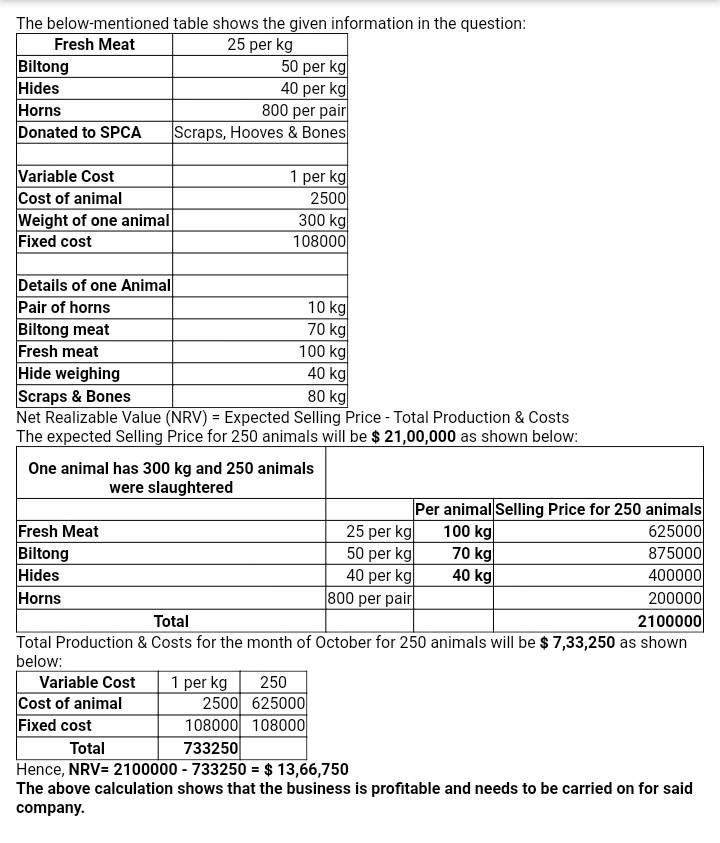
Question 3 (30 marks) Okapuka Tannery in Windhoek district runs a butchery on their farm in addition to other activities on the property. Okapuka Farm rears the cattle themselves and each animal slaughtered results in the following products; Fresh Meat which sells for N$25 per kg, some portion of meat is processed into Biltong and the biltong are sold for N$50 per kg, the Hides from the cattle are further processed on the farm and sold to a company that manufacture and sell leather shoes, Shilongo Leather for N$40 each. Horns are also processed further and sold to local Craftsmen for N$800 per pair. Scraps, Hooves and Bones which are donated to the local SPCA (Society for the Prevention of Cruelty to Animals). During October 2021, 250 cattle were slaughtered. Joint costs incurred in the slaughtering process per animal, based on normal capacity (budgeted) of 300 animals, has been summarised as follows: - Variable costs, (excluding cost of the animal) at N$1.00 per kg. - Fixed cost N\$108 000 per month. - The cost of the animal is N$2500, and on average it weighs 300kg. Each animal, on average, yields the following: - A pair of horns weighing 10kg - Biltong meat weighing 70kg - Fresh meat weighing 100kg - Hide weighing 40kg - Scraps and bones weighing 80kg Further processina costs are as follows: You are recently hired by Okapuka Tannery and your first task is to allocate the joint costs to the joint products. Page 11 of 16 FACULTY OF COMMERCE, MANAGEMENT AND LAW Except for the scraps, hooves and bones, hides are the only by-product. The NRV of the byproduct should be used to reduce the joint cost of the joint products. The below-mentioned table shows the aiven information in the question: Net Realizable Value (NRV) = Expected Selling Price Total Production \& Costs The expected Selling Price for 250 animals will be $21,00,000 as shown below: Total Production \& Costs for the month of October for 250 animals will be $7,33,250 as shown below: Hence, NRV =2100000733250=$13,66,750 The above calculation shows that the business is profitable and needs to be carried on for said company. Question 3 (30 marks) Okapuka Tannery in Windhoek district runs a butchery on their farm in addition to other activities on the property. Okapuka Farm rears the cattle themselves and each animal slaughtered results in the following products; Fresh Meat which sells for N$25 per kg, some portion of meat is processed into Biltong and the biltong are sold for N$50 per kg, the Hides from the cattle are further processed on the farm and sold to a company that manufacture and sell leather shoes, Shilongo Leather for N$40 each. Horns are also processed further and sold to local Craftsmen for N$800 per pair. Scraps, Hooves and Bones which are donated to the local SPCA (Society for the Prevention of Cruelty to Animals). During October 2021, 250 cattle were slaughtered. Joint costs incurred in the slaughtering process per animal, based on normal capacity (budgeted) of 300 animals, has been summarised as follows: - Variable costs, (excluding cost of the animal) at N$1.00 per kg. - Fixed cost N\$108 000 per month. - The cost of the animal is N$2500, and on average it weighs 300kg. Each animal, on average, yields the following: - A pair of horns weighing 10kg - Biltong meat weighing 70kg - Fresh meat weighing 100kg - Hide weighing 40kg - Scraps and bones weighing 80kg Further processina costs are as follows: You are recently hired by Okapuka Tannery and your first task is to allocate the joint costs to the joint products. Page 11 of 16 FACULTY OF COMMERCE, MANAGEMENT AND LAW Except for the scraps, hooves and bones, hides are the only by-product. The NRV of the byproduct should be used to reduce the joint cost of the joint products. The below-mentioned table shows the aiven information in the question: Net Realizable Value (NRV) = Expected Selling Price Total Production \& Costs The expected Selling Price for 250 animals will be $21,00,000 as shown below: Total Production \& Costs for the month of October for 250 animals will be $7,33,250 as shown below: Hence, NRV =2100000733250=$13,66,750 The above calculation shows that the business is profitable and needs to be carried on for said company
Step by Step Solution
There are 3 Steps involved in it

Get step-by-step solutions from verified subject matter experts
 Study Help