







Question: please help me with the first two questions Present Value of an Annuity Determine the present value of $110,000 to be received at the end
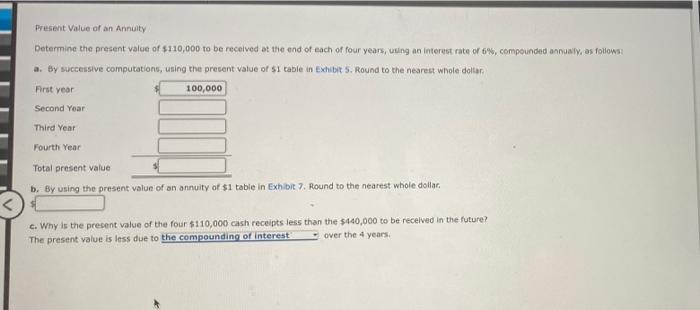
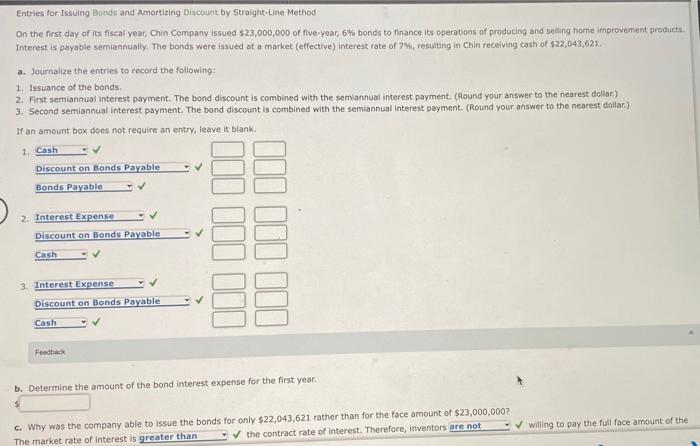
Present Value of an Annuity Determine the present value of $110,000 to be received at the end of each of four years, using an interest rate of 6%, compounded annually, as follows a. By successive computations, using the present value of Si table in Exhibit S. Round to the nearest whole dolan First year 100,000 Second Year Third Year Fourth Year Total present value b. By using the present value of an annuity of $1 table in Exhibit 7. Round to the nearest whole dollar c. Why is the present value of the four $110,000 cash receipts less than the $440,000 to be received in the future? The present value is less due to the compounding of interest over the 4 years Entries for Issuing Bonds and Amortizing Discount by Straight-Line Method On the first day of its fiscal year, Chin Company issued $23,000,000 of five-year, 6% bonds to finance its operations of producing and selling home improvement products, Interest is payable semiannually. The bonds were issued at a market (effective interest rate of 7%, resulting in Chin receiving cash of $22,043,621 a. Journalize the entries to record the following: 1. Issuance of the bonds. 2. First semiannual interest payment. The bond discount is combined with the semiannual interest payment. (Round your answer to the nearest dollar) 3. Second semiannual interest payment. The bond discount is combined with the semiannual interest payment. (Round your answer to the nearest dollar) If an amount box does not require an entry, leave it blank. 1. Cash Discount on Bonds Payable Bonds Payable 2. Interest Expense Discount on Bonds Payable Cash ul 111 3. Interest Expense Discount on Bonds Payable Cash Feedback b. Determine the amount of the bond interest expense for the first year. willing to pay the full face amount of the c. Why was the company able to issue the bonds for only $22,043,621 rather than for the face amount of $23,000,000? The market rate of interest is greater than the contract rate of interest. Therefore, inventors are not
Step by Step Solution
There are 3 Steps involved in it

Get step-by-step solutions from verified subject matter experts
 Study Help