Question: PLEASE HELP ME WITH THE FOLLOWING 2 question Question Al (CIO) (25 marks) Consider the following two articles about issues facing the Chief Information Officer
PLEASE HELP ME WITH THE FOLLOWING 2 question 
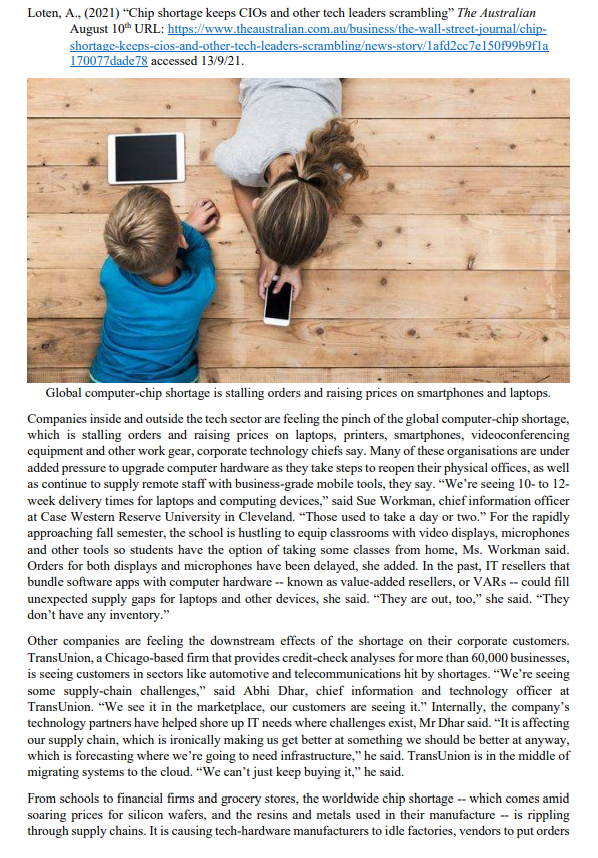
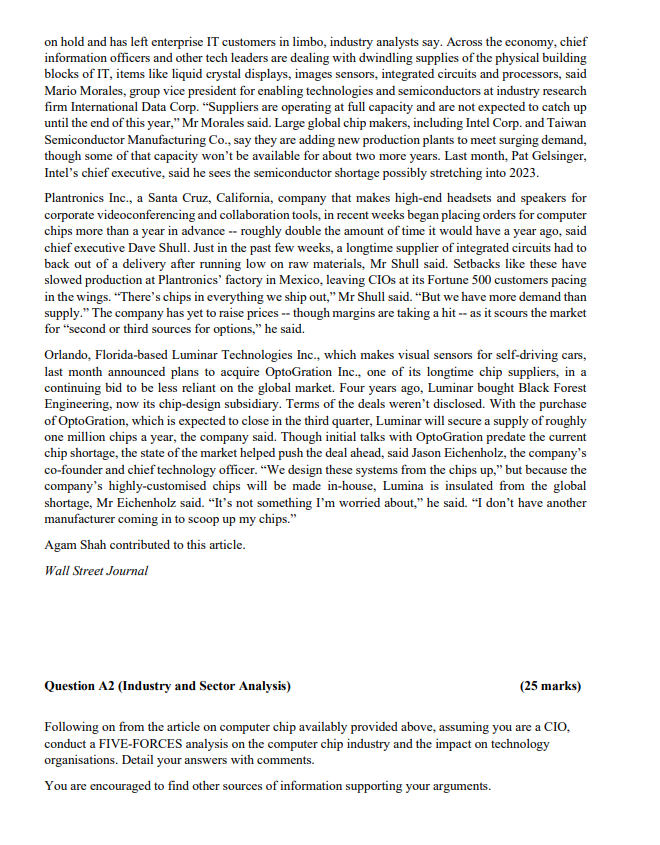
Question Al (CIO) (25 marks) Consider the following two articles about issues facing the Chief Information Officer (CIO). Conduct a PESTEL analysis on the issues CIOs currently face. Comment on the PESTEL factors you have selected. You may choose to focus on the computer chip industry specifically (as provided in the second article), or any other industry you are familiar with, regarding issues facing the role of the CIO today. You are encouraged to find other sources of information supporting your arguments. Fullerton, T., (2020) Lenovo's Matt Codrington sees CIOs in the hot seat as workplace heads home" The Australian December 13th URL: https://www.theaustralian.com.au/business/economics/ lenovos-matt-codrington-sees-cios-in-the-hot-seat-as-workplace-heads-homeews-story 71744d3ee975463cb48780a4db89c285b accessed 13/9/21. Lenovo ANZ managing director Matt Codrington at home in Neutral Bay in Sydney: 'Demands are much higher now. It's not just about technology.' Picture: Britta Campion Succession planning is the talk of the town over Christmas. Coincidentally, as boards wrestle with the required skill set for leadership in 2021, something else is happening across the C-suite: the rise and rise of the chief information officer. It is a phenomenon not lost on Matt Codrington. He runs the Australia and New Zealand operations for global tech giant Lenovo, the world's largest computer company with brands like ThinkPad and these days offering just about everything you can think of as a service" for customers. If I talk to one of the large banks here, they consider themselves a fintech company. So the view on the businesses, you look at Uber, Airbnb or the changing landscape around the disruption that happens, I think it's inevitable that either CIO becomes the chief executive officer or the CEO becomes the CIO." Traditionally, the chief financial officer has been the obvious internal candidate for CEO but thanks to COVID, working from home and data protection demands, the reliance that business now has on technology is fundamental. For months, most businesses have been in damage control. I don't think they've had a moment to think. It's just been let's go," Codrington says as he clicks his fingers. It doesn't matter if it's the largest government agency or a corner shop." Standing an imposing six foot four (1.93m), Codrington has 13 years under his belt with Lenovo starting in Singapore, then Japan and Australia, helping to transform a computer business into a consumer-centric tech business. This year, he has been on the front line with CIOs shirtfronted by pandemic disruption. He laughs and shakes his head when asked to explain what the acceleration in technology has been like for the average CIO. "Demands are much higher now. It's not just about the provision of technology. It's about 'we need to run the business now in this digital space, so what do we do about that? What are your ideas about that, the rapid move to online, or how we manage our supply chain? When the order came down to CIOs to transition the entire workforce to the home almost overnight, what made the task Herculean was not just the scaling, the deployment and remoteness. It was that the core of the business, the systems and the data, had to remain secure. "That's not always a simple thing to do says Codrington. "There are tools out there, there are ways to do it, but most businesses are bespoke with the systems they have and the way they interact. A recent Lenovo study found that technology was high anxiety for Aussies working from home. Two in three admitted using their personal devices simply because it was easier or their work device was not up to scratch with enough tech support; three in 10 said they did it all the time. The CIO then needs to make sure that they have a mitigation strategy for that," he says. I think they would tell you they prefer to use the platforms that are tried and tested and there is good reason for that of course, but working from home is with us now. We need to make sure we are also catering for that or at least considering what we do." Demand for technology products and solutions has skyrocketed and inevitably, rising costs and how to manage them are what keeps the CIO awake at night. This pressure point is where Codrington is focused. "If I could, I would get double the product I can now, but I can't. What I want to do is make it meaningful. It's not a social responsibility, but it is kind of like a social responsibility," he pitches. We want to make sure that we are utilising the technology in the best way to deliver the best outcome for the most people. The way forward, says Codrington, is for business to shift the technology spend from capital expenditure to operating expenditure. The buzz acronym is no longer SaaS, software as a service, but XaaS - everything as a service, built around the customer on an as-needs basis, from the leasing of devices to tech support and data protection. We now have an opportunity to deliver the product where it is a subscription model where they can take a bite of as much as they need, explains Codrington. We are also one of the only players in the market that has flexibility built into that. Some of our competition do not have that. You can flex up and down." Given the lack of clarity around where we all land on the working-from-home experiment, Codrington sees this flexibility as highly valuable to a CIO. We work with a large consulting firm and every year they have 900 graduates coming to their business and at the end of that there are probably 100 who stay and so they have this spike in their business that they need to cater for. You can have an employee finish and from that day we are not charging for that product until it's activated again. So it is a real consumption model." Considering how many Australians use Lenovo products and services daily, its corporate profile is low. As a multinational, Lenovo is a remarkable mix of east and west, starting in China building PCs in the 1990s but in 2005 buying IBM's PC business and expanding by acquisition into software, cloud, smart phones and data centres. Incorporated in Hong Kong, Lenovo has its global headquarters in Beijing, operational headquarters in North Carolina and a president based in Milan where the company's first concept store opened in September. It was Matt Codrington in Australia and New Zealand who in the last two years has pioneered the idea of shifting business customers from a capital expenditure to operating expenditure model. In part, it is because companies here continue to lead the way in early adoption of technology: the cloud, virtualisation, or consumption as a service. "That's got nothing to do with Lenovo - that's the nature of the market and so I intend to be at the cutting edge of our corporate strategy where I'm implementing these new ideas in this region far before India or Japan or Hong Kong," says Codrington. Several major customers are now on board. These are large tax consulting firms that have validated the model as the right opex model, the right way they account for their spend. So we have got that validation, and now this is expanding globally." That said, the balance of capex and opex in a company has always been a call for the chief financial officer. Yet as the CIO emerges from the back office, Codrington says the relationship is different. Traditionally the CFO has held the purse strings; we all know that. They have been involved with decisions, validated those decisions, they have had people present to them about the business case and so on, but it is changing now. Although the CIO has interacted with the CFO it's been more technology supporting the business. But in my mind, now it is driving the business, so there's a lot more influence there, a lot more responsibility. So as they work together, it is probably much more hand in hand. For both roles, job descriptions are changing. While there is constant talk about upskilling, Codrington says those in most need are not the young digital natives starting careers, but the C-suite in management and particularly the CFO. Upskilling is very, very important for the leadership team because it broadens their lens on what is possible, how you understand the digital landscape and what do you do about it." For the CIO, Codrington argues that a much bigger mandate awaits, one that demands a far better understanding of the business at large. Editor-at-large, The Australian Business Review Ticky Fullerton is one of Australia's most experienced commentators and journalists. She was previously Sky News Business Editor and co-anchor of Business Weekend on Sky News Australia. She has worked as an investigative reporter with Four Corners, as a political reporter in Canberra and also as presenter for the national farming program, Landline. Loten, A., (2021) "Chip shortage keeps CIOs and other tech leaders scrambling" The Australian August 10h URL: https://www.theaustralian.com.au/business/the-wall-street-journal/chip- shortage-keeps-cios-and-other-tech-leaders-scramblingews-story/lafd2cc7e150f99b9fla 170077dade 78 accessed 13/9/21. Global computer-chip shortage is stalling orders and raising prices on smartphones and laptops. Companies inside and outside the tech sector are feeling the pinch of the global computer-chip shortage, which is stalling orders and raising prices on laptops, printers, smartphones, videoconferencing equipment and other work gear, corporate technology chiefs say. Many of these organisations are under added pressure to upgrade computer hardware as they take steps to reopen their physical offices, as well as continue to supply remote staff with business-grade mobile tools, they say. "We're seeing 10-to 12- week delivery times for laptops and computing devices," said Sue Workman, chief information officer at Case Western Reserve University in Cleveland. Those used to take a day or two." For the rapidly approaching fall semester, the school is hustling to equip classrooms with video displays, microphones and other tools so students have the option of taking some classes from home, Ms. Workman said. Orders for both displays and microphones have been delayed, she added. In the past, IT resellers that bundle software apps with computer hardware -- known as value-added resellers, or VARs -- could fill unexpected supply gaps for laptops and other devices, she said. They are out, too," she said. They don't have any inventory." Other companies are feeling the downstream effects of the shortage on their corporate customers. TransUnion, a Chicago-based firm that provides credit check analyses for more than 60,000 businesses, is seeing customers in sectors like automotive and telecommunications hit by shortages. We're seeing some supply-chain challenges, said Abhi Dhar, chief information and technology officer at TransUnion. We see it in the marketplace, our customers are seeing it. Internally, the company's technology partners have helped shore up IT needs where challenges exist, Mr Dhar said. It is affecting our supply chain, which is ironically making us get better at something we should be better at anyway, which is forecasting where we're going to need infrastructure," he said. TransUnion is in the middle of migrating systems to the cloud. "We can't just keep buying it," he said. From schools to financial firms and grocery stores, the worldwide chip shortage -- which comes amid soaring prices for silicon wafers, and the resins and metals used in their manufacture -- is rippling through supply chains. It is causing tech-hardware manufacturers to idle factories, vendors to put orders on hold and has left enterprise IT customers in limbo, industry analysts say. Across the economy, chief information officers and other tech leaders are dealing with dwindling supplies of the physical building blocks of IT, items like liquid crystal displays, images sensors, integrated circuits and processors, said Mario Morales, group vice president for enabling technologies and semiconductors at industry research firm International Data Corp. "Suppliers are operating at full capacity and are not expected to catch up until the end of this year," Mr Morales said. Large global chip makers, including Intel Corp. and Taiwan Semiconductor Manufacturing Co., say they are adding new production plants to meet surging demand, though some of that capacity won't be available for about two more years. Last month, Pat Gelsinger, Intel's chief executive, said he sees the semiconductor shortage possibly stretching into 2023. Plantronics Inc., a Santa Cruz, California, company that makes high-end headsets and speakers for corporate videoconferencing and collaboration tools, in recent weeks began placing orders for computer chips more than a year in advance -- roughly double the amount of time it would have a year ago, said chief executive Dave Shull. Just in the past few weeks, a longtime supplier of integrated circuits had to back out of a delivery after running low on raw materials, Mr Shull said. Setbacks like these have slowed production at Plantronics' factory in Mexico, leaving CIOs at its Fortune 500 customers pacing in the wings. There's chips in everything we ship out," Mr Shull said. But we have more demand than supply." The company has yet to raise prices -- though margins are taking a hit -- as it scours the market for second or third sources for options," he said. Orlando, Florida-based Luminar Technologies Inc., which makes visual sensors for self-driving cars, last month announced plans to acquire OptoGration Inc., one of its longtime chip suppliers, in a continuing bid to be less reliant on the global market. Four years ago, Luminar bought Black Forest Engineering, now its chip-design subsidiary. Terms of the deals weren't disclosed. With the purchase of OptoGration, which is expected to close in the third quarter, Luminar will secure a supply of roughly one million chips a year, the company said. Though initial talks with OptoGration predate the current chip shortage, the state of the market helped push the deal ahead, said Jason Eichenholz, the company's co-founder and chief technology officer. We design these systems from the chips up," but because the company's highly-customised chips will be made in-house, Lumina is insulated from the global shortage, Mr Eichenholz said. It's not something I'm worried about," he said. "I don't have another manufacturer coming in to scoop up my chips." Agam Shah contributed to this article. Wall Street Journal Question A2 (Industry and Sector Analysis) (25 marks) Following on from the article on computer chip availably provided above, assuming you are a CIO, conduct a FIVE-FORCES analysis on the computer chip industry and the impact on technology organisations. Detail your answers with comments. You are encouraged to find other sources of information supporting your arguments. Question Al (CIO) (25 marks) Consider the following two articles about issues facing the Chief Information Officer (CIO). Conduct a PESTEL analysis on the issues CIOs currently face. Comment on the PESTEL factors you have selected. You may choose to focus on the computer chip industry specifically (as provided in the second article), or any other industry you are familiar with, regarding issues facing the role of the CIO today. You are encouraged to find other sources of information supporting your arguments. Fullerton, T., (2020) Lenovo's Matt Codrington sees CIOs in the hot seat as workplace heads home" The Australian December 13th URL: https://www.theaustralian.com.au/business/economics/ lenovos-matt-codrington-sees-cios-in-the-hot-seat-as-workplace-heads-homeews-story 71744d3ee975463cb48780a4db89c285b accessed 13/9/21. Lenovo ANZ managing director Matt Codrington at home in Neutral Bay in Sydney: 'Demands are much higher now. It's not just about technology.' Picture: Britta Campion Succession planning is the talk of the town over Christmas. Coincidentally, as boards wrestle with the required skill set for leadership in 2021, something else is happening across the C-suite: the rise and rise of the chief information officer. It is a phenomenon not lost on Matt Codrington. He runs the Australia and New Zealand operations for global tech giant Lenovo, the world's largest computer company with brands like ThinkPad and these days offering just about everything you can think of as a service" for customers. If I talk to one of the large banks here, they consider themselves a fintech company. So the view on the businesses, you look at Uber, Airbnb or the changing landscape around the disruption that happens, I think it's inevitable that either CIO becomes the chief executive officer or the CEO becomes the CIO." Traditionally, the chief financial officer has been the obvious internal candidate for CEO but thanks to COVID, working from home and data protection demands, the reliance that business now has on technology is fundamental. For months, most businesses have been in damage control. I don't think they've had a moment to think. It's just been let's go," Codrington says as he clicks his fingers. It doesn't matter if it's the largest government agency or a corner shop." Standing an imposing six foot four (1.93m), Codrington has 13 years under his belt with Lenovo starting in Singapore, then Japan and Australia, helping to transform a computer business into a consumer-centric tech business. This year, he has been on the front line with CIOs shirtfronted by pandemic disruption. He laughs and shakes his head when asked to explain what the acceleration in technology has been like for the average CIO. "Demands are much higher now. It's not just about the provision of technology. It's about 'we need to run the business now in this digital space, so what do we do about that? What are your ideas about that, the rapid move to online, or how we manage our supply chain? When the order came down to CIOs to transition the entire workforce to the home almost overnight, what made the task Herculean was not just the scaling, the deployment and remoteness. It was that the core of the business, the systems and the data, had to remain secure. "That's not always a simple thing to do says Codrington. "There are tools out there, there are ways to do it, but most businesses are bespoke with the systems they have and the way they interact. A recent Lenovo study found that technology was high anxiety for Aussies working from home. Two in three admitted using their personal devices simply because it was easier or their work device was not up to scratch with enough tech support; three in 10 said they did it all the time. The CIO then needs to make sure that they have a mitigation strategy for that," he says. I think they would tell you they prefer to use the platforms that are tried and tested and there is good reason for that of course, but working from home is with us now. We need to make sure we are also catering for that or at least considering what we do." Demand for technology products and solutions has skyrocketed and inevitably, rising costs and how to manage them are what keeps the CIO awake at night. This pressure point is where Codrington is focused. "If I could, I would get double the product I can now, but I can't. What I want to do is make it meaningful. It's not a social responsibility, but it is kind of like a social responsibility," he pitches. We want to make sure that we are utilising the technology in the best way to deliver the best outcome for the most people. The way forward, says Codrington, is for business to shift the technology spend from capital expenditure to operating expenditure. The buzz acronym is no longer SaaS, software as a service, but XaaS - everything as a service, built around the customer on an as-needs basis, from the leasing of devices to tech support and data protection. We now have an opportunity to deliver the product where it is a subscription model where they can take a bite of as much as they need, explains Codrington. We are also one of the only players in the market that has flexibility built into that. Some of our competition do not have that. You can flex up and down." Given the lack of clarity around where we all land on the working-from-home experiment, Codrington sees this flexibility as highly valuable to a CIO. We work with a large consulting firm and every year they have 900 graduates coming to their business and at the end of that there are probably 100 who stay and so they have this spike in their business that they need to cater for. You can have an employee finish and from that day we are not charging for that product until it's activated again. So it is a real consumption model." Considering how many Australians use Lenovo products and services daily, its corporate profile is low. As a multinational, Lenovo is a remarkable mix of east and west, starting in China building PCs in the 1990s but in 2005 buying IBM's PC business and expanding by acquisition into software, cloud, smart phones and data centres. Incorporated in Hong Kong, Lenovo has its global headquarters in Beijing, operational headquarters in North Carolina and a president based in Milan where the company's first concept store opened in September. It was Matt Codrington in Australia and New Zealand who in the last two years has pioneered the idea of shifting business customers from a capital expenditure to operating expenditure model. In part, it is because companies here continue to lead the way in early adoption of technology: the cloud, virtualisation, or consumption as a service. "That's got nothing to do with Lenovo - that's the nature of the market and so I intend to be at the cutting edge of our corporate strategy where I'm implementing these new ideas in this region far before India or Japan or Hong Kong," says Codrington. Several major customers are now on board. These are large tax consulting firms that have validated the model as the right opex model, the right way they account for their spend. So we have got that validation, and now this is expanding globally." That said, the balance of capex and opex in a company has always been a call for the chief financial officer. Yet as the CIO emerges from the back office, Codrington says the relationship is different. Traditionally the CFO has held the purse strings; we all know that. They have been involved with decisions, validated those decisions, they have had people present to them about the business case and so on, but it is changing now. Although the CIO has interacted with the CFO it's been more technology supporting the business. But in my mind, now it is driving the business, so there's a lot more influence there, a lot more responsibility. So as they work together, it is probably much more hand in hand. For both roles, job descriptions are changing. While there is constant talk about upskilling, Codrington says those in most need are not the young digital natives starting careers, but the C-suite in management and particularly the CFO. Upskilling is very, very important for the leadership team because it broadens their lens on what is possible, how you understand the digital landscape and what do you do about it." For the CIO, Codrington argues that a much bigger mandate awaits, one that demands a far better understanding of the business at large. Editor-at-large, The Australian Business Review Ticky Fullerton is one of Australia's most experienced commentators and journalists. She was previously Sky News Business Editor and co-anchor of Business Weekend on Sky News Australia. She has worked as an investigative reporter with Four Corners, as a political reporter in Canberra and also as presenter for the national farming program, Landline. Loten, A., (2021) "Chip shortage keeps CIOs and other tech leaders scrambling" The Australian August 10h URL: https://www.theaustralian.com.au/business/the-wall-street-journal/chip- shortage-keeps-cios-and-other-tech-leaders-scramblingews-story/lafd2cc7e150f99b9fla 170077dade 78 accessed 13/9/21. Global computer-chip shortage is stalling orders and raising prices on smartphones and laptops. Companies inside and outside the tech sector are feeling the pinch of the global computer-chip shortage, which is stalling orders and raising prices on laptops, printers, smartphones, videoconferencing equipment and other work gear, corporate technology chiefs say. Many of these organisations are under added pressure to upgrade computer hardware as they take steps to reopen their physical offices, as well as continue to supply remote staff with business-grade mobile tools, they say. "We're seeing 10-to 12- week delivery times for laptops and computing devices," said Sue Workman, chief information officer at Case Western Reserve University in Cleveland. Those used to take a day or two." For the rapidly approaching fall semester, the school is hustling to equip classrooms with video displays, microphones and other tools so students have the option of taking some classes from home, Ms. Workman said. Orders for both displays and microphones have been delayed, she added. In the past, IT resellers that bundle software apps with computer hardware -- known as value-added resellers, or VARs -- could fill unexpected supply gaps for laptops and other devices, she said. They are out, too," she said. They don't have any inventory." Other companies are feeling the downstream effects of the shortage on their corporate customers. TransUnion, a Chicago-based firm that provides credit check analyses for more than 60,000 businesses, is seeing customers in sectors like automotive and telecommunications hit by shortages. We're seeing some supply-chain challenges, said Abhi Dhar, chief information and technology officer at TransUnion. We see it in the marketplace, our customers are seeing it. Internally, the company's technology partners have helped shore up IT needs where challenges exist, Mr Dhar said. It is affecting our supply chain, which is ironically making us get better at something we should be better at anyway, which is forecasting where we're going to need infrastructure," he said. TransUnion is in the middle of migrating systems to the cloud. "We can't just keep buying it," he said. From schools to financial firms and grocery stores, the worldwide chip shortage -- which comes amid soaring prices for silicon wafers, and the resins and metals used in their manufacture -- is rippling through supply chains. It is causing tech-hardware manufacturers to idle factories, vendors to put orders on hold and has left enterprise IT customers in limbo, industry analysts say. Across the economy, chief information officers and other tech leaders are dealing with dwindling supplies of the physical building blocks of IT, items like liquid crystal displays, images sensors, integrated circuits and processors, said Mario Morales, group vice president for enabling technologies and semiconductors at industry research firm International Data Corp. "Suppliers are operating at full capacity and are not expected to catch up until the end of this year," Mr Morales said. Large global chip makers, including Intel Corp. and Taiwan Semiconductor Manufacturing Co., say they are adding new production plants to meet surging demand, though some of that capacity won't be available for about two more years. Last month, Pat Gelsinger, Intel's chief executive, said he sees the semiconductor shortage possibly stretching into 2023. Plantronics Inc., a Santa Cruz, California, company that makes high-end headsets and speakers for corporate videoconferencing and collaboration tools, in recent weeks began placing orders for computer chips more than a year in advance -- roughly double the amount of time it would have a year ago, said chief executive Dave Shull. Just in the past few weeks, a longtime supplier of integrated circuits had to back out of a delivery after running low on raw materials, Mr Shull said. Setbacks like these have slowed production at Plantronics' factory in Mexico, leaving CIOs at its Fortune 500 customers pacing in the wings. There's chips in everything we ship out," Mr Shull said. But we have more demand than supply." The company has yet to raise prices -- though margins are taking a hit -- as it scours the market for second or third sources for options," he said. Orlando, Florida-based Luminar Technologies Inc., which makes visual sensors for self-driving cars, last month announced plans to acquire OptoGration Inc., one of its longtime chip suppliers, in a continuing bid to be less reliant on the global market. Four years ago, Luminar bought Black Forest Engineering, now its chip-design subsidiary. Terms of the deals weren't disclosed. With the purchase of OptoGration, which is expected to close in the third quarter, Luminar will secure a supply of roughly one million chips a year, the company said. Though initial talks with OptoGration predate the current chip shortage, the state of the market helped push the deal ahead, said Jason Eichenholz, the company's co-founder and chief technology officer. We design these systems from the chips up," but because the company's highly-customised chips will be made in-house, Lumina is insulated from the global shortage, Mr Eichenholz said. It's not something I'm worried about," he said. "I don't have another manufacturer coming in to scoop up my chips." Agam Shah contributed to this article. Wall Street Journal Question A2 (Industry and Sector Analysis) (25 marks) Following on from the article on computer chip availably provided above, assuming you are a CIO, conduct a FIVE-FORCES analysis on the computer chip industry and the impact on technology organisations. Detail your answers with comments. You are encouraged to find other sources of information supporting your arguments









 Study Help