Question: Please help me with the following assignment I don't know how to started. Please help --- YOU CAN MAKE YOUR OWN PRODUCT PROPOSAL BECAUSE I
Please help me with the following assignment I don't know how to started. Please help
--- YOU CAN MAKE YOUR OWN PRODUCT PROPOSAL BECAUSE I JUST WANT THIS AS AN EXAMPLE TO HELP ME OFF WITH STARTING---
THANK YOU,
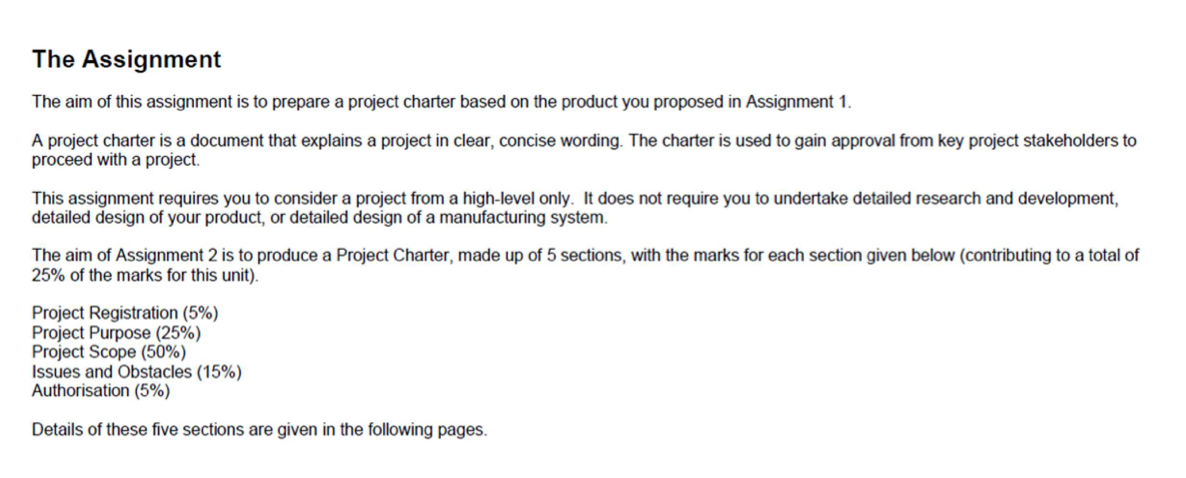
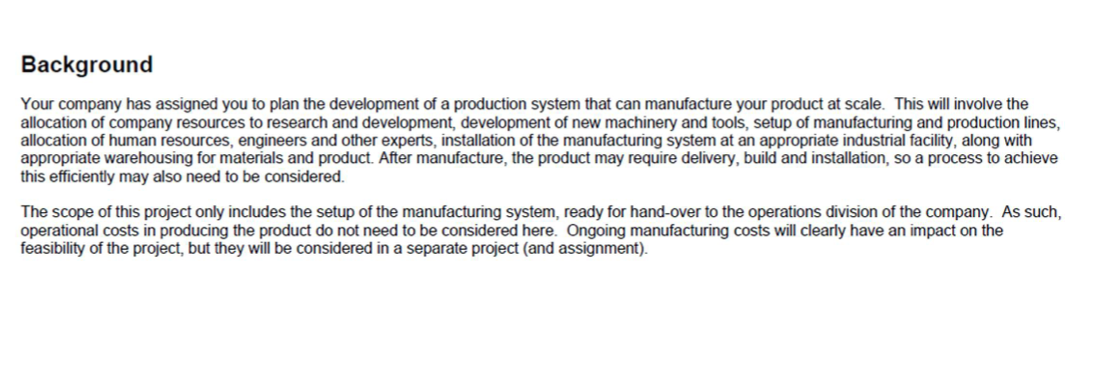
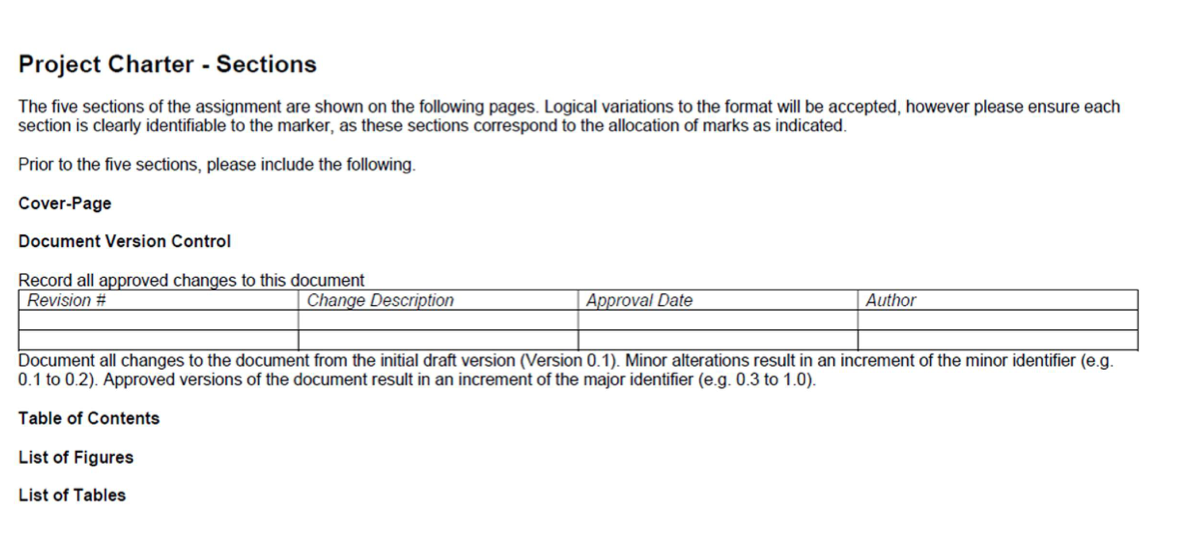
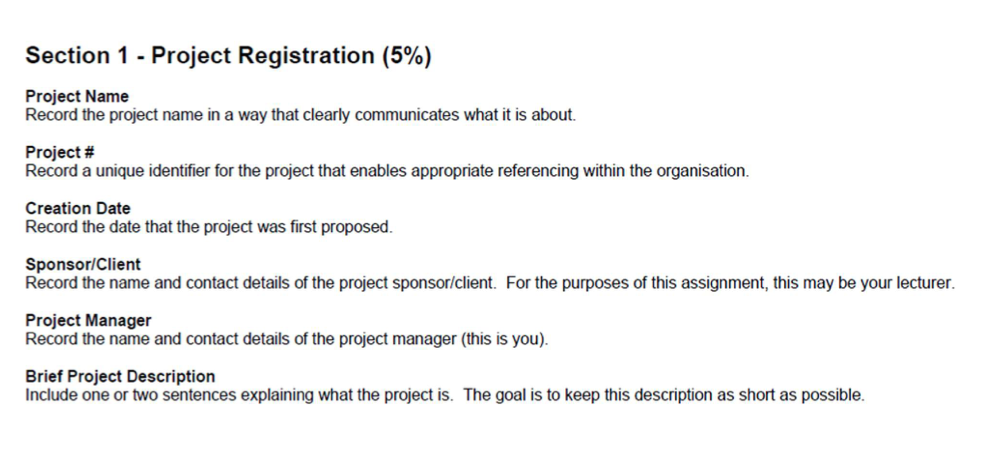
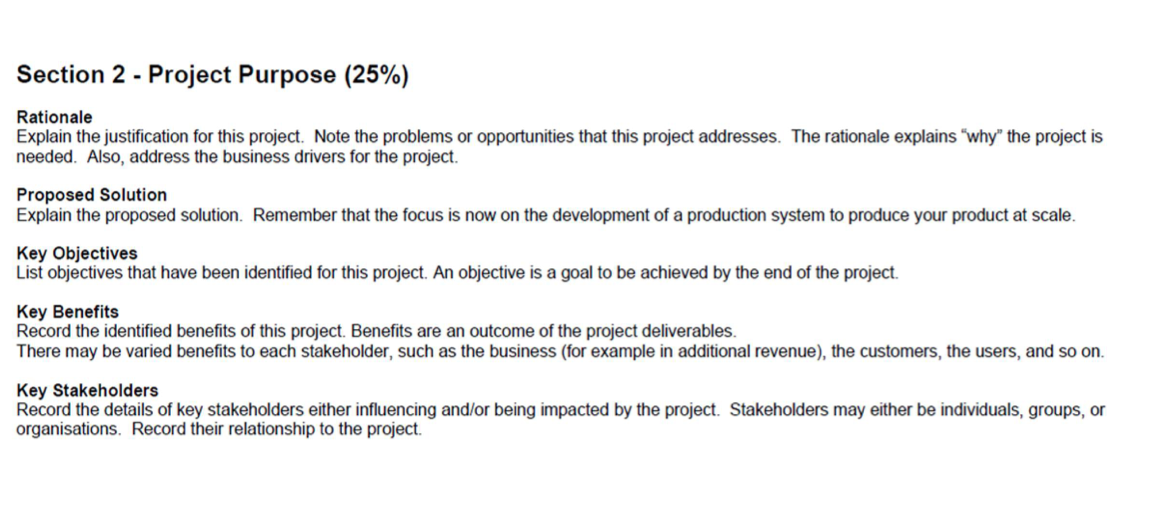
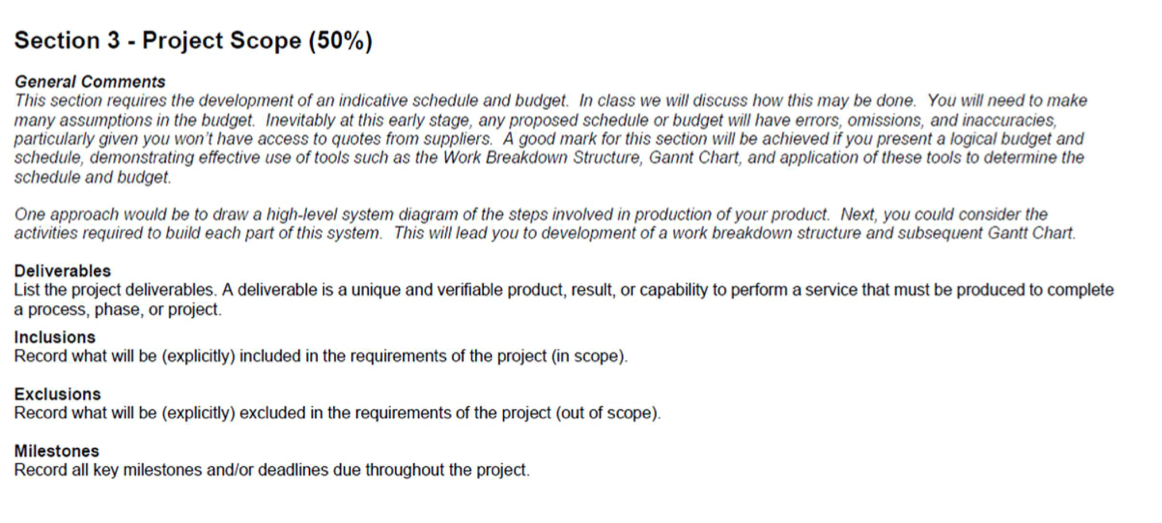
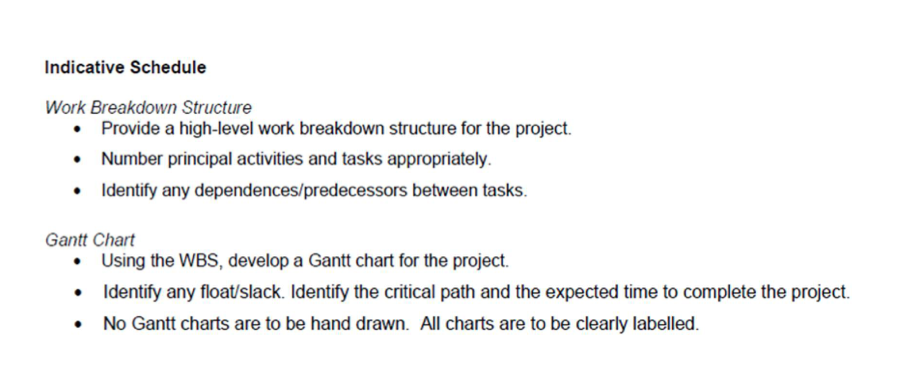
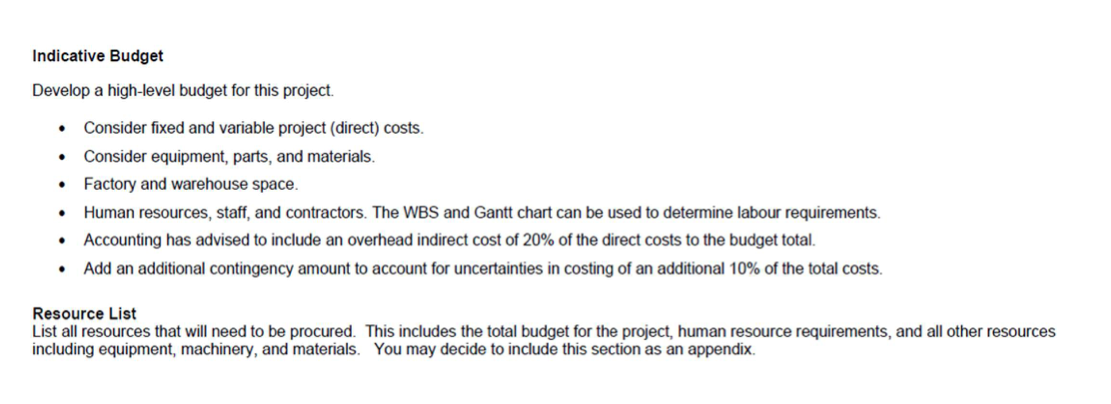
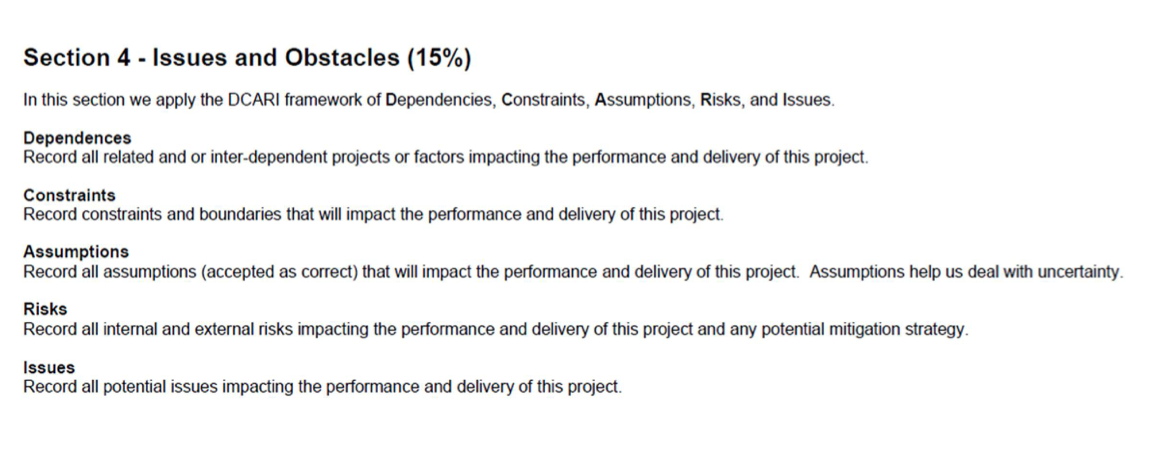
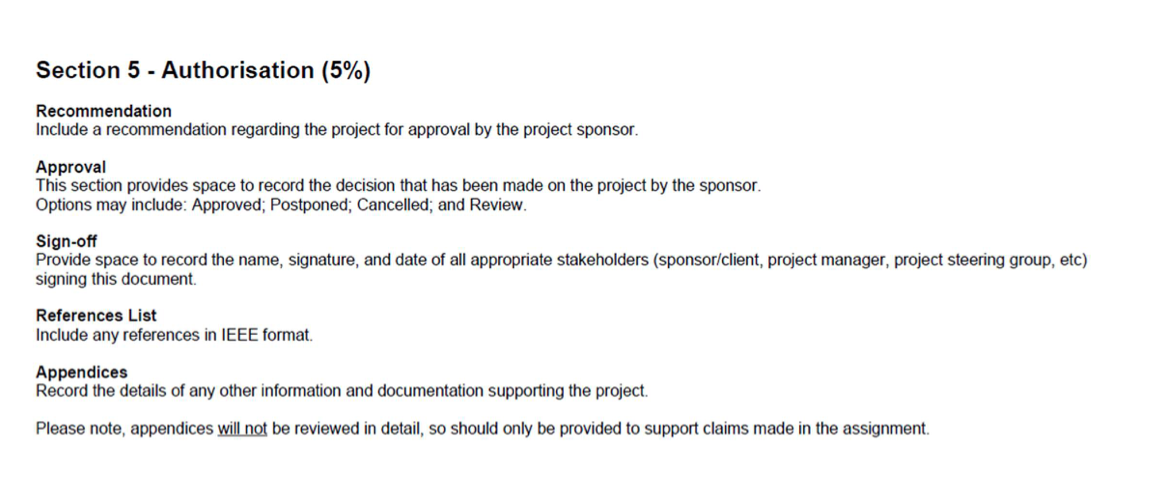
The Assignment The aim of this assignment is to prepare a project charter based on the product you proposed in Assignment 1. A project charter is a document that explains a project in clear, concise wording. The charter is used to gain approval from key project stakeholders to proceed with a project. This assignment requires you to consider a project from a high-level only. It does not require you to undertake detailed research and development, detailed design of your product, or detailed design of a manufacturing system. The aim of Assignment 2 is to produce a Project Charter, made up of 5 sections, with the marks for each section given below (contributing to a total of 25% of the marks for this unit) Project Registration (5%) Project Purpose (25%) Project Scope (50%) Issues and Obstacles (15%) Authorisation (5%) Details of these five sections are given in the following pages. Background Your company has assigned you to plan the development of a production system that can manufacture your product at scale. This will involve the allocation of company resources to research and development, development of new machinery and tools, setup of manufacturing and production lines, allocation of human resources, engineers and other experts, installation of the manufacturing system at an appropriate industrial facility, along with appropriate warehousing for materials and product. After manufacture, the product may require delivery, build and installation, so a process to achieve this efficiently may also need to be considered. The scope of this project only includes the setup of the manufacturing system, ready for hand-over to the operations division of the company. As such, operational costs in producing the product do not need to be considered here. Ongoing manufacturing costs will clearly have an impact on the feasibility of the project, but they will be considered in a separate project and assignment). Project Charter - Sections The five sections of the assignment are shown on the following pages. Logical variations to the format will be accepted, however please ensure each section is clearly identifiable to the marker, as these sections correspond to the allocation of marks as indicated. Prior to the five sections, please include the following. Cover-Page Document Version Control Record all approved changes to this document Revision # Change Description Approval Date Author Document all changes to the document from the initial draft version (Version 0.1). Minor alterations result in an increment of the minor identifier (e.g. 0.1 to 0.2). Approved versions of the document result in an increment of the major identifier (e.g. 0.3 to 1.0). Table of Contents List of Figures List of Tables Section 1 - Project Registration (5%) Project Name Record the project name in a way that clearly communicates what it is about. Project # Record a unique identifier for the project that enables appropriate referencing within the organisation. Creation Date Record the date that the project was first proposed. Sponsor/Client Record the name and contact details of the project sponsor/client. For the purposes of this assignment, this may be your lecturer. Project Manager Record the name and contact details of the project manager (this is you) Brief Project Description Include one or two sentences explaining what the project is. The goal is to keep this description as short as possible. Section 2 - Project Purpose (25%) Rationale Explain the justification for this project. Note the problems or opportunities that this project addresses. The rationale explains why" the project is needed. Also, address the business drivers for the project. Proposed Solution Explain the proposed solution. Remember that the focus is now on the development of a production system to produce your product at scale. Key Objectives List objectives that have been identified for this project. An objective is a goal to be achieved by the end of the project. Key Benefits Record the identified benefits of this project. Benefits are an outcome of the project deliverables. There may be varied benefits to each stakeholder, such as the business (for example in additional revenue), the customers, the users, and so on. Key Stakeholders Record the details of key stakeholders either influencing and/or being impacted by the project. Stakeholders may either be individuals, groups, or organisations. Record their relationship to the project. Section 3 - Project Scope (50%) General Comments This section requires the development of an indicative schedule and budget. In class we will discuss how this may be done. You will need to make many assumptions in the budget. Inevitably at this early stage, any proposed schedule or budget will have errors, omissions, and inaccuracies, particularly given you won't have access to quotes from suppliers. A good mark for this section will be achieved if you present a logical budget and schedule, demonstrating effective use of tools such as the Work Breakdown Structure, Gannt Chart, and application of these tools to determine the schedule and budget. One approach would be to draw a high-level system diagram of the steps involved in production of your product. Next, you could consider the activities required to build each part of this system. This will lead you to development of a work breakdown structure and subsequent Gantt Chart. Deliverables List the project deliverables. A deliverable is a unique and verifiable product, result, or capability to perform a service that must be produced to complete a process, phase, or project. Inclusions Record what will be (explicitly) included in the requirements of the project (in scope). Exclusions Record what will be (explicitly) excluded in the requirements of the project (out of scope). Milestones Record all key milestones and/or deadlines due throughout the project. Indicative Schedule Work Breakdown Structure Provide a high-level work breakdown structure for the project. Number principal activities and tasks appropriately. Identify any dependences/predecessors between tasks. Gantt Chart Using the WBS, develop a Gantt chart for the project. Identify any float/slack. Identify the critical path and the expected time to complete the project. No Gantt charts are to be hand drawn. All charts are to be clearly labelled. . Indicative Budget Develop a high-level budget for this project. . . Consider fixed and variable project direct) costs. Consider equipment, parts, and materials. Factory and warehouse space. Human resources, staff, and contractors. The WBS and Gantt chart can be used to determine labour requirements. Accounting has advised to include an overhead indirect cost of 20% of the direct costs to the budget total. Add an additional contingency amount to account for uncertainties in costing of an additional 10% of the total costs. . . . Resource List List all resources that will need to be procured. This includes the total budget for the project, human resource requirements, and all other resources including equipment, machinery, and materials. You may decide to include this section as an appendix. Section 4 - Issues and Obstacles (15%) In this section we apply the DCARI framework of Dependencies, Constraints, Assumptions, Risks, and Issues. Dependences Record all related and or inter-dependent projects or factors impacting the performance and delivery of this project. Constraints Record constraints and boundaries that will impact the performance and delivery of this project. Assumptions Record all assumptions (accepted as correct) that will impact the performance and delivery of this project. Assumptions help us deal with uncertainty. Risks Record all internal and external risks impacting the performance and delivery of this project and any potential mitigation strategy. Issues Record all potential issues impacting the performance and delivery of this project. Section 5 - Authorisation (5%) Recommendation Include a recommendation regarding the project for approval by the project sponsor. Approval This section provides space to record the decision that has been made on the project by the sponsor. Options may include: Approved, Postponed; Cancelled; and Review. Sign-off Provide space to record the name, signature, and date of all appropriate stakeholders (sponsor/client, project manager, project steering group, etc) signing this document. References List Include any references in IEEE format. Appendices Record the details of any other information and documentation supporting the project. Please note, appendices will not be reviewed in detail, so should only be provided to support claims made in the assignment









 Study Help