Question: Please help me with the following Project Management question regarding bottom-up estimating approach. You have been asked to estimate a project budget by using the

Please help me with the following Project Management question regarding bottom-up estimating approach.
Please help me with the following ProjectPlease help me with the following ProjectPlease help me with the following Project

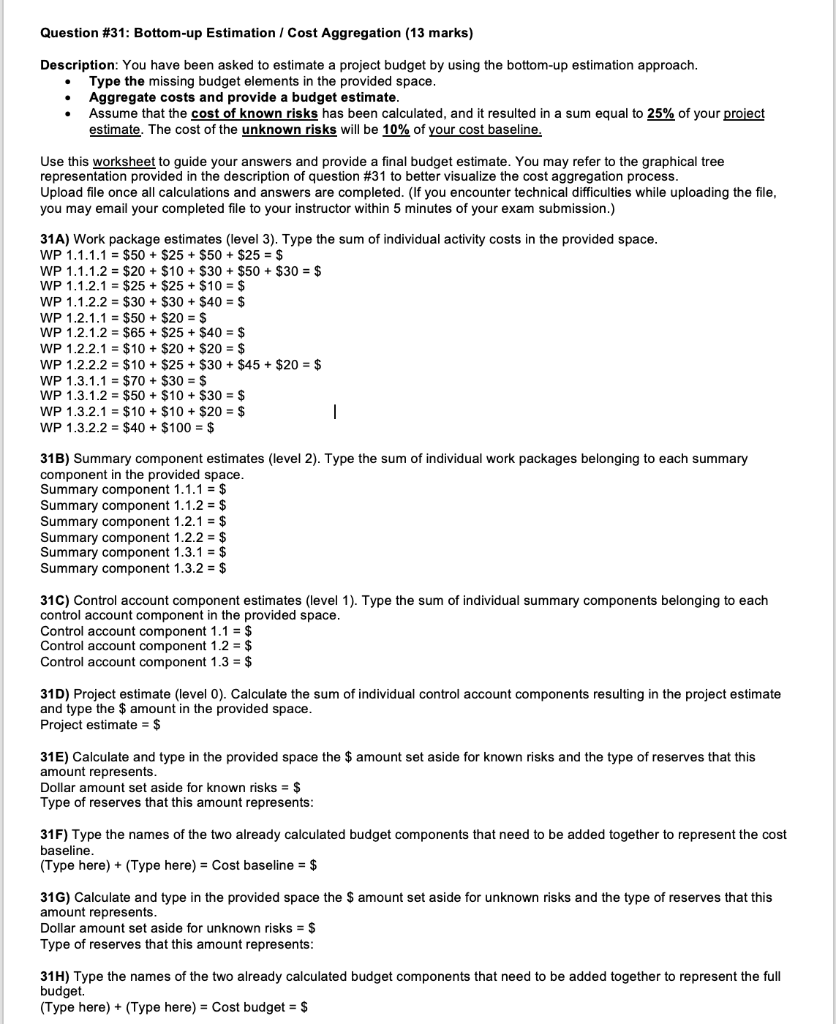
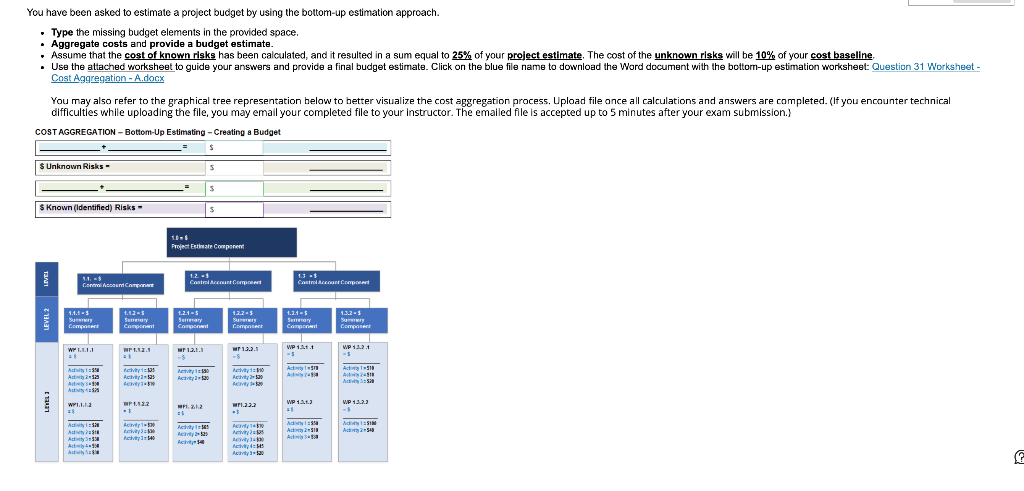
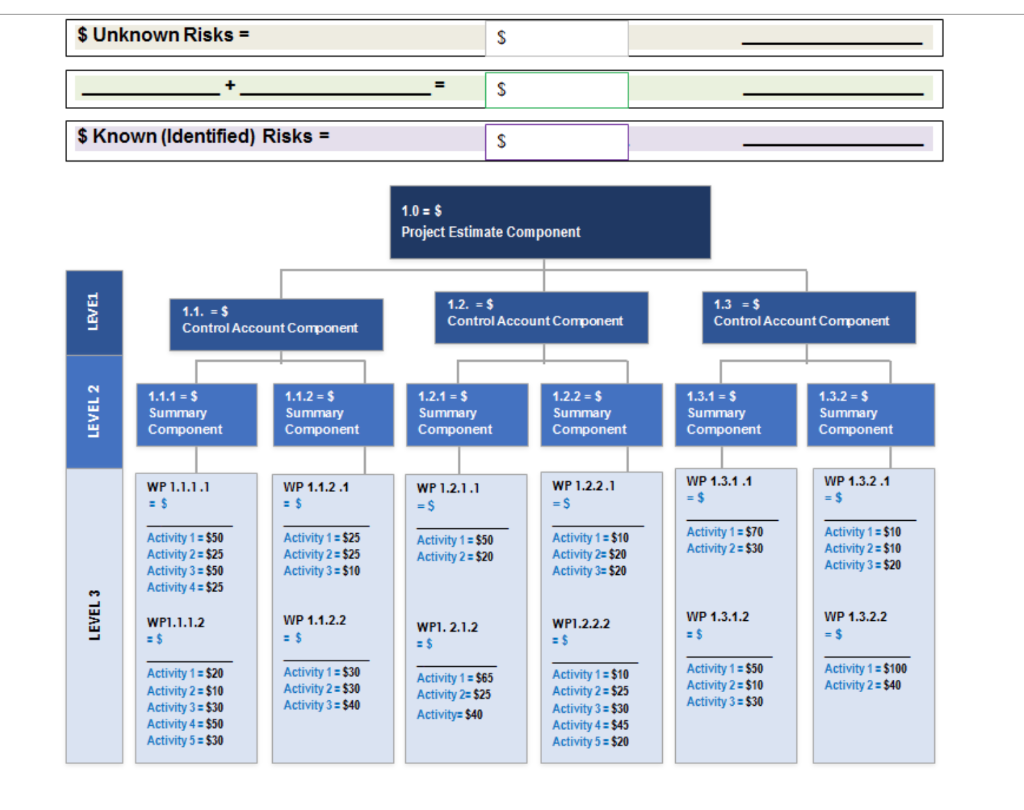
You have been asked to estimate a project budget by using the bottom-up estimation approach. Type the missing budget elements in the provided space. Aggregate costs and provide a budget estimate Assume that the cost of known risks has been calculated, and it resulted in a sum equal to 25% of your project estimate. The cost of the unknown risks will be 10% of your cost baseline. Use the attached worksheet to guide your answers and provide a final budget estimate. Click on the blue file name to download the Word document with the bottom-up estimation worksheet: Question 31 Worksheet - Cost Aggregation - A.docx You may also refer to the graphical tree representation below to better visualize the cost aggregation process. Upload file once all calculations and answers are completed. (If you encounter technical difficulties while uploading the file, you may email your completed file to your instructor. The emailed file is accepted up to 5 minutes after your exam submission.) COST AGGREGATION-Bottom-Up Estimating - Creating a Budget S $ Unknown Risks - $ S Known (Identified) Risks - Project Estate Compe 16-3 Carmina 1.2. - $ Cosind Account Camper 1.3 $ Control Account Component 1.1.13 Com 1.12-5 Component 1.2.1- 1.2.1-5 Com Component 12.2. 1.2.2-5 Como 1.2.1 1.3.15 Seray Component 1.29 Comment WP LLLL 12. W 1.2.1.1 W 1.2.2.1 WP 18.1.1 WP 1.3.2.1 AWE Ad Ich 1535 lava Activity 2500 Adyen A Acay-520 Actres 1-10 ASI Ach=52 WPL.1.12 WP1122 WF1.3.2.2 WP 10 WP 12.2.) Act19 NE Ad A A3534 Adhe MA 2:22 ASTRO A2510 NES A2540 140 Ac Activity: $ Unknown Risks = S + S $ Known (Identified) Risks = S 1.0 = $ Project Estimate Component LEVE1 1.1. = $ Control Account Component 1.2. = $ Control Account Component 1.3 = $ Control Account Component LEVEL 2 1.1.1 = $ Summary Component 1.1.2 = $ Summary Component 1.2.1 = $ Summary Component 1.2.2 = $ Summary Component 1.3.1 = $ Summary Component 1.3.2 = $ Summary Component WP 1.1.1.1 = $ WP 1.1.2.1 = $ WP 1.2.1.1 = $ WP 1.2.2.1 = $ WP 1.3.1.1 = $ WP 1.3.2.1 = $ Activity 1 = $50 Activity 2 = $25 Activity 3 = $50 Activity 4 = $25 Activity 1 = $25 Activity 2 = $25 Activity 3 = $10 Activity 1 = $50 Activity 2 = $20 Activity 1 = $10 Activity 2= $20 Activity 3= $20 Activity 1 = $70 Activity 2 = $30 Activity 1 = $10 Activity 2 = $10 Activity 3 = $20 LEVEL 3 WP1.1.1.2 :$ WP 1.1.2.2 = $ WP1. 2.1.2 = $ WP1.2.2.2 = $ WP 1.3.1.2 : $ WP 1.3.2.2 = $ Activity 1 = $20 Activity 2 = $10 Activity 3 = $30 Activity 4 = $50 Activity 5 = $30 Activity 1 = $30 Activity 2 = $30 Activity 3 = $40 Activity 1 = $100 Activity 2 = $40 Activity 1 = $65 Activity 2= $25 Activity= $40 Activity 1 = $10 Activity 2 = $25 Activity 3 = $30 Activity 4 = $45 Activity 5 = $20 Activity 1 = $50 Activity 2 = $10 Activity 3 = $30 Question #31: Bottom-up Estimation / Cost Aggregation (13 marks) Description: You have been asked to estimate a project budget by using the bottom-up estimation approach. Type the missing budget elements in the provided space. Aggregate costs and provide a budget estimate. Assume that the cost of known risks has been calculated, and it resulted in a sum equal to 25% of your project estimate. The cost of the unknown risks will be 10% of your cost baseline. Use this worksheet to guide your answers and provide a final budget estimate. You may refer to the graphical tree representation provided in the description of question #31 to better visualize the cost aggregation process. Upload file once all calculations and answers are completed. (If you encounter technical difficulties while uploading the file, you may email your completed file to your instructor within 5 minutes of your exam submission.) 31A) Work package estimates (level 3). Type the sum of individual activity costs in the provided space. WP 1.1.1.1 = $50 + $25 + $50 + $25 = $ WP 1.1.1.2 = $20 + $10+ $30 + $50 + $30 = $ WP 1.1.2.1 = $25 + $25 + $10 = $ WP 1.1.2.2 = $30 + $30+ $40 = $ WP 1.2.1.1 = $50 + $20 = $ WP 1.2.1.2 = $65 + $25 + $40 = $ WP 1.2.2.1 = $10 + $20 + $20 = $ WP 1.2.2.2 = $10 + $25 + $30+ $45 + $20 = $ WP 1.3.1.1 = $70 + $30 = $ WP 1.3.1.2 = $50 + $10 + $30 = $ WP 1.3.2.1 = $ 10+ $10 + $20 = $ I WP 1.3.2.2 = $40 + $100 = $ 31B) Summary component estimates (level 2). Type the sum of individual work packages belonging to each summary component in the provided space. Summary component 1.1.1 = $ Summary component 1.1.2 = $ Summary component 1.2.1 = $ Summary component 1.3.1 = $ ummary component 1.2.2 = $ Summary component 1.3.2 = $ 31C) Control account component estimates (level 1). Type the sum of individual summary components belonging to each control account component in the provided space. Control account component 1.1 = $ Control account component 1.2 = $ Control account component 1.3 = $ 31D) Project estimate (level o). Calculate the sum of individual control account components resulting in the project estimate and type the $ amount in the provided space. Project estimate = $ 31E) Calculate and type in the provided space the $ amount set aside for known risks and the type of reserves that this amount represents. Dollar amount set aside for known risks = $ Type of reserves that this amount represents: 31F) Type the names of the two already calculated budget components that need to be added together to represent the cost baseline. (Type here) + (Type here) = Cost baseline = $ 31G) Calculate and type in the provided space the $ amount set aside for unknown risks and the type of reserves that this amount represents. Dollar amount set aside for unknown risks = $ Type of reserves that this amount represents: 31H) Type the names of the two already calculated budget components that need to be added together to represent the full budget. (Type here) + (Type here) = Cost budget = $ You have been asked to estimate a project budget by using the bottom-up estimation approach. Type the missing budget elements in the provided space. Aggregate costs and provide a budget estimate Assume that the cost of known risks has been calculated, and it resulted in a sum equal to 25% of your project estimate. The cost of the unknown risks will be 10% of your cost baseline. Use the attached worksheet to guide your answers and provide a final budget estimate. Click on the blue file name to download the Word document with the bottom-up estimation worksheet: Question 31 Worksheet - Cost Aggregation - A.docx You may also refer to the graphical tree representation below to better visualize the cost aggregation process. Upload file once all calculations and answers are completed. (If you encounter technical difficulties while uploading the file, you may email your completed file to your instructor. The emailed file is accepted up to 5 minutes after your exam submission.) COST AGGREGATION-Bottom-Up Estimating - Creating a Budget S $ Unknown Risks - $ S Known (Identified) Risks - Project Estate Compe 16-3 Carmina 1.2. - $ Cosind Account Camper 1.3 $ Control Account Component 1.1.13 Com 1.12-5 Component 1.2.1- 1.2.1-5 Com Component 12.2. 1.2.2-5 Como 1.2.1 1.3.15 Seray Component 1.29 Comment WP LLLL 12. W 1.2.1.1 W 1.2.2.1 WP 18.1.1 WP 1.3.2.1 AWE Ad Ich 1535 lava Activity 2500 Adyen A Acay-520 Actres 1-10 ASI Ach=52 WPL.1.12 WP1122 WF1.3.2.2 WP 10 WP 12.2.) Act19 NE Ad A A3534 Adhe MA 2:22 ASTRO A2510 NES A2540 140 Ac Activity: $ Unknown Risks = S + S $ Known (Identified) Risks = S 1.0 = $ Project Estimate Component LEVE1 1.1. = $ Control Account Component 1.2. = $ Control Account Component 1.3 = $ Control Account Component LEVEL 2 1.1.1 = $ Summary Component 1.1.2 = $ Summary Component 1.2.1 = $ Summary Component 1.2.2 = $ Summary Component 1.3.1 = $ Summary Component 1.3.2 = $ Summary Component WP 1.1.1.1 = $ WP 1.1.2.1 = $ WP 1.2.1.1 = $ WP 1.2.2.1 = $ WP 1.3.1.1 = $ WP 1.3.2.1 = $ Activity 1 = $50 Activity 2 = $25 Activity 3 = $50 Activity 4 = $25 Activity 1 = $25 Activity 2 = $25 Activity 3 = $10 Activity 1 = $50 Activity 2 = $20 Activity 1 = $10 Activity 2= $20 Activity 3= $20 Activity 1 = $70 Activity 2 = $30 Activity 1 = $10 Activity 2 = $10 Activity 3 = $20 LEVEL 3 WP1.1.1.2 :$ WP 1.1.2.2 = $ WP1. 2.1.2 = $ WP1.2.2.2 = $ WP 1.3.1.2 : $ WP 1.3.2.2 = $ Activity 1 = $20 Activity 2 = $10 Activity 3 = $30 Activity 4 = $50 Activity 5 = $30 Activity 1 = $30 Activity 2 = $30 Activity 3 = $40 Activity 1 = $100 Activity 2 = $40 Activity 1 = $65 Activity 2= $25 Activity= $40 Activity 1 = $10 Activity 2 = $25 Activity 3 = $30 Activity 4 = $45 Activity 5 = $20 Activity 1 = $50 Activity 2 = $10 Activity 3 = $30 Question #31: Bottom-up Estimation / Cost Aggregation (13 marks) Description: You have been asked to estimate a project budget by using the bottom-up estimation approach. Type the missing budget elements in the provided space. Aggregate costs and provide a budget estimate. Assume that the cost of known risks has been calculated, and it resulted in a sum equal to 25% of your project estimate. The cost of the unknown risks will be 10% of your cost baseline. Use this worksheet to guide your answers and provide a final budget estimate. You may refer to the graphical tree representation provided in the description of question #31 to better visualize the cost aggregation process. Upload file once all calculations and answers are completed. (If you encounter technical difficulties while uploading the file, you may email your completed file to your instructor within 5 minutes of your exam submission.) 31A) Work package estimates (level 3). Type the sum of individual activity costs in the provided space. WP 1.1.1.1 = $50 + $25 + $50 + $25 = $ WP 1.1.1.2 = $20 + $10+ $30 + $50 + $30 = $ WP 1.1.2.1 = $25 + $25 + $10 = $ WP 1.1.2.2 = $30 + $30+ $40 = $ WP 1.2.1.1 = $50 + $20 = $ WP 1.2.1.2 = $65 + $25 + $40 = $ WP 1.2.2.1 = $10 + $20 + $20 = $ WP 1.2.2.2 = $10 + $25 + $30+ $45 + $20 = $ WP 1.3.1.1 = $70 + $30 = $ WP 1.3.1.2 = $50 + $10 + $30 = $ WP 1.3.2.1 = $ 10+ $10 + $20 = $ I WP 1.3.2.2 = $40 + $100 = $ 31B) Summary component estimates (level 2). Type the sum of individual work packages belonging to each summary component in the provided space. Summary component 1.1.1 = $ Summary component 1.1.2 = $ Summary component 1.2.1 = $ Summary component 1.3.1 = $ ummary component 1.2.2 = $ Summary component 1.3.2 = $ 31C) Control account component estimates (level 1). Type the sum of individual summary components belonging to each control account component in the provided space. Control account component 1.1 = $ Control account component 1.2 = $ Control account component 1.3 = $ 31D) Project estimate (level o). Calculate the sum of individual control account components resulting in the project estimate and type the $ amount in the provided space. Project estimate = $ 31E) Calculate and type in the provided space the $ amount set aside for known risks and the type of reserves that this amount represents. Dollar amount set aside for known risks = $ Type of reserves that this amount represents: 31F) Type the names of the two already calculated budget components that need to be added together to represent the cost baseline. (Type here) + (Type here) = Cost baseline = $ 31G) Calculate and type in the provided space the $ amount set aside for unknown risks and the type of reserves that this amount represents. Dollar amount set aside for unknown risks = $ Type of reserves that this amount represents: 31H) Type the names of the two already calculated budget components that need to be added together to represent the full budget. (Type here) + (Type here) = Cost budget = $

Step by Step Solution

There are 3 Steps involved in it

1 Expert Approved Answer
Step: 1 Unlock blur-text-image

Question Has Been Solved by an Expert!

Get step-by-step solutions from verified subject matter experts

Step: 2 Unlock
Step: 3 Unlock

Students Have Also Explored These Related General Management Questions!