



Question: Please help me with these questions! O This worksheet is another statement that is equivalent in strength to the standard formulation of induction we covered
Please help me with these questions!
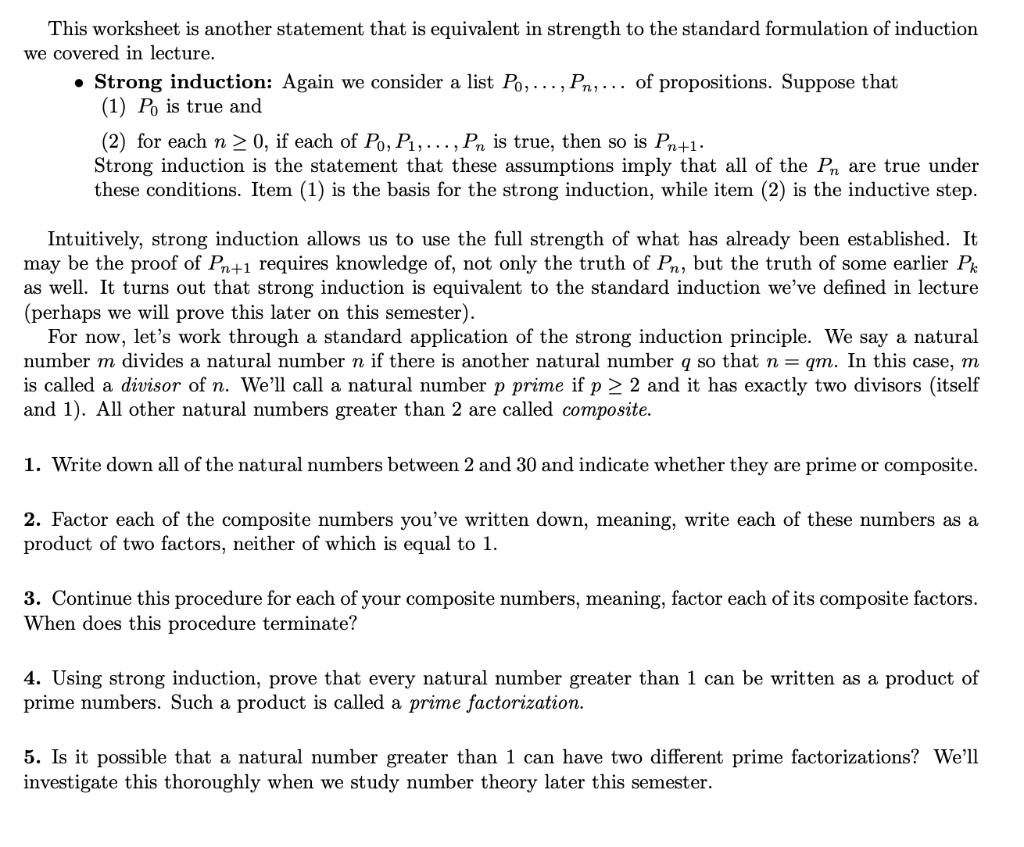
O This worksheet is another statement that is equivalent in strength to the standard formulation of induction we covered in lecture. Strong induction: Again we consider a list Po, ..., Pn,... of propositions. Suppose that (1) Po is true and (2) for each n > 0, if each of Po, P1, ...,Pn is true, then so is Pn+1. Strong induction is the statement that these assumptions imply that all of the Pn are true under these conditions. Item (1) is the basis for the strong induction, while item (2) is the inductive step. Intuitively, strong induction allows us to use the full strength of what has already been established. It may be the proof of Pn+1 requires knowledge of, not only the truth of Pn, but the truth of some earlier Pk as well. It turns out that strong induction is equivalent to the standard induction we've defined in lecture (perhaps we will prove this later on this semester). For now, let's work through a standard application of the strong induction principle. We say a natural number m divides a natural number n if there is another natural number q so that n=qm. In this case, m is called a divisor of n. We'll call a natural number p prime if p > 2 and it has exactly two divisors (itself and 1). All other natural numbers greater than 2 are called composite. 1. Write down all of the natural numbers between 2 and 30 and indicate whether they are prime or composite. 2. Factor each of the composite numbers you've written down, meaning, write each of these numbers as a product of two factors, neither of which is equal to 1. 3. Continue this procedure for each of your composite numbers, meaning, factor each of its composite factors. When does this procedure terminate? 4. Using strong induction, prove that every natural number greater than 1 can be written as a product of prime numbers. Such a product is called a prime factorization. 5. Is it possible that a natural number greater than 1 can have two different prime factorizations? We'll investigate this thoroughly when we study number theory later this semester. O This worksheet is another statement that is equivalent in strength to the standard formulation of induction we covered in lecture. Strong induction: Again we consider a list Po, ..., Pn,... of propositions. Suppose that (1) Po is true and (2) for each n > 0, if each of Po, P1, ...,Pn is true, then so is Pn+1. Strong induction is the statement that these assumptions imply that all of the Pn are true under these conditions. Item (1) is the basis for the strong induction, while item (2) is the inductive step. Intuitively, strong induction allows us to use the full strength of what has already been established. It may be the proof of Pn+1 requires knowledge of, not only the truth of Pn, but the truth of some earlier Pk as well. It turns out that strong induction is equivalent to the standard induction we've defined in lecture (perhaps we will prove this later on this semester). For now, let's work through a standard application of the strong induction principle. We say a natural number m divides a natural number n if there is another natural number q so that n=qm. In this case, m is called a divisor of n. We'll call a natural number p prime if p > 2 and it has exactly two divisors (itself and 1). All other natural numbers greater than 2 are called composite. 1. Write down all of the natural numbers between 2 and 30 and indicate whether they are prime or composite. 2. Factor each of the composite numbers you've written down, meaning, write each of these numbers as a product of two factors, neither of which is equal to 1. 3. Continue this procedure for each of your composite numbers, meaning, factor each of its composite factors. When does this procedure terminate? 4. Using strong induction, prove that every natural number greater than 1 can be written as a product of prime numbers. Such a product is called a prime factorization. 5. Is it possible that a natural number greater than 1 can have two different prime factorizations? We'll investigate this thoroughly when we study number theory later this semester
Step by Step Solution
There are 3 Steps involved in it

Get step-by-step solutions from verified subject matter experts