







Question: Please help me with this 7. (6 marks) Consider the standard OLG model with money. Individuals are endowed with y units of a perishable consumption
Please help me with this
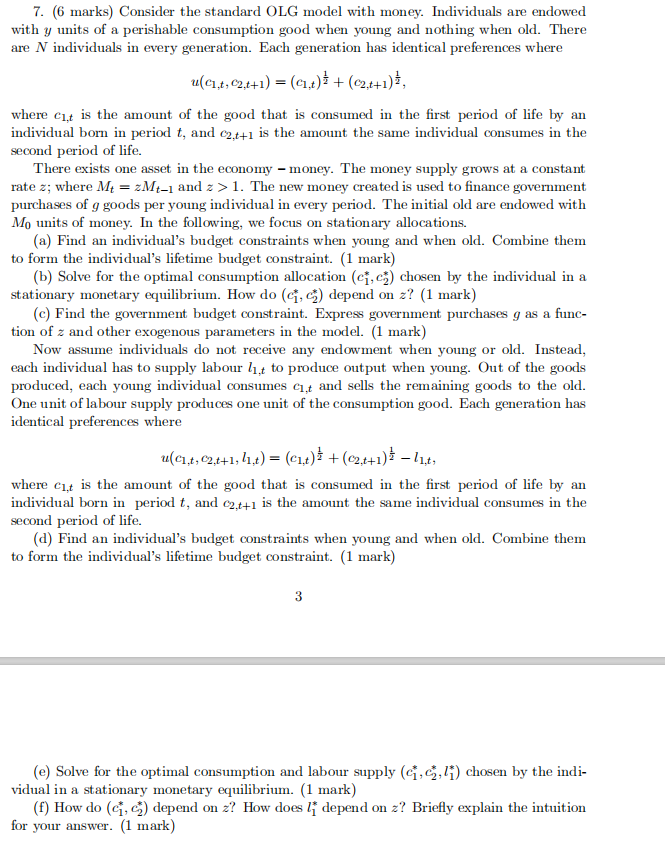
7. (6 marks) Consider the standard OLG model with money. Individuals are endowed with y units of a perishable consumption good when young and nothing when old. There are N individuals in every generation. Each generation has identical preferences where u( c.t, (2,t+ 1) = (c1,t)= + (c2,#+1)#, where cit is the amount of the good that is consumed in the first period of life by an individual born in period t, and caf+1 is the amount the same individual consumes in the second period of life. There exists one asset in the economy - money. The money supply grows at a constant rate z; where Me = =Mt-1 and z > 1. The new money created is used to finance government purchases of g goods per young individual in every period. The initial old are endowed with Mo units of money. In the following, we focus on stationary allocations. (a) Find an individual's budget constraints when young and when old. Combine them to form the individual's lifetime budget constraint. (1 mark) (b) Solve for the optimal consumption allocation (ci, c;) chosen by the individual in a stationary monetary equilibrium. How do (ci, c;) depend on z? (1 mark) (c) Find the government budget constraint. Express government purchases g as a func- tion of z and other exogenous parameters in the model. (1 mark) Now assume individuals do not receive any endowment when young or old. Instead, each individual has to supply labour ,t to produce output when young. Out of the goods produced, each young individual consumes cut and sells the remaining goods to the old. One unit of labour supply produces one unit of the consumption good. Each generation has identical preferences where u(C.t, (2,t+ 1, h,t) = (cut)# + (cat+1)= - but, where cit is the amount of the good that is consumed in the first period of life by an individual born in period , and cat+1 is the amount the same individual consumes in the second period of life. (d) Find an individual's budget constraints when young and when old. Combine them to form the individual's lifetime budget constraint. (1 mark) 3 (e) Solve for the optimal consumption and labour supply (ci, c;, (;) chosen by the indi- vidual in a stationary monetary equilibrium. (1 mark) (f) How do (cj, c) depend on z? How does If depend on z? Briefly explain the intuition for your answer. (1 mark)
Step by Step Solution
There are 3 Steps involved in it

Get step-by-step solutions from verified subject matter experts
 Study Help