







Question: Please help me with this coding question! See pictures below, coding language Python. Thanks! Part 2: Denoising 10 Data In this problem, we will study
Please help me with this coding question!
See pictures below, coding language Python.
Thanks!
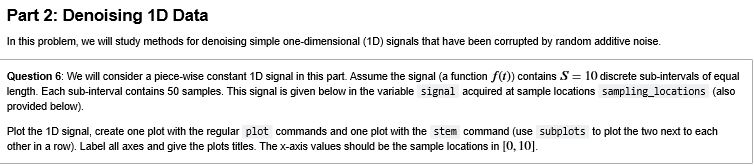
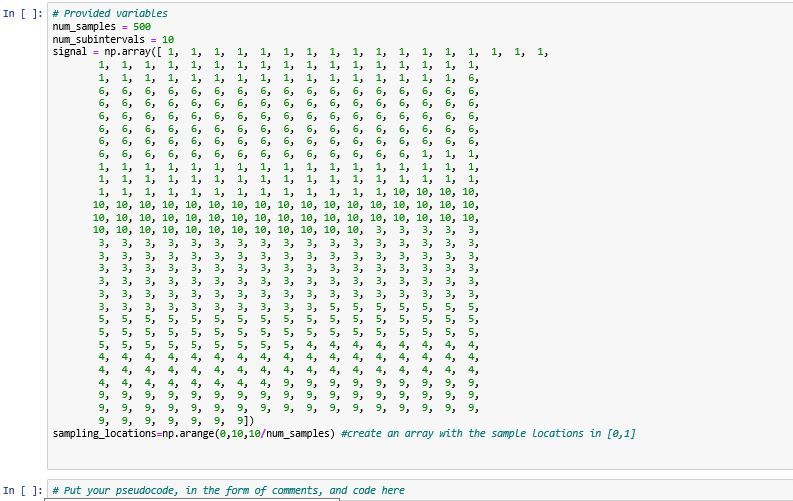
Part 2: Denoising 10 Data In this problem, we will study methods for denoising simple one-dimensional (1D) signals that have been corrupted by random additive noise. Question 6: We will consider a piece-wise constant 1D signal in this part. Assume the signal (a function fo) contains S= 10 discrete sub-intervals of equal length. Each sub-interval contains 50 samples. This signal is given below in the variable signal acquired at sample locations sampling_locations (also provided below). Plot the 1D signal, create one plot with the regular plot commands and one plot with the stem command (use subplots to plot the two next to each other in a row). Label all axes and give the plots titles. The x-axis values should be the sample locations in [0.10). 2, 1, 1, 1, - - ' - -- ' ' ' ' ' ' ' ' ' + ' ' ' - ' ' ' - ' ' ' - - - 4 4 4 - - -- 4 4 4 - - - - ' - ' - - -- - - - ' - - - ' ' '' ' ' ' ' ' ' ' - - - ' ' '' g ' ' - f' f' '' ' - - 4 * * - - '' ' - - - 9, 4, 8, 9, 9, 2, 3, 8, 9, 4, 9, 3, 9, sampling_locations=np.arange(0,10,10um_samples) #create an array with the sample Locations in [0,1] 4, 4, 9, 3, 9, 4, 4, 4, 8, 9, 9, 5, 4, 4, 5, 9, 9, 5, 4, 4, 4, 9, 9, 4, 4, 9, 9, 9]) 4, 4, 9, 9, 9, 4, 4, 8, 9, 9, 4, 4, 3, 9, 9, 4, 4, 4, 3, 9, 9, 4, 4, 4, 3, 9, 9, 4, 4, 4, 9, 9, 9, In [ ]: # Put your pseudocode, in the form of comments, and code here 1, 1, 8, 8, 1, 2, 6, 6, 1, 1, 5, 5, num_samples = 500 num_subintervals = 10 signal = np.array([ 1, 1, 1, In [ ]: # Provided variables 6, 6
Step by Step Solution
There are 3 Steps involved in it

Get step-by-step solutions from verified subject matter experts
 Study Help