Question: Please help me with this Managament Information Systems case study W han U.S. Army Reserve Staff Sergeant Ryan Kelly returned to Abilene, Texas, from Iraq,
Please help me with this Managament Information Systems case study
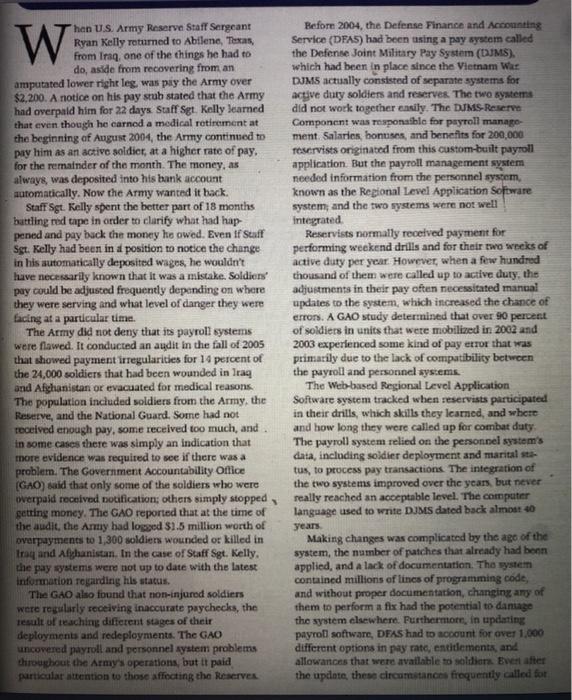
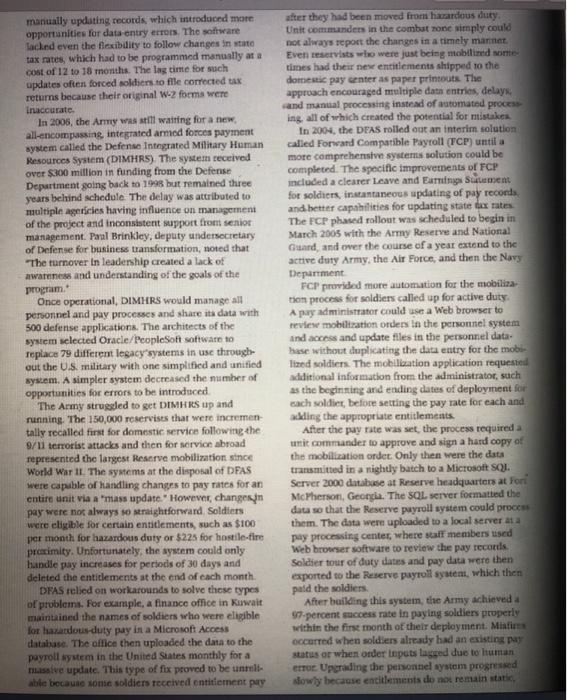
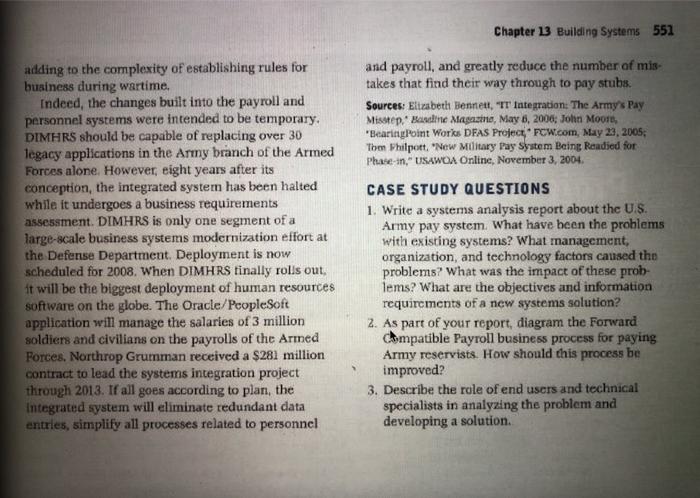
W han U.S. Army Reserve Staff Sergeant Ryan Kelly returned to Abilene, Texas, from Iraq, one of the things he had to do, aside from recovering from an amputated lower right leg, was pay the Army over $2,200. A notice on his pay stub stated that the Army had overpald him for 22 days Staff Sgt. Kelly learned that even though he carned a medical retirement at the beginning of August 2004, the Army continued to pay him as an active soldier, at a higher rate of pay, for the remainder of the month. The money, as always, was deposited into his bank account automatically. Now the Army wanted it back. Staff Sgt. Kelly spent the better part of 18 months battling med tape in order to clarify what had hap pened and pay back the money he owed. Even If Staff Sgt. Kelly had been in a position to notice the change in his automatically deposited wages, he wouldn't have necessarily known that it was a mistake. Soldiers pay could be adjusted frequently depending on where they were serving and what level of danger they were facing at a particular time. The Army did not deny that is payroll systems were flawed. It conducted an audit in the fall of 2005 that showed payment irregularities for 14 percent of the 24,000 soldiers that had been wounded in Iraq and Afghanistan or evacuated for medical reasons The population included soldiers from the Army, the Reserve, and the National Guard. Some had not received enough pay, some received too much, and in some cases there was simply an indication that more evidence was required to see if there was a problem. The Government Accountability Office (GA) said that only some of the soldiers who were overpaid received notification; others simply stopped getting money. The GAO reported that at the time of the audit, the Army had logged $1.5 million worth of overpayments to 1,300 soldiers wounded or killed in Iraq and Afghanistan. In the case of Staff Sgt. Kelly. the pay systems were not up to date with the latest information regarding his status, The GAO also found that non-injured soldiers were regularly receiving inaccurate paychecks, the result of teaching different stages of their deployments and redeployments. The GAO uncovered payroll and personnel system problema throughout the Army's operations, but it paid particular attention to those affecting the Reserves Before 2004, the Defense Finance and Accounting Service (DFAS) had been tasing a pay system called the Defense Joint Military Pay System (TJMS), which had been in place since the Vietnam War DJMS actually consisted of separate systems for active duty soldiers and reserves. The two systems did not work together easily. The DUMS Reserve Component was oponable for payroll manago ment. Salaries, bonuses, and benefits for 200,000 Teservists originated from this custom-built payroll application. But the payroll management system needed information from the personnel system, known as the Regional Level Application Software system, and the two systems were not well Integrated Reservists normally received payment for performing weekend drills and for their two weeks of active duty per year. However, when a few hundred thousand of them were called up to active duty, the adjustments in their pay often necessitated manual updates to the system, which increased the chance of errors. A GAO study determined that over 90 percent of soldiers in units that were mobilized in 2002 and 2003 experienced some kind of pay error that was primarily due to the lack of compatibility between the payroll and personnel systems The Web-based Regional Level Application Software system tracked when reservists participated in their drills, which skills they learned, and where and how long they were called up for combat duty The payroll system relied on the personnel system's data, including soldier deployment and marital sta tus, to process pay transactions. The integration of the two systems improved over the years, but never really reached an acceptable level. The computer language used to write DJMS dated back almost 46 years Making changes was complicated by the age of the system, the number of patches that already had been applied, and a lack of documentation. The system contained millions of lines of programming code, and without proper documentation, changing any of them to perform a fix had the potential to damage the system elsewhere. Purthermore, in updating payroll software, DFAS had to account for over 1,000 different options in pay rate, entitlements, and allowances that were available to soldier. Even after the update these circumstances frequently called for manually updating records, which introduced more opportunities for data entry errors. The software Lacked even the flexibdity to follow changes in state tax rates, which had to be programmed manually at a cost of 12 to 18 months. The lag time for such updates often forced soldiers to fille corrected to returns because their original W-2 forms were Inaccurate In 2005, the Army was still waiting for a new all-encompassing, integrated armed forces payment system called the Defense Integrated Military Human Resources System (DIMHRS). The system received over $300 million in funding from the Defense Department going back to 1995 but remained three years behind schedule. The delay was attributed to multiple agercles having influence on management of the project and inconsistent support from senior management. Paul Brinkley, deputy undersecretary of Defense for business transformation, noted that "The turnover in leadership created a lack of awareness and understanding of the goals of the program Once operational, DIMHRS would manage all personnel and pay processes and share its data with 500 defense applications. The architects of the system selected Oracle/PeopleSoft software to replace 79 different legacy systems in use through out the U.S. military with one simplified and unified aysem. A simpler system decreased the number of opportunities for errors to be introduced The Army struggled to get DIMHRS up and running. The 150,000 reservists that were incremen tally recalled first for domestic service following the 9/11 terrorist attacks and then for service abroad represented the largest Reserve mobilization since World War II The systems at the disposal of DFAS were capable of handling changes to pay rates for an entire unit via a mass update. However changes in pay were not always so straightforward. Soldiers were eligible for certain entitlements, such as $100 per month for hazardous duty or $225 for hostile-time prescimity. Unfortunately, the system could only handle pay increases for periods of 30 days and deleted the entitlements at the end of each month. DFAS relied on workarounds to solve these types of problems. For example, a finance office in Kuwait maintained the names of soldiers who were eligible for hazardous-duty pay in a Microsoft Access database. The office then uploaded the data to the payroll system in the United States monthly for a massive update. This type of fix proved to be un able because some soldiers teceived entitiement pay after they had been moved from hazardous duty Unit commanders in the combat tone simply could not always report the changes in a timely manner. Even reservists who were just being mobilind some times had their new entitlements shipped to the domestic pay center as paper printouts. The approach encouraged multiple data entries, delays, and manual processing instead of automated proces ing, all of which created the potential for mistakes In 2004, the DEAS rolled out an interim solution called forward Compatible Payroll (TCP) until a more comprehensive systems solution could be completed. The specific improvements of FCP included a clearer Leave and Euring Sument for soldiers, instantaneous updating of pay records and better capabilities for updating state tax rates The PCP phased rollout was scheduled to begin in March 2005 with the Army Reserve and National Guard, and over the course of a year extend to the active duty Army, the Air Force, and then the Navy Department PCP provided more automation for the mobiliza tion process for soldiers called up for active duty A pay administrator could use a Web browser to review mobilization orders in the personnel system and access and update files in the personnel data- hase without duplicating the data entry for the mobi lized soldiers. The mobilization application requested additional information from the administrator, such as the beginning and ending dates of deployment for cach soldier, before setting the pay rate for each and adding the appropriate entitlements After the pay rate was set the process required a unit commander to approve and sign a hard copy of the mobilization ordet. Only then were the data transmitted in a nightly batch to a Microsoft SQL Server 2000 database at Reserve headquarters at Fori McPherson, Georgia. The SQL server formatted the data so that the Reserve payroll system could proces them. The data were uploaded to a local server ta pay processing center, where staff members used Web browser software to review the pay records Soldier tour of duty dates and pay data were then exported to the Reserve payroll system, which then paid the soldiers After building this system, the Army achieved a 57.percent success rate in paying soldiers properly within the first month of their deployment. Misfits occurred when soldiers already had an existing pay status or when order inputs tagged due to human error Upgrading the personnel system progressed slowly because entitlements do not remain statie, Chapter 13 Building Systems 551 adding to the complexity of establishing rules for business during wartime. Indeed, the changes built into the payroll and personnel systems were intended to be temporary, DIMHRS should be capable of replacing over 30 legacy applications in the Army branch of the Armed Forces alone. However, eight years after its conception, the integrated system has been halted while it undergoes a business requirements assessment. DIMHRS is only one segment of a large-scale business systems modernization effort at the Defense Department Deployment is now scheduled for 2008. When DIMHRS finally rolls out. it will be the biggest deployment of human resources software on the globe. The Oracle/PeopleSoft application will manage the salaries of 3 million soldiers and civilians on the payrolls of the Armed Forces, Northrop Grumman received a $281 million contract to lead the systems integration project through 2013. If all goes according to plan, the Integrated system will eliminate redundant data entries, simplify all processes related to personnel and payroll, and greatly reduce the number of mis- takes that find their way through to pay stubs. Sources: Elizabeth Bennett, "TT Integration: The Army Pay Misstep, Hanne Magazine, May 6, 2000; John Moore, Bearing Point Works DFAS Project FCW.com, May 23, 2005; Toe Philpott. "New Military Pay System Being Readied for Phase-in," USAWDA Online, November 3, 2004 CASE STUDY QUESTIONS 1. Write a systems analysis report about the U.S. Army pay system. What have been the problems with existing systems? What management, organization, and technology factors caused the problems? What was the impact of these prob- lems? What are the objectives and information requirements of a new systems solution? 2. As part of your report, diagram the Forward Compatible Payroll business process for paying Army reservists. How should this process be improved? 3. Describe the role of end users and technical specialists in analyzing the problem and developing a solution









 Study Help