Question: Please help me with this please see the equation and the information to help me with the images attached GRASS must be used for every
Please help me with this please see the equation and the information to help me with the images attached
GRASS must be used for every solution.
State all given information, required information, and general formulas used.
A final statement, using acomplete sentence, must be provided for each question. One mark is deducted for each missing final statement.
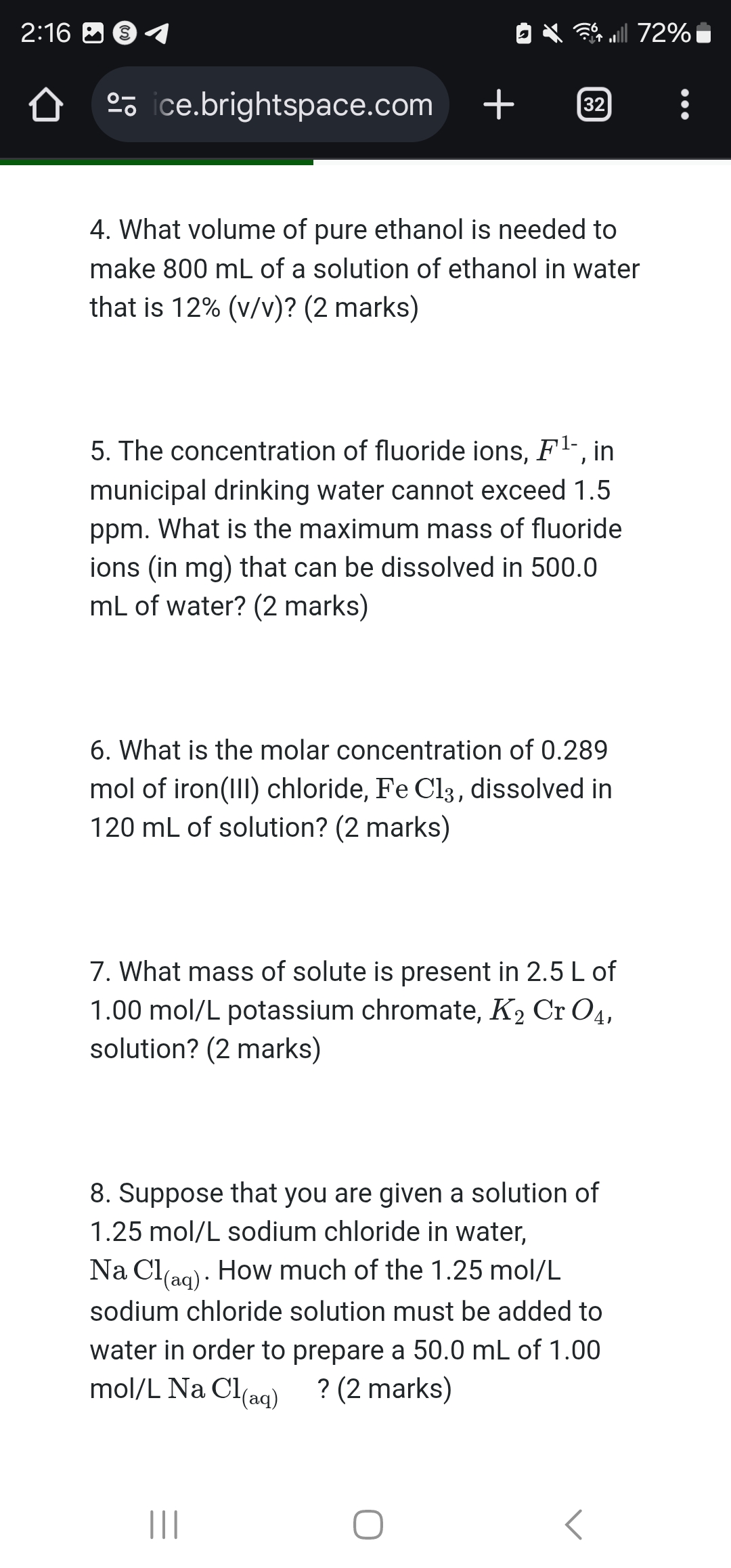
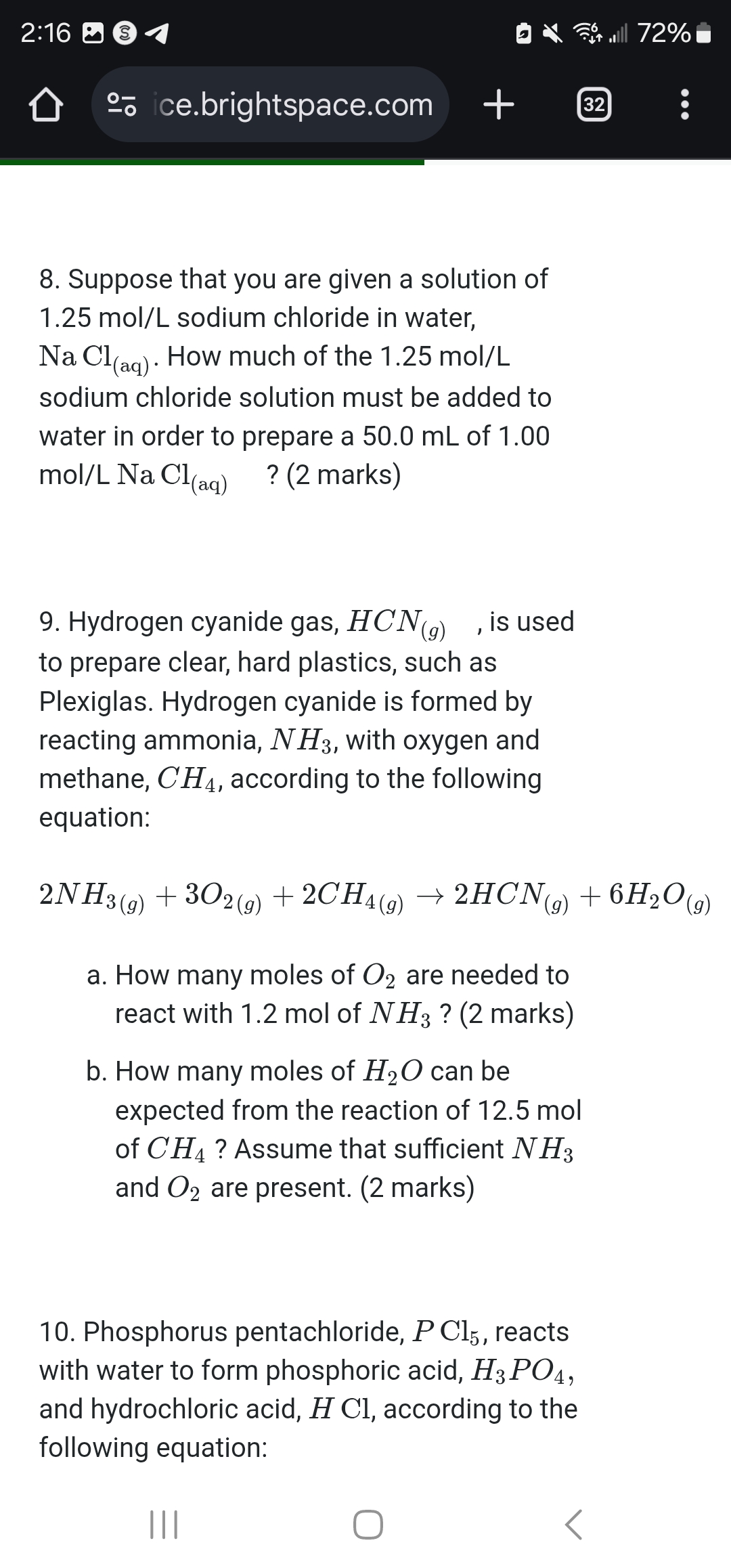
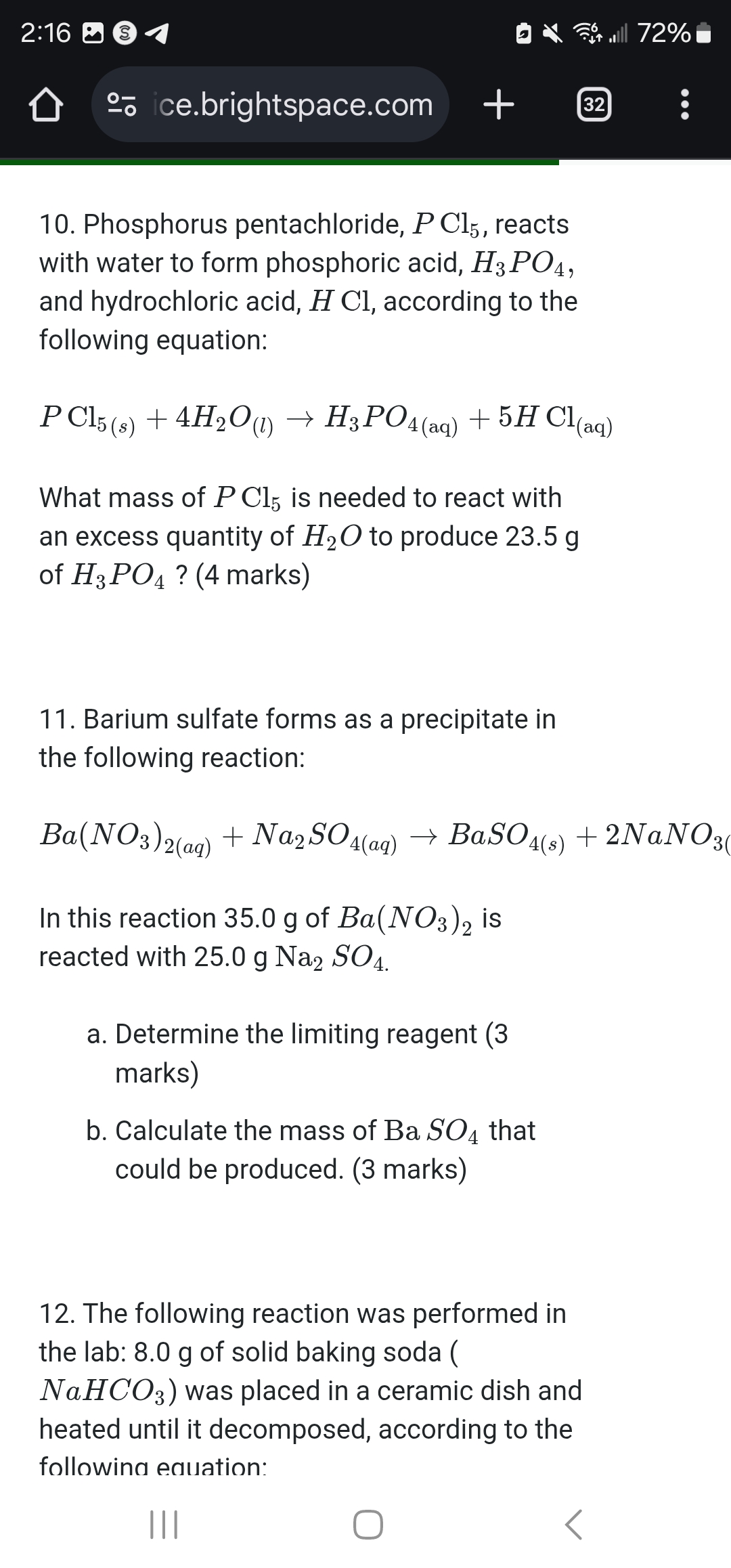
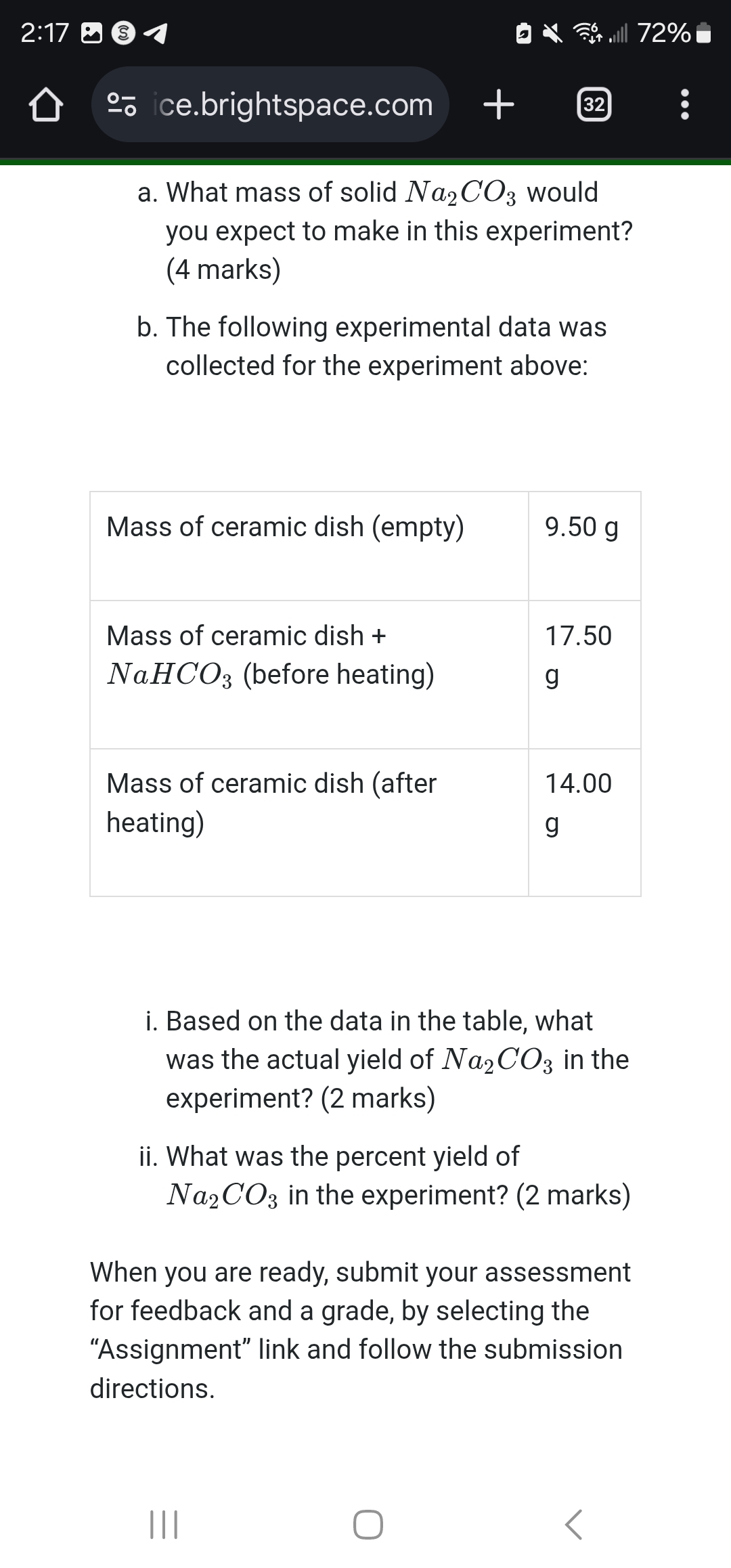
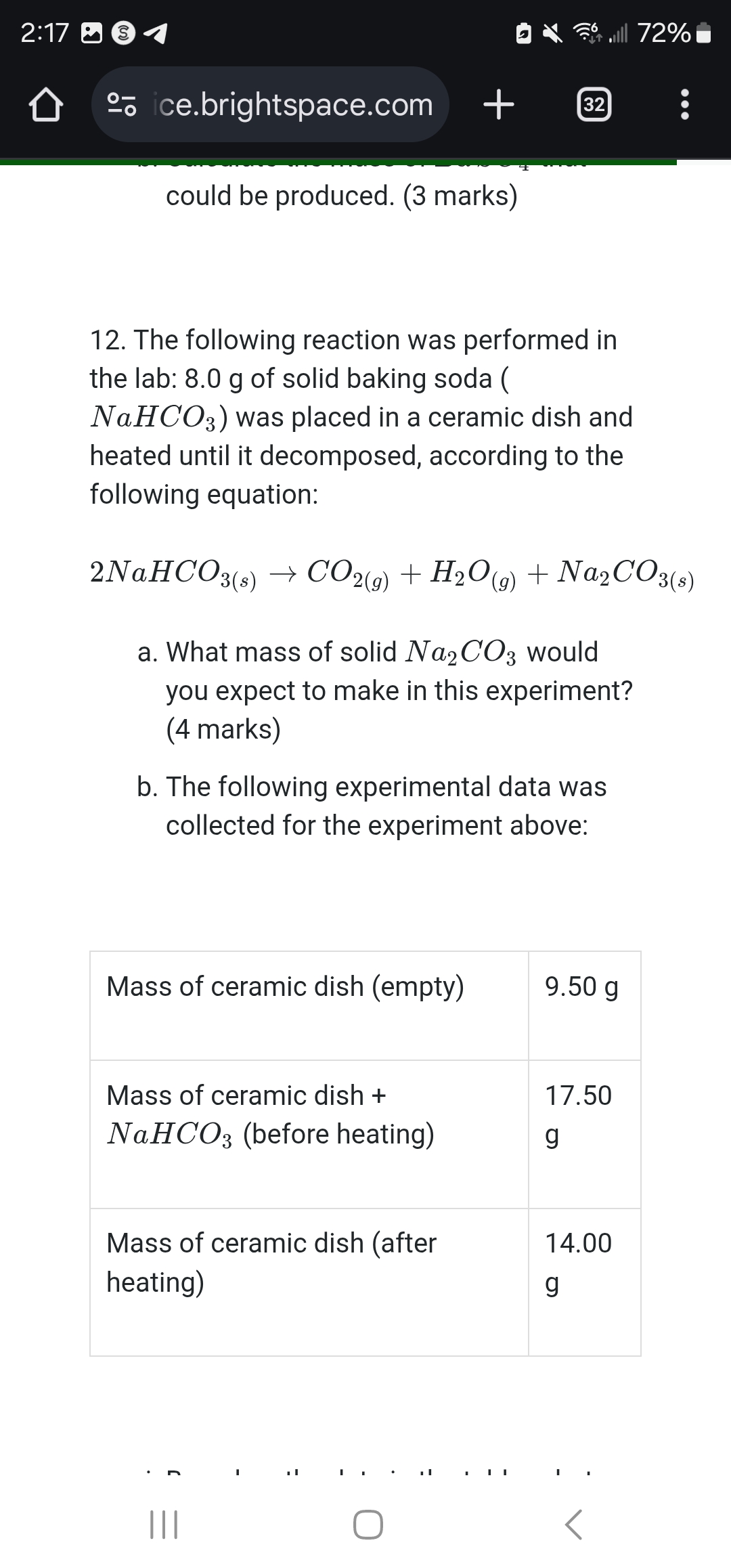
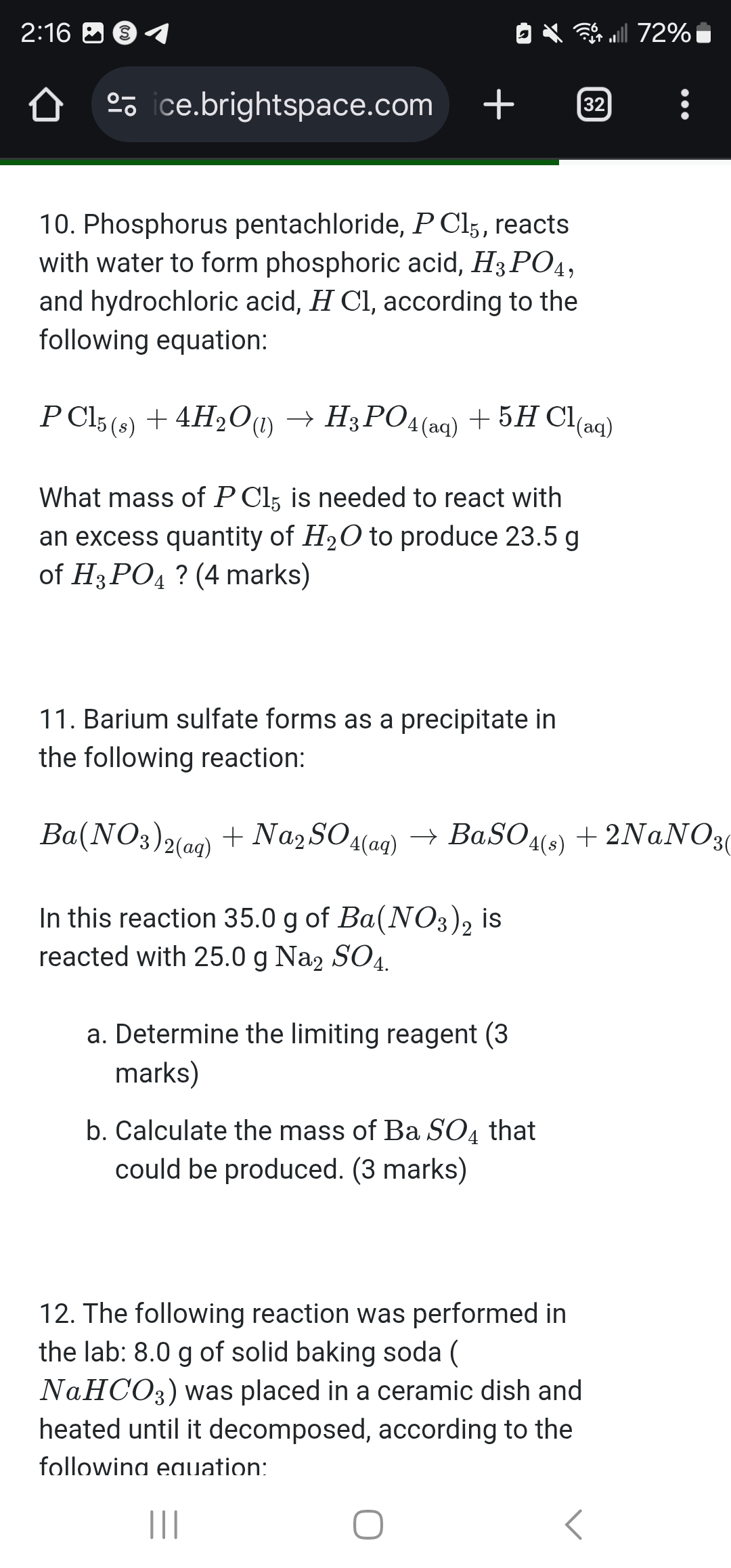
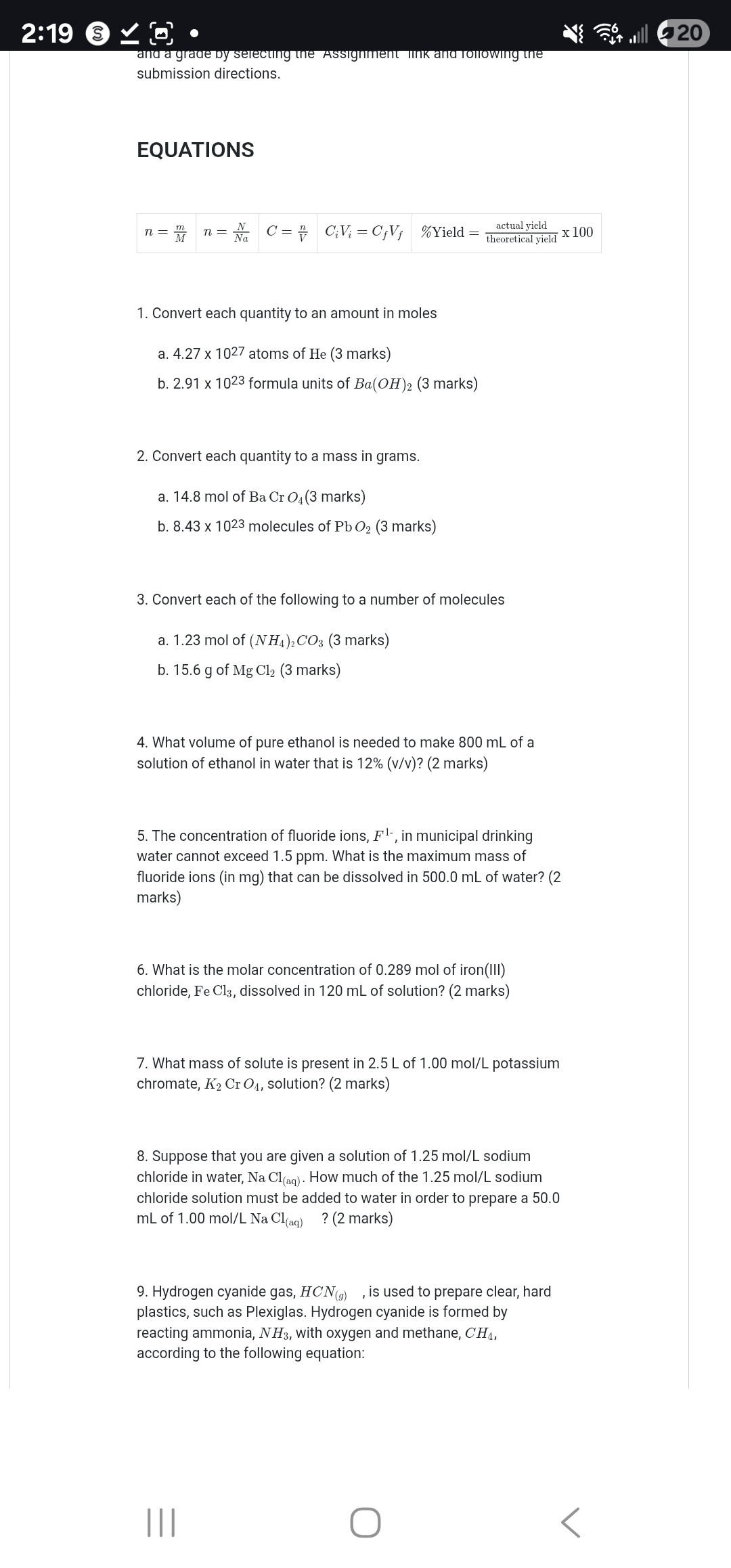
2:16 2 S 0 , till 72% go ice.brightspace.com + 32 4. What volume of pure ethanol is needed to make 800 mL of a solution of ethanol in water that is 12% (v/v)? (2 marks) 5. The concentration of fluoride ions, Fl-, in municipal drinking water cannot exceed 1.5 ppm. What is the maximum mass of fluoride ions (in mg) that can be dissolved in 500.0 mL of water? (2 marks) 6. What is the molar concentration of 0.289 mol of iron(Ill) chloride, Fe Cl3, dissolved in 120 mL of solution? (2 marks) 7. What mass of solute is present in 2.5 L of 1.00 mol/L potassium chromate, K2 Cr 04, solution? (2 marks) 8. Suppose that you are given a solution of 1.25 mol/L sodium chloride in water, Na Cl(aq) . How much of the 1.25 mol/L sodium chloride solution must be added to water in order to prepare a 50.0 mL of 1.00 mol/L Na Cl(aq) ? (2 marks) O2:16 2 S 0 0 will 72% go ice.brightspace.com + 32 . . 8. Suppose that you are given a solution of 1.25 mol/L sodium chloride in water, Na Cl(aq) . How much of the 1.25 mol/L sodium chloride solution must be added to water in order to prepare a 50.0 mL of 1.00 mol/L Na Cl(aq) ? (2 marks) 9. Hydrogen cyanide gas, HCN(g) , is used to prepare clear, hard plastics, such as Plexiglas. Hydrogen cyanide is formed by reacting ammonia, NH3, with oxygen and methane, CH4, according to the following equation: 2N H3(9) + 302(9) + 2CH4(9) - 2HCN(9) + 6H20(9) a. How many moles of O2 are needed to react with 1.2 mol of NH ? (2 marks) b. How many moles of H20 can be expected from the reaction of 12.5 mol of CH4 ? Assume that sufficient NH3 and O2 are present. (2 marks) 10. Phosphorus pentachloride, P C15, reacts with water to form phosphoric acid, H3 PO4, and hydrochloric acid, H Cl, according to the following equation: O A2:16 2 S 0 0 will 72% go ice.brightspace.com + 32 . . 10. Phosphorus pentachloride, P Cl;, reacts with water to form phosphoric acid, H3 PO4, and hydrochloric acid, H Cl, according to the following equation: P Cl5(s) + 4H20(1) - H3PO4(aq) + 5H Cl(aq) What mass of P Cl; is needed to react with an excess quantity of H20 to produce 23.5 g of H3 PO4 ? (4 marks) 11. Barium sulfate forms as a precipitate in the following reaction: Ba(NO3)2(aq) + Naz SO4(aq) - BaSOA(s) + 2NaNO, In this reaction 35.0 g of Ba(NO3)2 is reacted with 25.0 g Na2 SO4. a. Determine the limiting reagent (3 marks) b. Calculate the mass of Ba SO4 that could be produced. (3 marks) 12. The following reaction was performed in the lab: 8.0 g of solid baking soda ( NaHCO3) was placed in a ceramic dish and heated until it decomposed, according to the following equation: O A2:17 2 3 4 0 0 .Ill 72% go ice.brightspace.com + 32 a. What mass of solid Na2 CO3 would you expect to make in this experiment? (4 marks) b. The following experimental data was collected for the experiment above: Mass of ceramic dish (empty) 9.50 g Mass of ceramic dish + 17.50 NaHCO3 (before heating) g Mass of ceramic dish (after 14.00 heating ) g i. Based on the data in the table, what was the actual yield of Na2 CO3 in the experiment? (2 marks) ii. What was the percent yield of Na2 CO3 in the experiment? (2 marks) When you are ready, submit your assessment for feedback and a grade, by selecting the "Assignment" link and follow the submission directions. O2:17 2 3 4 0 0 .Ill 72% go ice.brightspace.com + 32 . . could be produced. (3 marks) 12. The following reaction was performed in the lab: 8.0 g of solid baking soda ( NaHCO3) was placed in a ceramic dish and heated until it decomposed, according to the following equation: 2NaHCO3(s) - CO2(9) + H20(9) + Naz CO3(s) a. What mass of solid Na2 CO3 would you expect to make in this experiment? (4 marks) b. The following experimental data was collected for the experiment above: Mass of ceramic dish (empty) 9.50 g Mass of ceramic dish + 17.50 NaHCO3 (before heating) g Mass of ceramic dish (after 14.00 heating ) g O A2:16 2 S 0 0 will 72% go ice.brightspace.com + 32 . . 10. Phosphorus pentachloride, P Cl;, reacts with water to form phosphoric acid, H3 PO4, and hydrochloric acid, H Cl, according to the following equation: P Cl5(s) + 4H20(1) - H3PO4(aq) + 5H Cl(aq) What mass of P Cl; is needed to react with an excess quantity of H20 to produce 23.5 g of H3 PO4 ? (4 marks) 11. Barium sulfate forms as a precipitate in the following reaction: Ba(NO3)2(aq) + Naz SO4(aq) - BaSOA(s) + 2NaNO, In this reaction 35.0 g of Ba(NO3)2 is reacted with 25.0 g Na2 SO4. a. Determine the limiting reagent (3 marks) b. Calculate the mass of Ba SO4 that could be produced. (3 marks) 12. The following reaction was performed in the lab: 8.0 g of solid baking soda ( NaHCO3) was placed in a ceramic dish and heated until it decomposed, according to the following equation: O A2:19 S VO . For all 20 and a grade by selecting the Assignment link and Tollowing the submission directions. EQUATIONS n = M n = NO C = # CiVi = CfVf %Yield = actual yield theoretical yield X 100 1. Convert each quantity to an amount in moles a. 4.27 x 1027 atoms of He (3 marks) b. 2.91 x 10²³ formula units of Ba(OH)2 (3 marks) 2. Convert each quantity to a mass in grams. a. 14.8 mol of Ba Cr 04(3 marks) b. 8.43 x 10²³ molecules of Pb O2 (3 marks) 3. Convert each of the following to a number of molecules a. 1.23 mol of (NHA)2 CO3 (3 marks) b. 15.6 g of Mg Cl2 (3 marks) 4. What volume of pure ethanol is needed to make 800 mL of a solution of ethanol in water that is 12% (v/V)? (2 marks) 5. The concentration of fluoride ions, Fl-, in municipal drinking water cannot exceed 1.5 ppm. What is the maximum mass of fluoride ions (in mg) that can be dissolved in 500.0 mL of water? (2 marks) 6. What is the molar concentration of 0.289 mol of iron(III) chloride, Fe Cl3, dissolved in 120 mL of solution? (2 marks) 7. What mass of solute is present in 2.5 L of 1.00 mol/L potassium chromate, K2 Cr 04, solution? (2 marks) 8. Suppose that you are given a solution of 1.25 mol/L sodium chloride in water, Na Cl(aq) . How much of the 1.25 mol/L sodium chloride solution must be added to water in order to prepare a 50.0 mL of 1.00 mol/L Na Cl(aq) ? (2 marks) 9. Hydrogen cyanide gas, HCN() , is used to prepare clear, hard plastics, such as Plexiglas. Hydrogen cyanide is formed by reacting ammonia, NH3, with oxygen and methane, CH4, according to the following equation: O
Step by Step Solution
There are 3 Steps involved in it
1 Expert Approved Answer
Step: 1 Unlock
Question Has Been Solved by an Expert!
Get step-by-step solutions from verified subject matter experts
Step: 2 Unlock
Step: 3 Unlock
Students Have Also Explored These Related Accounting Questions!









 Study Help