







Question: please help me with this problem, needed all parts they are simple please its urgent and example 4.2 is also given below for reference, and
please help me with this problem, needed all parts they are simple please its urgent and example 4.2 is also given below for reference, and please don.t ask for reference..
Recall the peppered moth analysis introduced in Example 4.2. In the field, it is quite difficult to distinguish the insularia and typica phenotypes due to variations in wing color and mottle. In addition to the 622 moths mentioned in the example, suppose the sample collected by the researchers actually included nU= 578 more moths that were known to be insularia or typical but whose exact phenotypes could not be determined.
a. Derive the EM algorithm for maximum likelihood estimation of pC, pI, and pIfor this modified problem having observed data nC, nI, nT, and nUas given above.
b. Apply the algorithm to find the MLEs.
c. Estimate the standard errors and pairwise correlations forC,I, andIusing the SEM algorithm.
d. Estimate the standard errors and pairwise correlations forC,I, andIby bootstrapping.
e. Implement the EM gradient algorithm for these data. Experiment with step halving to ensure ascent and with other step scalings that may speed convergence.
f. Implement Aitken accelerated EM for these data. Use step halving.
g. Implement quasi-Newton EM for these data. Compare performance with and without step halving.
h. Compare the effectiveness and efficiency of the standard EM algorithm and the three variants in (e), (f), and (g). Use step halving to ensure ascent with the three variants. Base your comparison on a variety of starting points.
Create graph analogous to Figure 4.3.
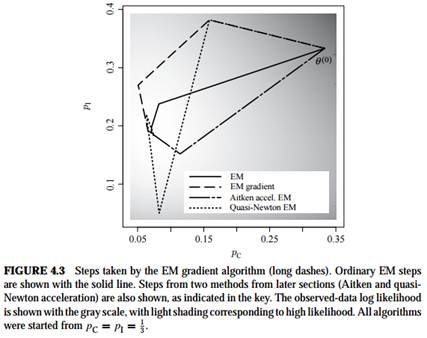
2- E EM gradient Aitken accel. EM Quasi-Newton EM 0.05 0.15 0.25 0.35 Pc FIGURE 4.3 Steps taken by the EM gradient algorithm (long dashes). Ordinary EM steps are shown with the solid line. Steps from two methods from later sections (Aitken and quasi- Newton acceleration) are also shown, as indicated in the key. The observed-data log likelihood is shown with the gray scale, with light shading corresponding to high likelihood. All algorithms were started from pc = p = 3
Step by Step Solution
There are 3 Steps involved in it

Get step-by-step solutions from verified subject matter experts
 Study Help