Question: Please help me with this question!!! Thank you so much~ Problem 1: In this problem, we will learn four tricks using binary variables. These tricks
 Please help me with this question!!! Thank you so much~
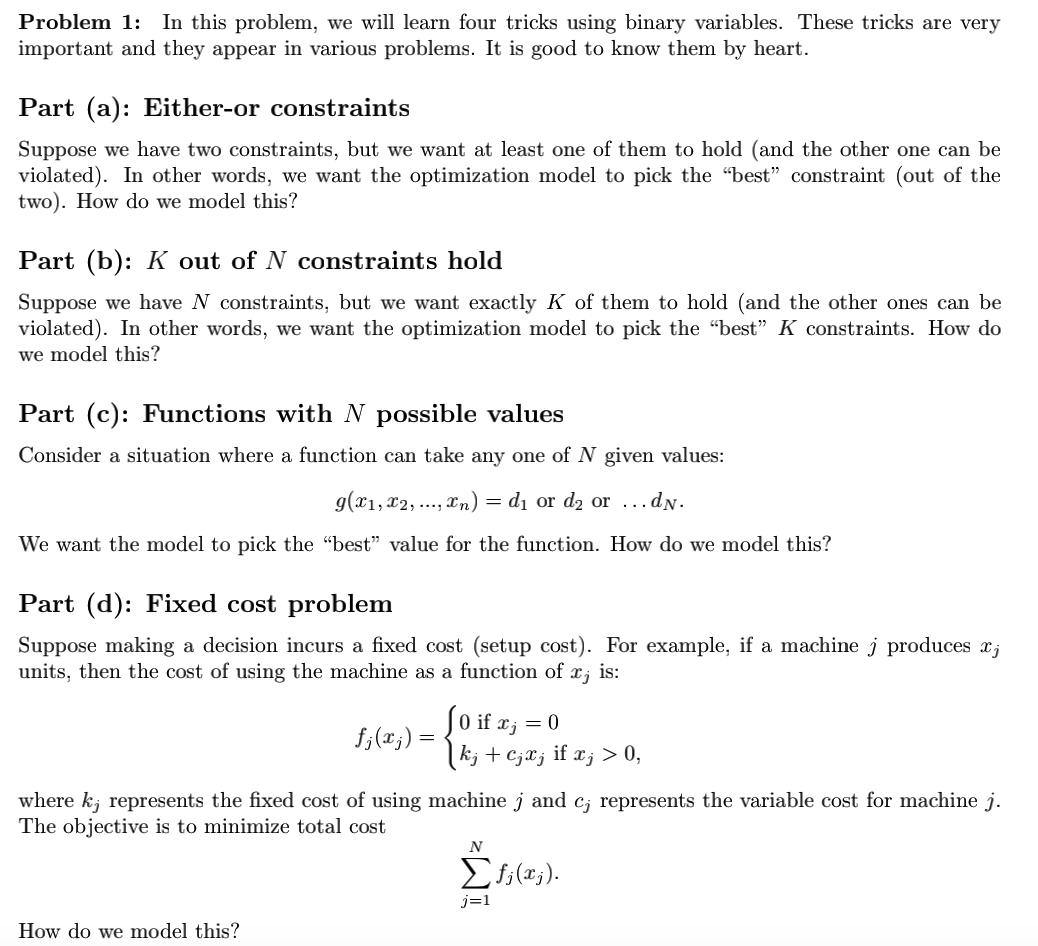
Problem 1: In this problem, we will learn four tricks using binary variables. These tricks are very important and they appear in various problems. It is good to know them by heart. Part (a): Either-or constraints Suppose we have two constraints, but we want at least one of them to hold (and the other one can be violated). In other words, we want the optimization model to pick the "best" constraint (out of the two). How do we model this? Part (b): K out of N constraints hold Suppose we have N constraints, but we want exactly K of them to hold (and the other ones can be violated). In other words, we want the optimization model to pick the "best" K constraints. How do we model this? Part (c): Functions with N possible values Consider a situation where a function can take any one of N given values: g(21, 12, ..., In) = d or d2 or ...dn. We want the model to pick the "best" value for the function. How do we model this? Part (d): Fixed cost problem Suppose making a decision incurs a fixed cost (setup cost). For example, if a machine i produces x; units, then the cost of using the machine as a function of xj is: So if x; = 0 fj(x;) = |k; +Cjl; if X; > 0, where k; represents the fixed cost of using machine j and c; represents the variable cost for machine j. The objective is to minimize total cost N fj(Lj). j=1 How do we model this? Problem 1: In this problem, we will learn four tricks using binary variables. These tricks are very important and they appear in various problems. It is good to know them by heart. Part (a): Either-or constraints Suppose we have two constraints, but we want at least one of them to hold (and the other one can be violated). In other words, we want the optimization model to pick the "best" constraint (out of the two). How do we model this? Part (b): K out of N constraints hold Suppose we have N constraints, but we want exactly K of them to hold (and the other ones can be violated). In other words, we want the optimization model to pick the "best" K constraints. How do we model this? Part (c): Functions with N possible values Consider a situation where a function can take any one of N given values: g(21, 12, ..., In) = d or d2 or ...dn. We want the model to pick the "best" value for the function. How do we model this? Part (d): Fixed cost problem Suppose making a decision incurs a fixed cost (setup cost). For example, if a machine i produces x; units, then the cost of using the machine as a function of xj is: So if x; = 0 fj(x;) = |k; +Cjl; if X; > 0, where k; represents the fixed cost of using machine j and c; represents the variable cost for machine j. The objective is to minimize total cost N fj(Lj). j=1 How do we model this









 Study Help