Question: Please help me with this rcode question, thank you Problem 4 [R - 24 points. In this problem, you will investigate via simulation the effect
Please help me with this rcode question, thank you
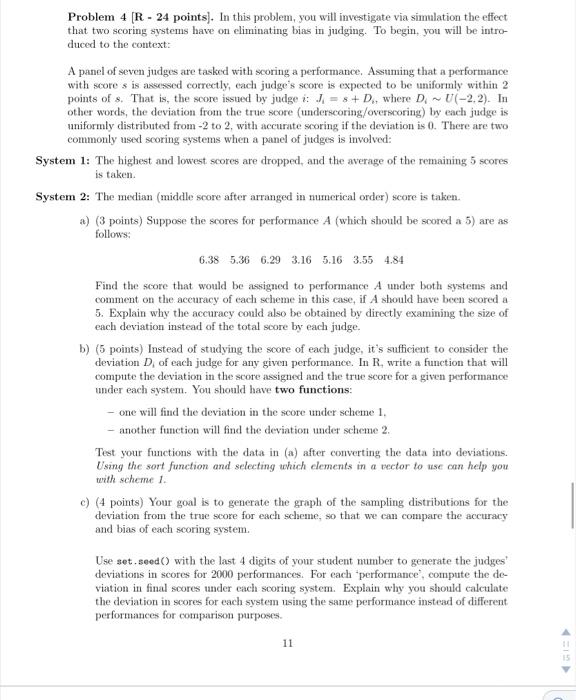
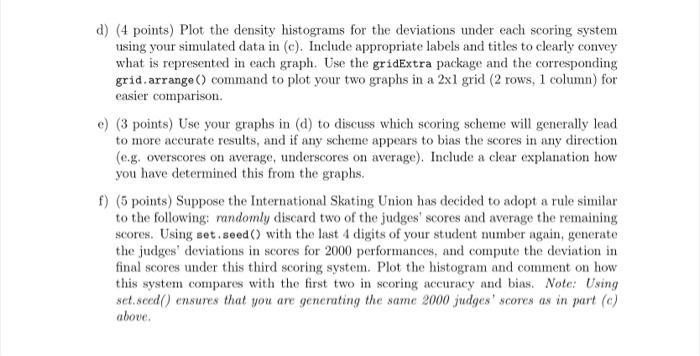
Problem 4 [R - 24 points. In this problem, you will investigate via simulation the effect that two scoring systems have on eliminating bias in judging. To begin, you will be intro- duced to the context: A panel of seven judges are tasked with scoring a performance. Assuming that a performance with score s is assessed correctly, cach judge's score is expected to be uniformly within 2 points of s. That is, the score issued by judge i: J = 8 + D., where DU(-2.2). In other words, the deviation from the true score underscoring/overscoring) by each judge is uniformly distributed from -2 to 2 with accurate scoring if the deviation is 0. There are two commonly used scoring systems when a panel of judges is involved: System 1: The highest and lowest scores are dropped, and the average of the remaining 5 scores is taken System 2: The median (middle score after arranged in numerical order) score is taken. a) 3 points) Suppose the scores for performance A (which should be scored a 5) are as follows: 6.38 5.36 6.29 3.16 5.16 3.55 4.84 Find the score that would be assigned to performance A under both systems and comment on the accuracy of each scheme in this case, if A should have been scored a 5. Explain why the accuracy could also be obtained by directly examining the size of each deviation instead of the total score by each judge. b) (5 points) Instead of studying the score of each judge, it's sufficient to consider the deviation D, of each judge for any given performance. In Rwrite a function that will compute the deviation in the score assigned and the true score for a given performance under each system. You should have two functions: one will find the deviation in the score under scheme 1. another function will find the deviation under scheme 2. Test your functions with the data in (a) after converting the data into deviations. Using the sort function and selecting which elements in a sector to use can help you with scheme 1. c) (4 points) Your goal is to generate the graph of the sampling distributions for the deviation from the true score for each scheme, so that we can compare the accuracy and bias of each scoring system. Use set.seed() with the last 4 digits of your student number to generate the judges' deviations in scores for 2000 performances. For each performance, compute the de viation in final scores under cach scoring system. Explain why you should calculate the deviation in scores for each system using the same performance instead of different performances for comparison purposes. 11 15 d) (4 points) Plot the density histograms for the deviations under each scoring system using your simulated data in (c). Include appropriate labels and titles to clearly convey what is represented in each graph. Use the gridExtra package and the corresponding grid arrange() command to plot your two graphs in a 2xl grid (2 rows, 1 column) for easier comparison e) (3 points) Use your graphs in (d) to discuss which scoring scheme will generally lead to more accurate results, and if any scheme appears to bias the scores in any direction (e.g. overscores on average, underscores on average). Include a clear explanation how you have determined this from the graphs. f) (5 points) Suppose the International Skating Union has decided to adopt a rule similar to the following: randomly discard two of the judges' scores and average the remaining scores. Using set.seed) with the last 4 digits of your student number again, generate the judges' deviations in scores for 2000 performances, and compute the deviation in final scores under this third scoring system. Plot the histogram and comment on how this system compares with the first two in scoring accuracy and bias. Note: Using set.seed() ensures that you are generating the same 2000 judges' scores as in part (c) above. Problem 4 [R - 24 points. In this problem, you will investigate via simulation the effect that two scoring systems have on eliminating bias in judging. To begin, you will be intro- duced to the context: A panel of seven judges are tasked with scoring a performance. Assuming that a performance with score s is assessed correctly, cach judge's score is expected to be uniformly within 2 points of s. That is, the score issued by judge i: J = 8 + D., where DU(-2.2). In other words, the deviation from the true score underscoring/overscoring) by each judge is uniformly distributed from -2 to 2 with accurate scoring if the deviation is 0. There are two commonly used scoring systems when a panel of judges is involved: System 1: The highest and lowest scores are dropped, and the average of the remaining 5 scores is taken System 2: The median (middle score after arranged in numerical order) score is taken. a) 3 points) Suppose the scores for performance A (which should be scored a 5) are as follows: 6.38 5.36 6.29 3.16 5.16 3.55 4.84 Find the score that would be assigned to performance A under both systems and comment on the accuracy of each scheme in this case, if A should have been scored a 5. Explain why the accuracy could also be obtained by directly examining the size of each deviation instead of the total score by each judge. b) (5 points) Instead of studying the score of each judge, it's sufficient to consider the deviation D, of each judge for any given performance. In Rwrite a function that will compute the deviation in the score assigned and the true score for a given performance under each system. You should have two functions: one will find the deviation in the score under scheme 1. another function will find the deviation under scheme 2. Test your functions with the data in (a) after converting the data into deviations. Using the sort function and selecting which elements in a sector to use can help you with scheme 1. c) (4 points) Your goal is to generate the graph of the sampling distributions for the deviation from the true score for each scheme, so that we can compare the accuracy and bias of each scoring system. Use set.seed() with the last 4 digits of your student number to generate the judges' deviations in scores for 2000 performances. For each performance, compute the de viation in final scores under cach scoring system. Explain why you should calculate the deviation in scores for each system using the same performance instead of different performances for comparison purposes. 11 15 d) (4 points) Plot the density histograms for the deviations under each scoring system using your simulated data in (c). Include appropriate labels and titles to clearly convey what is represented in each graph. Use the gridExtra package and the corresponding grid arrange() command to plot your two graphs in a 2xl grid (2 rows, 1 column) for easier comparison e) (3 points) Use your graphs in (d) to discuss which scoring scheme will generally lead to more accurate results, and if any scheme appears to bias the scores in any direction (e.g. overscores on average, underscores on average). Include a clear explanation how you have determined this from the graphs. f) (5 points) Suppose the International Skating Union has decided to adopt a rule similar to the following: randomly discard two of the judges' scores and average the remaining scores. Using set.seed) with the last 4 digits of your student number again, generate the judges' deviations in scores for 2000 performances, and compute the deviation in final scores under this third scoring system. Plot the histogram and comment on how this system compares with the first two in scoring accuracy and bias. Note: Using set.seed() ensures that you are generating the same 2000 judges' scores as in part (c) above









 Study Help