Question: Please help me with this. You name the catastrophe, and JIT has been through it and survived. Toyota Motor Corporation has had its world-renowned JIT
 Please help me with this.
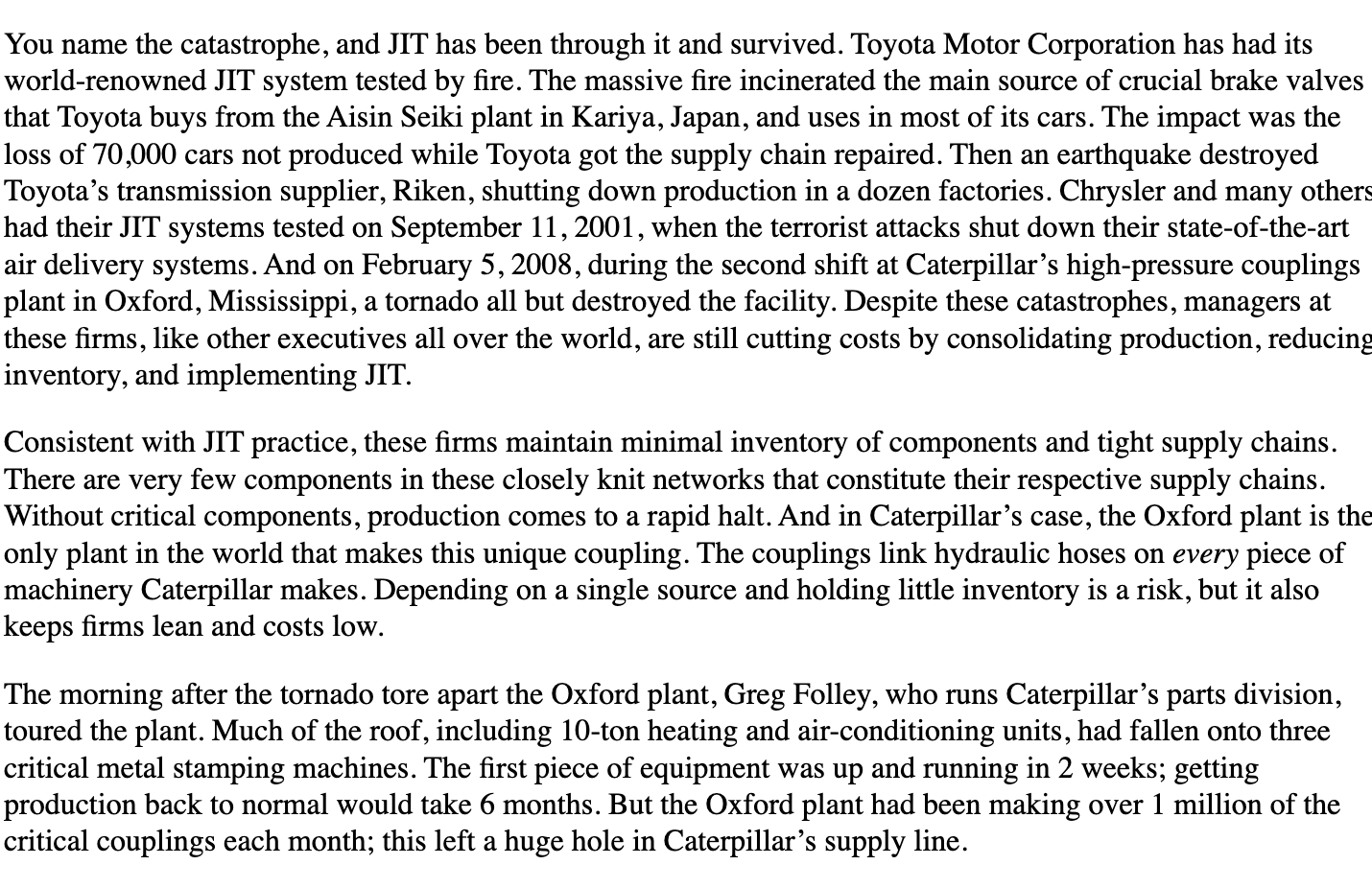
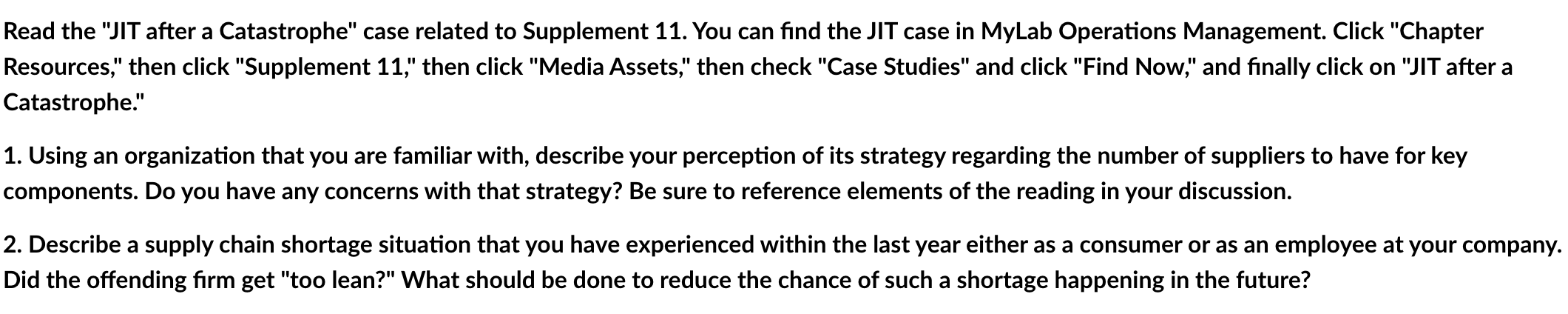
You name the catastrophe, and JIT has been through it and survived. Toyota Motor Corporation has had its world-renowned JIT system tested by fire. The massive fire incinerated the main source of crucial brake valves that Toyota buys from the Aisin Seiki plant in Kariya, Japan, and uses in most of its cars. The impact was the loss of 70,000 cars not produced while Toyota got the supply chain repaired. Then an earthquake destroyed Toyota's transmission supplier, Riken, shutting down production in a dozen factories. Chrysler and many other: had their JIT systems tested on September 11, 2001, when the terrorist attacks shut down their state-of-the-art air delivery systems. And on February 5, 2008, during the second shift at Caterpillar's high-pressure couplings plant in Oxford, Mississippi, a tornado all but destroyed the facility. Despite these catastrophes, managers at these firms, like other executives all over the world, are still cutting costs by consolidating production, reducing inventory, and implementing JIT. Consistent with JIT practice, these firms maintain minimal inventory of components and tight supply chains. There are very few components in these closely knit networks that constitute their respective supply chains. Without critical components, production comes to a rapid halt. And in Caterpillar's case, the Oxford plant is the only plant in the world that makes this unique coupling. The couplings link hydraulic hoses on every piece of machinery Caterpillar makes. Depending on a single source and holding little inventory is a risk, but it also keeps firms lean and costs low. The morning after the tornado tore apart the Oxford plant, Greg Folley, who runs Caterpillar's parts division, toured the plant. Much of the roof, including 10-ton heating and air-conditioning units, had fallen onto three critical metal stamping machines. The first piece of equipment was up and running in 2 weeks; getting production back to normal would take 6 months. But the Oxford plant had been making over 1 million of the critical couplings each month; this left a huge hole in Caterpillar's supply line. Read the "JIT after a Catastrophe" case related to Supplement 11. You can find the JIT case in MyLab Operations Management. Click "Chapter Resources," then click "Supplement 11," then click "Media Assets," then check "Case Studies" and click "Find Now," and finally click on "JIT after a Catastrophe." 1. Using an organization that you are familiar with, describe your perception of its strategy regarding the number of suppliers to have for key components. Do you have any concerns with that strategy? Be sure to reference elements of the reading in your discussion. 2. Describe a supply chain shortage situation that you have experienced within the last year either as a consumer or as an employee at your company. Did the offending firm get "too lean?" What should be done to reduce the chance of such a shortage happening in the future









 Study Help