







Question: Please help me with Wireless and mobile network question Considering a simple BSS topology where all the STAs can hear each other (i.e., no hidden
 Please help me with Wireless and mobile network question
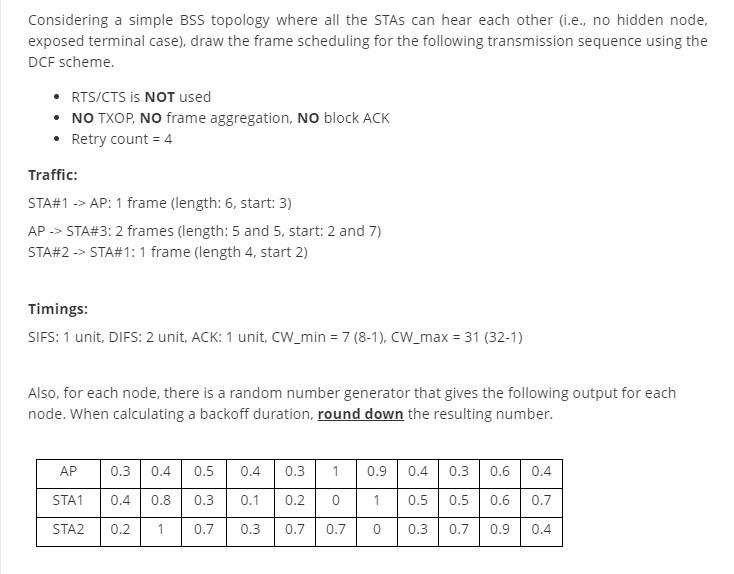
Considering a simple BSS topology where all the STAs can hear each other (i.e., no hidden node. exposed terminal case), draw the frame scheduling for the following transmission sequence using the DCF scheme. RTS/CTS is NOT used NO TXOP, NO frame aggregation, No block ACK Retry count = 4 Traffic: STA#1 -> AP: 1 frame (length: 6, start: 3) AP -> STA#3: 2 frames (length: 5 and 5, start: 2 and 7) STA#2 -> STA#1: 1 frame (length 4, start 2) Timings: SIFS: 1 unit, DIFS: 2 unit, ACK: 1 unit. CW_min = 7 (8-1), CW_max = 31 (32-1) Also, for each node, there is a random number generator that gives the following output for each node. When calculating a backoff duration, round down the resulting number. AP 0.3 0.4 0.5 0.4 0.3 1 0.9 0.4 0.3 0.6 0.4 STA1 0.4 0.8 0.3 0.1 0.2 0 1 0.5 0.5 0.6 0.7 STA2 0.2 1 0.7 0.3 0.7 0.7 0 0.3 0.7 0.9 0.4 Considering a simple BSS topology where all the STAs can hear each other (i.e., no hidden node. exposed terminal case), draw the frame scheduling for the following transmission sequence using the DCF scheme. RTS/CTS is NOT used NO TXOP, NO frame aggregation, No block ACK Retry count = 4 Traffic: STA#1 -> AP: 1 frame (length: 6, start: 3) AP -> STA#3: 2 frames (length: 5 and 5, start: 2 and 7) STA#2 -> STA#1: 1 frame (length 4, start 2) Timings: SIFS: 1 unit, DIFS: 2 unit, ACK: 1 unit. CW_min = 7 (8-1), CW_max = 31 (32-1) Also, for each node, there is a random number generator that gives the following output for each node. When calculating a backoff duration, round down the resulting number. AP 0.3 0.4 0.5 0.4 0.3 1 0.9 0.4 0.3 0.6 0.4 STA1 0.4 0.8 0.3 0.1 0.2 0 1 0.5 0.5 0.6 0.7 STA2 0.2 1 0.7 0.3 0.7 0.7 0 0.3 0.7 0.9 0.4
Step by Step Solution
There are 3 Steps involved in it

Get step-by-step solutions from verified subject matter experts
 Study Help