Question: Please help me write all this questions attached on paper please clear write la. Convert 4.27 x 1027 atoms of He to moles G: 4.27

Please help me write all this questions attached on paper please clear write
Please help me write all this questions attachedPlease help me write all this questions attachedPlease help me write all this questions attachedPlease help me write all this questions attachedPlease help me write all this questions attachedPlease help me write all this questions attachedPlease help me write all this questions attachedPlease help me write all this questions attachedPlease help me write all this questions attached
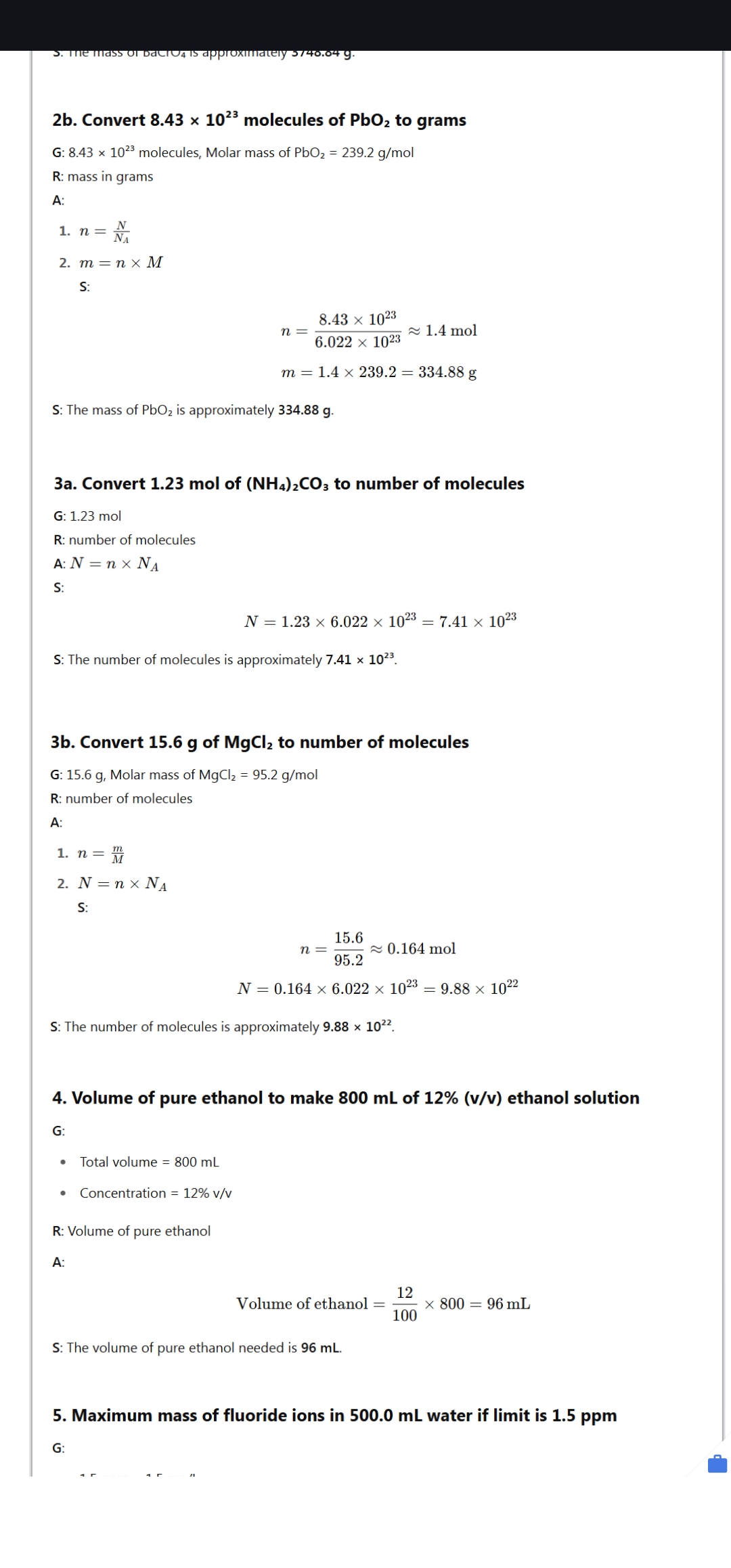
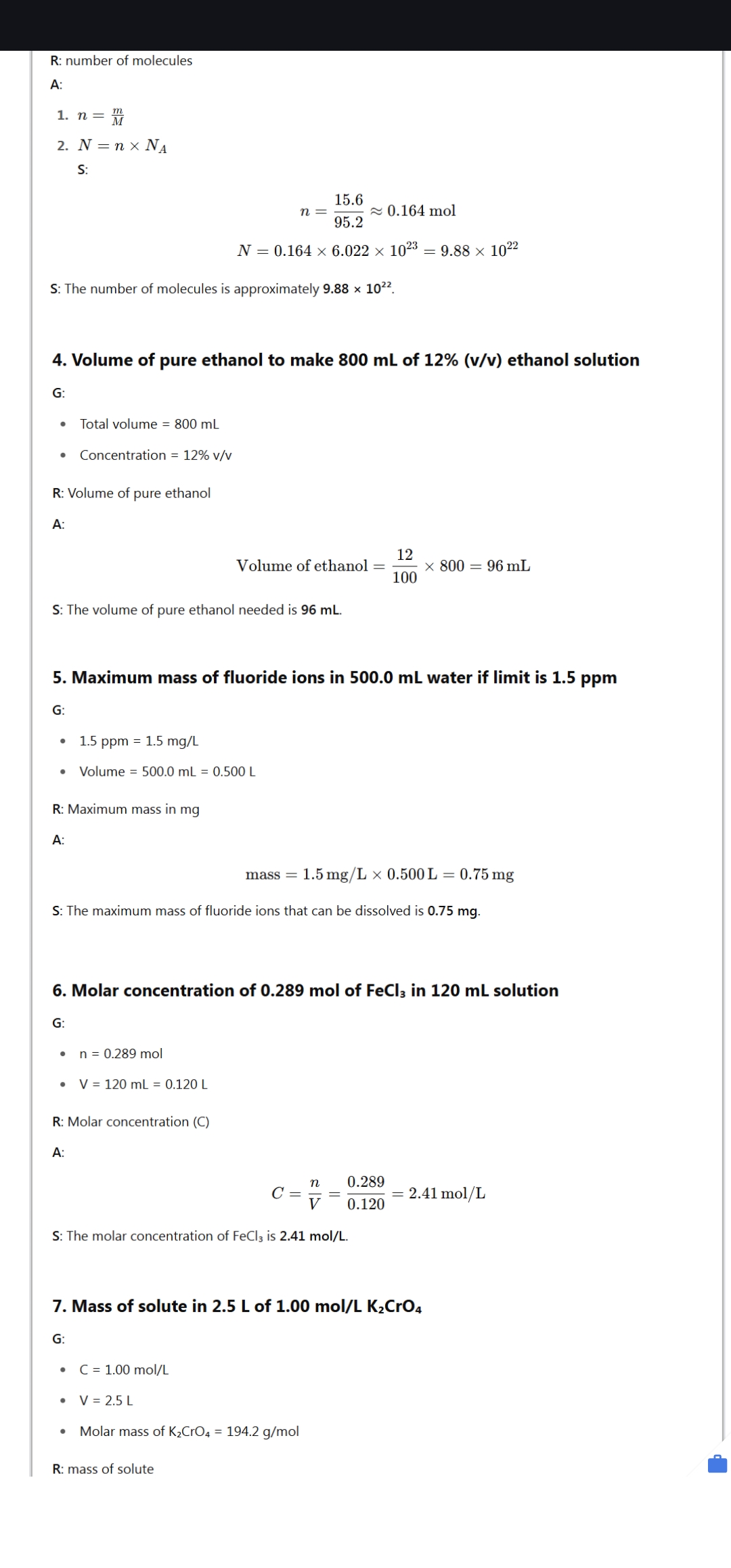
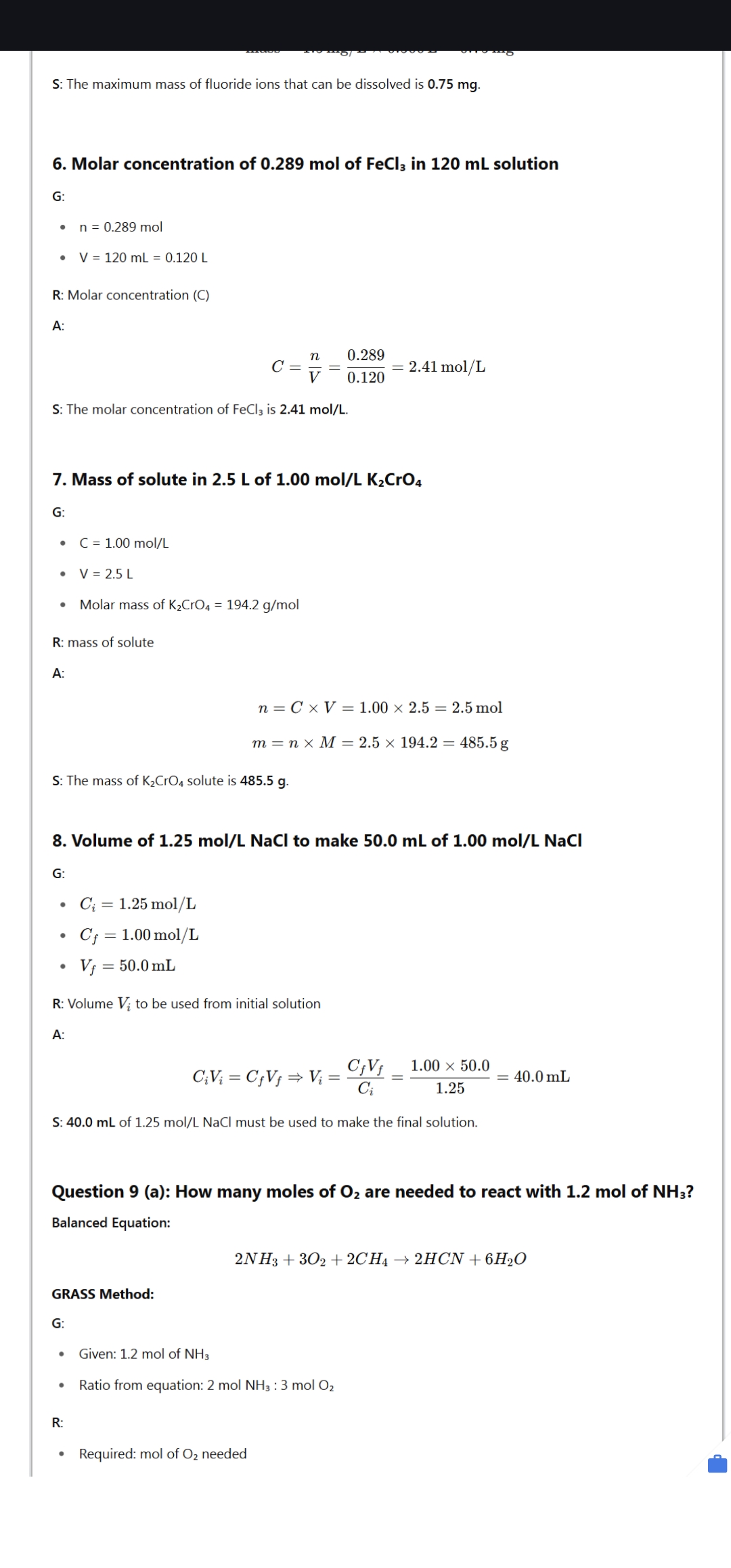
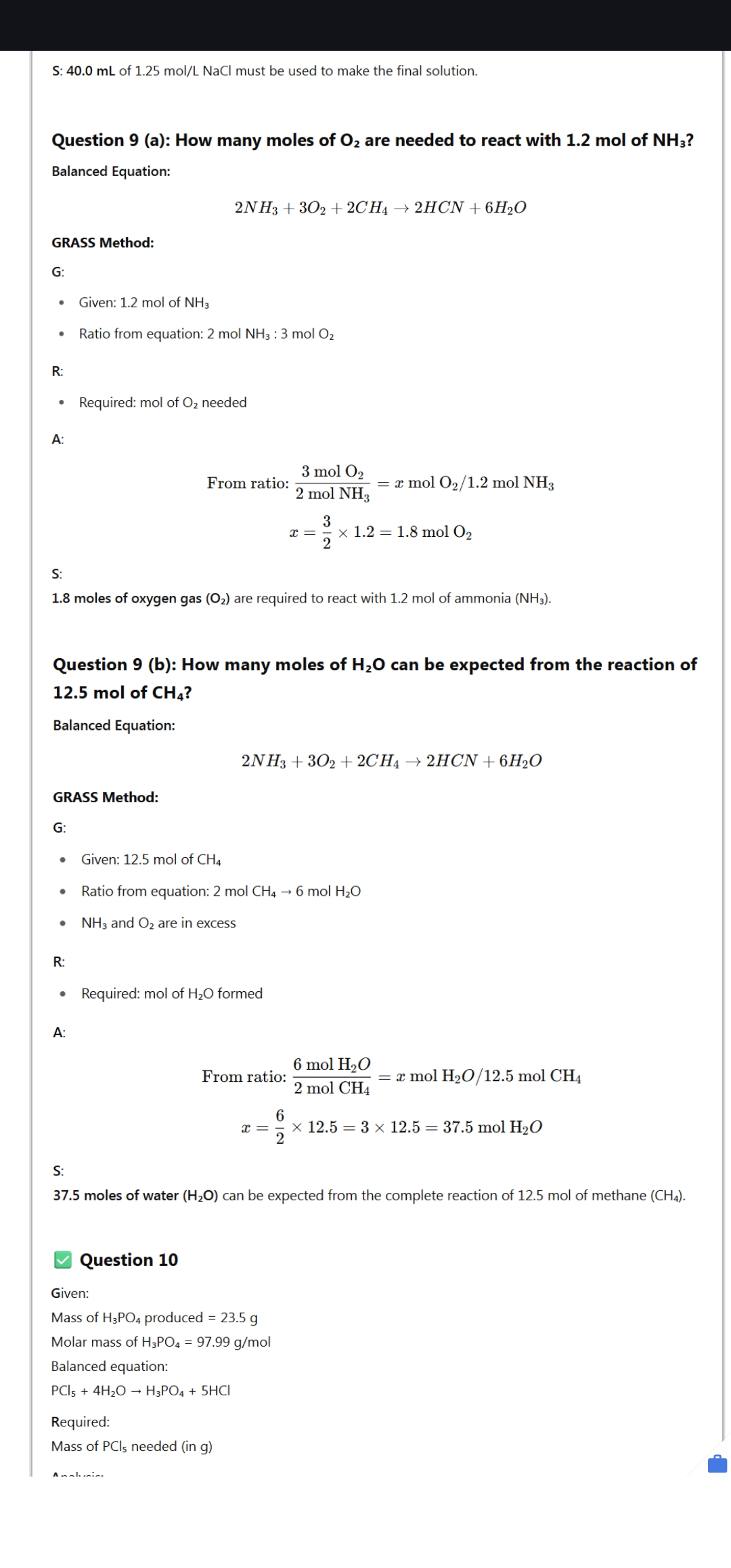
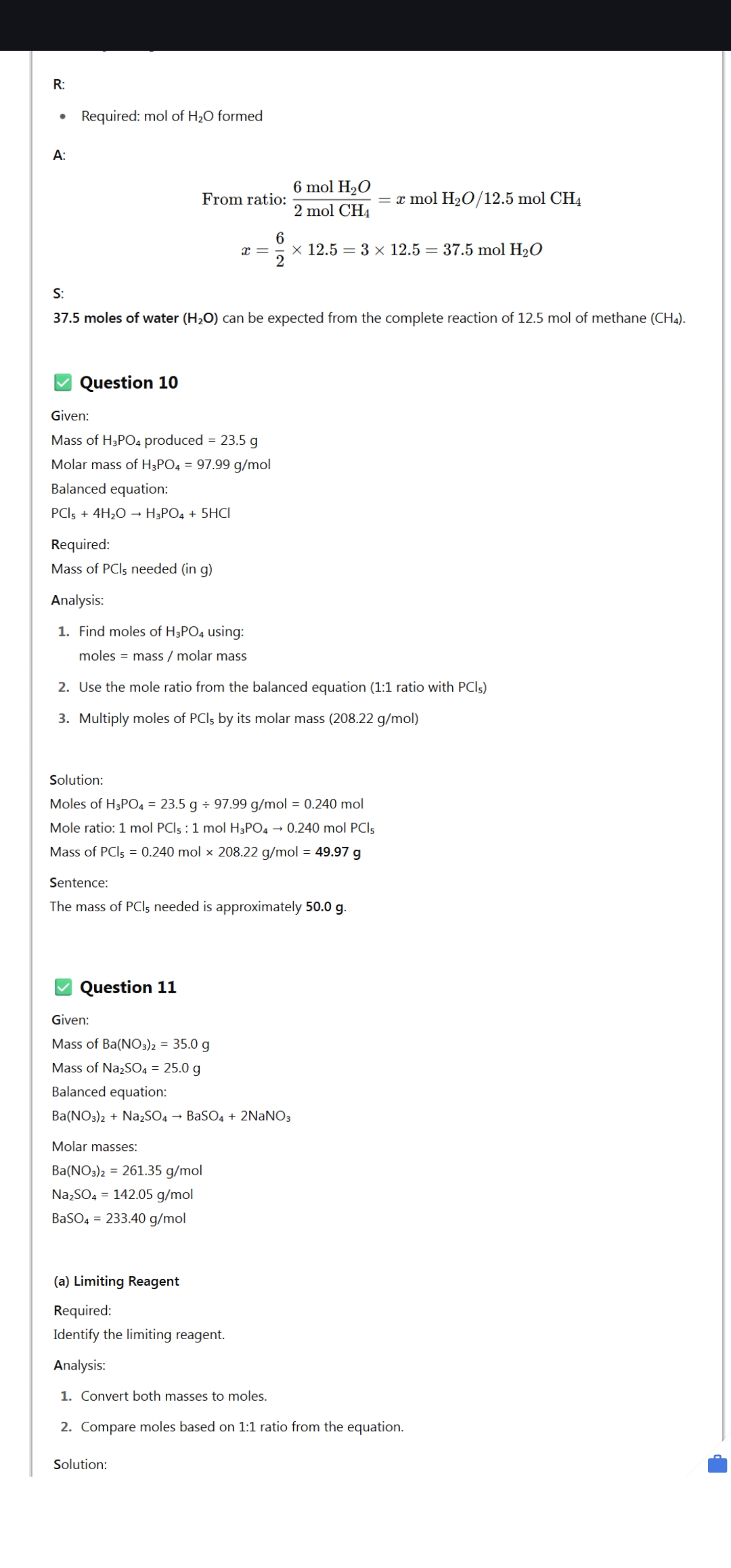
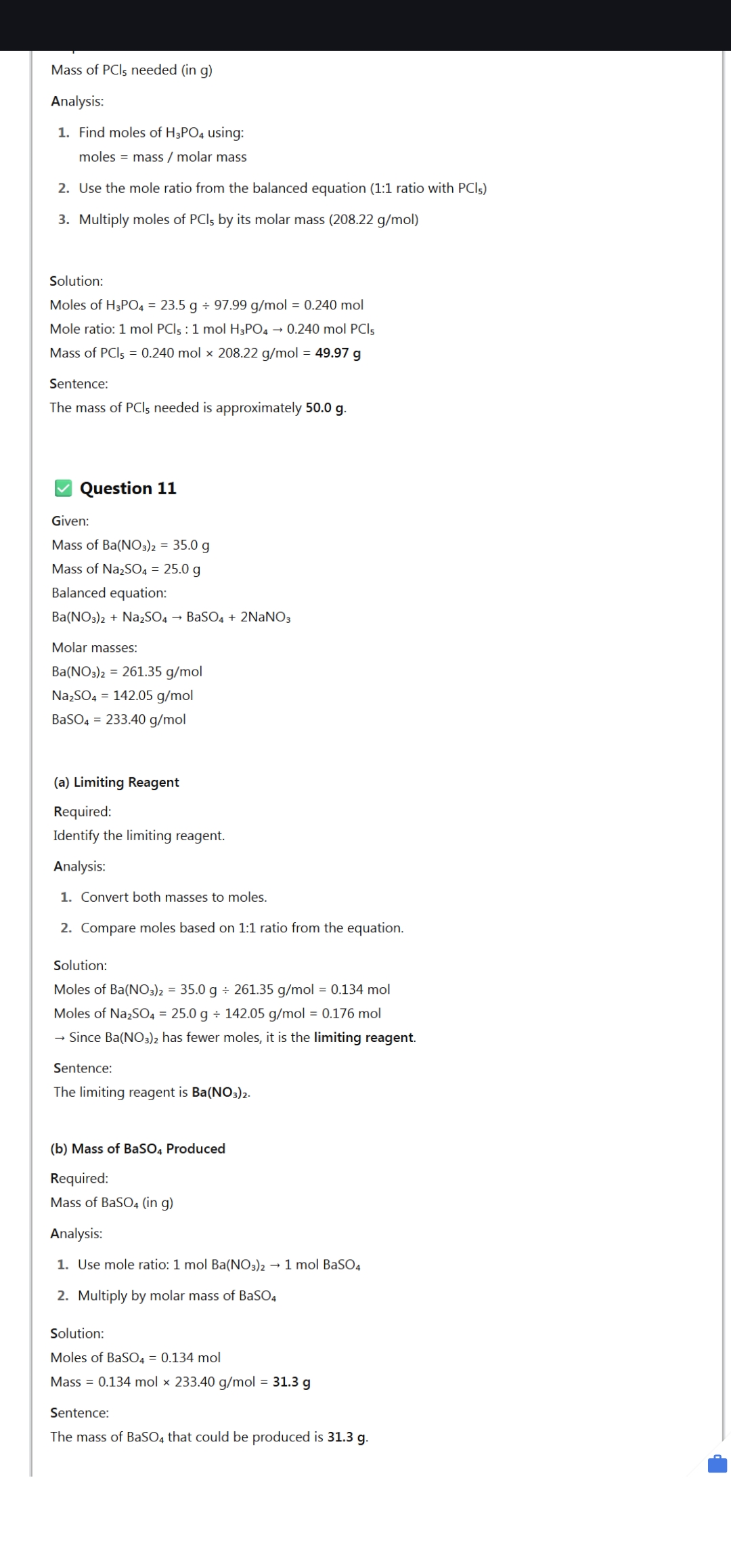
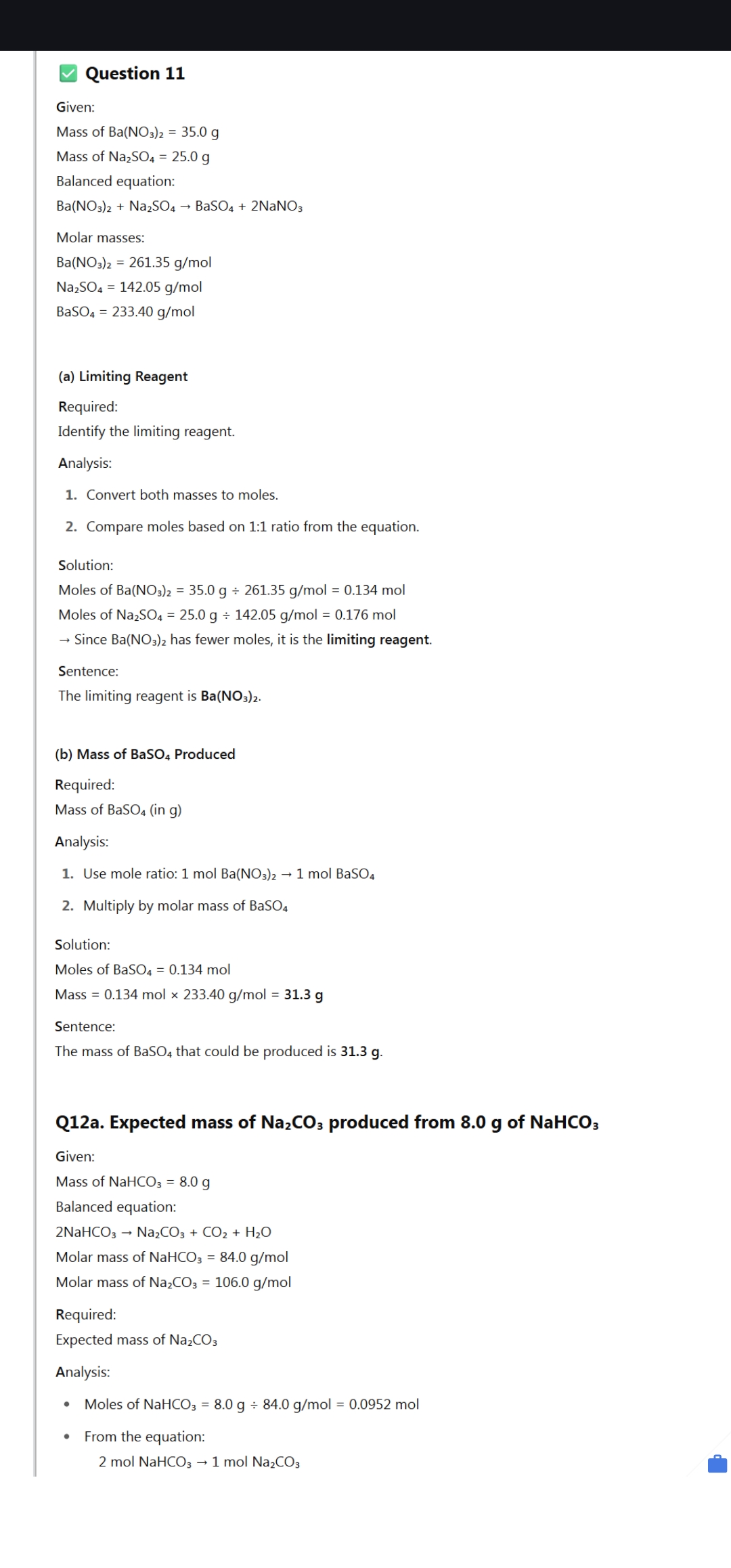
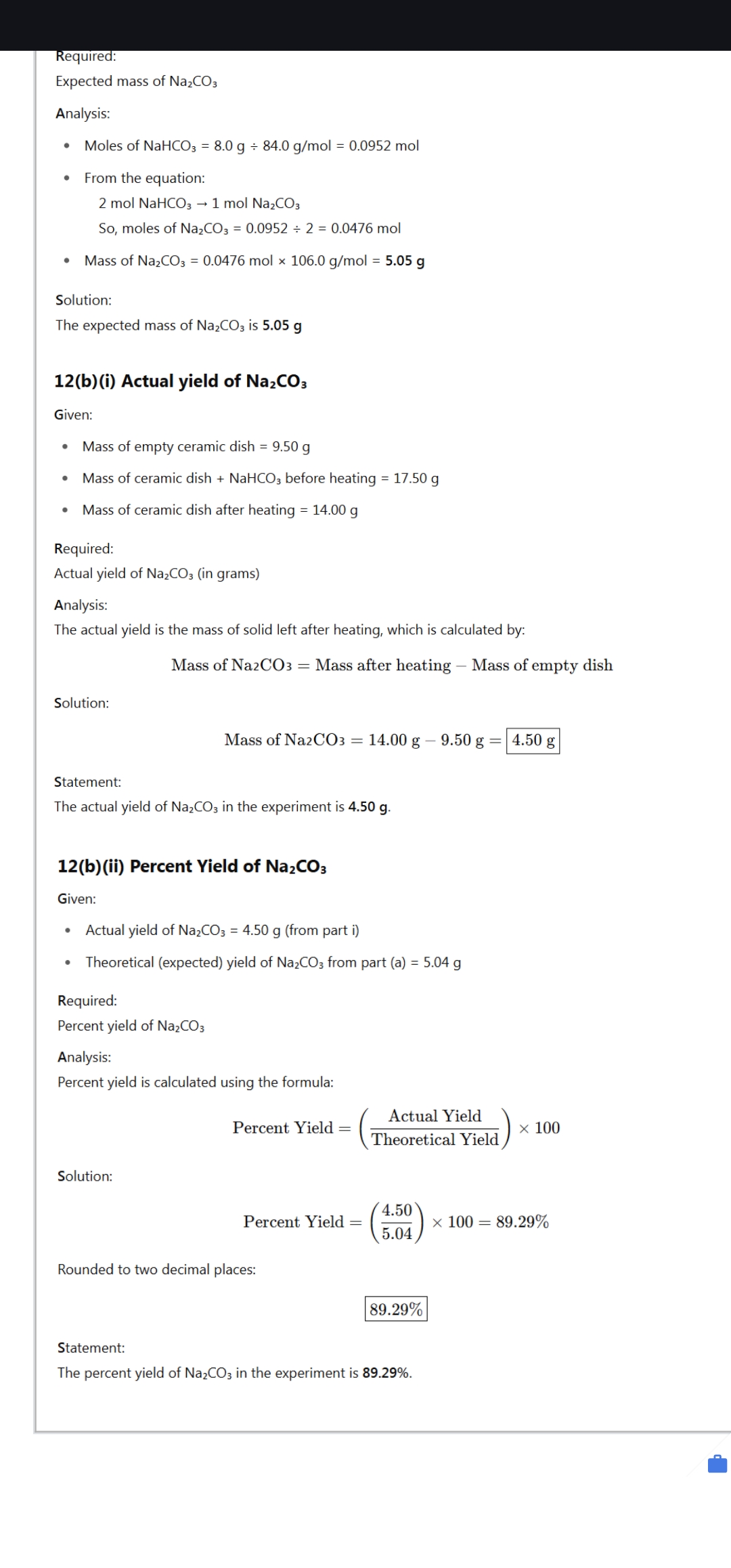
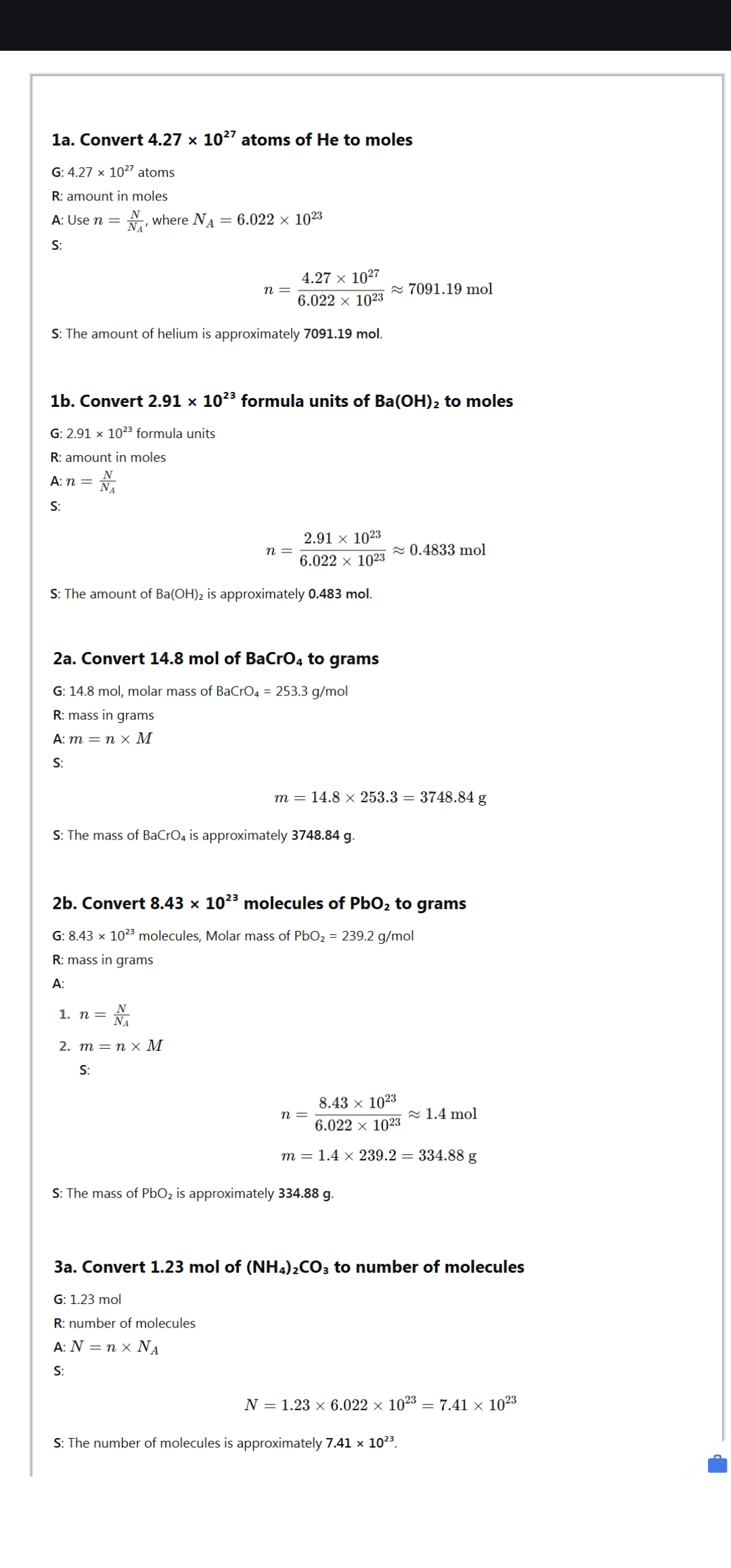
la. Convert 4.27 x 1027 atoms of He to moles G: 4.27 x 1027 atoms R: amount in moles A: Use n = M. where NA = 6.022 x 10²³ S 4.27 x 1027 n = 6.022 x 10²³ ~ 7091.19 mol S: The amount of helium is approximately 7091.19 mol. 1b. Convert 2.91 x 1025 formula units of Ba(OH)2 to moles G: 2.91 x 1025 formula units R: amount in moles A: n = NA S 2.91 x 10²³ n= 6.022 x 10²³ ~ 0.4833 mol S: The amount of Ba(OH)2 is approximately 0.483 mol. 2a. Convert 14.8 mol of BaCro4 to grams G: 14.8 mol, molar mass of BaCro4 = 253.3 g/mol R: mass in grams A: m = n X M S m = 14.8 x 253.3 = 3748.84 g S: The mass of BaCro4 is approximately 3748.84 g. 2b. Convert 8.43 x 1025 molecules of PbO2 to grams G: 8.43 x 1025 molecules, Molar mass of PbO2 = 239.2 g/mol R: mass in grams A 1. n = N 2. m =n x M S: 8.43 x 10²³ n = 6.022 x 10²³ ~ 1.4 mol m = 1.4 x 239.2 = 334.88 g S: The mass of PbO2 is approximately 334.88 g. 3a. Convert 1.23 mol of (NH4)2CO: to number of molecules G: 1.23 mol R: number of molecules A: N = n X NA S: N = 1.23 x 6.022 x 1023 = 7.41 x 10²³ S: The number of molecules is approximately 7.41 x 1023.mass o 2b. Convert 8.43 x 1025 molecules of PbO2 to grams G: 8.43 x 1025 molecules, Molar mass of PbO2 = 239.2 g/mol R: mass in grams A: 1. n = N 2. m =n x M S. 8.43 x 10²³ n = 6.022 x 10²³ ~ 1.4 mol m = 1.4 x 239.2 = 334.88 g S: The mass of PbO2 is approximately 334.88 g. 3a. Convert 1.23 mol of (NH4)2CO: to number of molecules G: 1.23 mol R: number of molecules A: N = n X NA S: N = 1.23 x 6.022 x 1023 = 7.41 x 10²³ S: The number of molecules is approximately 7.41 x 10²³. 3b. Convert 15.6 g of MgCl2 to number of molecules G: 15.6 g, Molar mass of MgCl2 = 95.2 g/mol R: number of molecules A: 1. n = 2. N =n XNA S; 15.6 n : ~0.164 mol 95.2 N = 0.164 x 6.022 x 1023 = 9.88 x 10²² S: The number of molecules is approximately 9.88 x 10²². 4. Volume of pure ethanol to make 800 mL of 12% (v/v) ethanol solution G: Total volume = 800 ml Concentration = 12% v/v R: Volume of pure ethanol A: Volume of ethanol = = 12 x 800 = 96 mL 100 S: The volume of pure ethanol needed is 96 mL. 5. Maximum mass of fluoride ions in 500.0 mL water if limit is 1.5 ppm GR: number of molecules A: 1. n = M 2. N =n XNA S: 15.6 n = ~0.164 mol 95.2 N = 0.164 x 6.022 x 1025 = 9.88 x 10²² S: The number of molecules is approximately 9.88 x 10²² 4. Volume of pure ethanol to make 800 mL of 12% (v/v) ethanol solution G: Total volume = 800 mL Concentration = 12% v/v R: Volume of pure ethanol A Volume of ethanol = - 12 100 X 800 = 96 mL S: The volume of pure ethanol needed is 96 mL. 5. Maximum mass of fluoride ions in 500.0 ml water if limit is 1.5 ppm G. . 1.5 ppm = 1.5 mg/L . Volume = 500.0 ml = 0.500 L R: Maximum mass in mg A: mass = 1.5mg/L x 0.500L = 0.75 mg S: The maximum mass of fluoride ions that can be dissolved is 0.75 mg. 6. Molar concentration of 0.289 mol of FeCls in 120 mL solution G . n = 0.289 mol . V = 120 ml = 0.120 L R: Molar concentration (C) A: n 0.289 C = V 0.120 - 2.41 mol/L S: The molar concentration of FeCly is 2.41 mol/L. 7. Mass of solute in 2.5 L of 1.00 mol/L K2Cr04 G: . C = 1.00 mol/L V = 2.5 L Molar mass of K2Cr04 = 194.2 g/mol R: mass of soluteS: The maximum mass of fluoride ions that can be dissolved is 0.75 mg. 6. Molar concentration of 0.289 mol of FeCls in 120 mL solution G: n = 0.289 mol . V = 120 ml = 0.120 L R: Molar concentration (C) A: C = n 0.289 V 0.120 = 2.41 mol/L S: The molar concentration of FeCls is 2.41 mol/L. 7. Mass of solute in 2.5 L of 1.00 mol/L K2Cr04 G . C = 1.00 mol/L V = 2.5 L . Molar mass of K2Cr04 = 194.2 g/mol R: mass of solute n = C x V = 1.00 x 2.5 = 2.5 mol m = n x M = 2.5 x 194.2 = 485.5 g S: The mass of K2Cr04 solute is 485.5 g. 8. Volume of 1.25 mol/L NaCl to make 50.0 mL of 1.00 mol/L NaCl G: . Ci = 1.25 mol/L . Cf = 1.00 mol/L . Vf = 50.0 mL R: Volume Vi to be used from initial solution A: CiVi = CIVs = Vi = CIVs 1.00 x 50.0 Ci = 40.0 mL 1.25 S: 40.0 mL of 1.25 mol/L NaCl must be used to make the final solution. Question 9 (a): How many moles of Oz are needed to react with 1.2 mol of NH3? Balanced Equation: 2NH3 + 302 + 2CH4 - 2HCN + 6H20 GRASS Method: G Given: 1.2 mol of NH3 . Ratio from equation: 2 mol NH3 : 3 mol Oz R Required: mol of Oz neededS: 40.0 mL of 1.25 mol/L NaCl must be used to make the final solution. Question 9 (a): How many moles of Oz are needed to react with 1.2 mol of NH3? Balanced Equation: 2NH3 + 302 + 2CHA - 2HCN + 6H20 GRASS Method: G Given: 1.2 mol of NH3 Ratio from equation: 2 mol NH3 : 3 mol Oz R . Required: mol of Oz needed A: From ratio: 3 mol O2 2 mol NH3 = x mol O2/1.2 mol NH3 x = , x 1.2 = 1.8 mol Oz S 1.8 moles of oxygen gas (02) are required to react with 1.2 mol of ammonia (NH3). Question 9 (b): How many moles of H2O can be expected from the reaction of 12.5 mol of CH4? Balanced Equation: 2NH3 + 302 + 2CH4 - 2HCN + 6H20 GRASS Method: G Given: 12.5 mol of CH4 Ratio from equation: 2 mol CH4 - 6 mol H20 NH3 and Oz are in excess . Required: mol of H2O formed A: 6 mol H20 From ratio: 2 mol CH4 = x mol H20/12.5 mol CH4 x 12.5 = 3 x 12.5 = 37.5 mol H20 S: 37.5 moles of water (H20) can be expected from the complete reaction of 12.5 mol of methane (CH4). Question 10 Given: Mass of H3PO4 produced = 23.5 g Molar mass of H3PO4 = 97.99 g/mol Balanced equation: PCIs + 4H20 - H3PO4 + 5HCI Required: Mass of PCIs needed (in g)R Required: mol of H2O formed A: From ratio: 6 mol HO 2 mol CH4 = x mol H20/12.5 mol CH4 x 12.5 = 3 x 12.5 = 37.5 mol H20 S: 37.5 moles of water (H20) can be expected from the complete reaction of 12.5 mol of methane (CH4). Question 10 Given: Mass of H3PO4 produced = 23.5 g Molar mass of H3PO4 = 97.99 g/mol Balanced equation: PCls + 4H20 - H3PO4 + 5HCI Required: Mass of PCIs needed (in g) Analysis: 1. Find moles of H3PO4 using: moles = mass / molar mass 2. Use the mole ratio from the balanced equation (1:1 ratio with PCIs) 3. Multiply moles of PCIs by its molar mass (208.22 g/mol) Solution: Moles of H3PO4 = 23.5 g + 97.99 g/mol = 0.240 mol Mole ratio: 1 mol PCIs : 1 mol HaPO4 - 0.240 mol PCIs Mass of PCIs = 0.240 mol x 208.22 g/mol = 49.97 g Sentence: The mass of PCIs needed is approximately 50.0 g. Question 11 Given: Mass of Ba(NO3)2 = 35.0 g Mass of NazSO4 = 25.0 g Balanced equation: Ba(NO3)2 + NazSO4 - BaSO4 + 2NaNO3 Molar masses: Ba(NO3)2 = 261.35 g/mol Na2SO4 = 142.05 g/mol BaSO4 = 233.40 g/mol (a) Limiting Reagent Required: Identify the limiting reagent. Analysis: 1. Convert both masses to moles. 2. Compare moles based on 1:1 ratio from the equation. Solution:Mass of PCIs needed (in g) Analysis: 1. Find moles of H3PO4 using: moles = mass / molar mass 2. Use the mole ratio from the balanced equation (1:1 ratio with PCIs) 3. Multiply moles of PCIs by its molar mass (208.22 g/mol) Solution: Moles of H3PO4 = 23.5 g : 97.99 g/mol = 0.240 mol Mole ratio: 1 mol PCIs : 1 mol H3PO4 - 0.240 mol PCIs Mass of PCIs = 0.240 mol x 208.22 g/mol = 49.97 g Sentence: The mass of PCIs needed is approximately 50.0 g. Question 11 Given: Mass of Ba(NO3)2 = 35.0 g Mass of Na2SO4 = 25.0 g Balanced equation: Ba(NO3)2 + NazSO4 - BaSO4 + 2NaNO3 Molar masses: Ba(NO3)2 = 261.35 g/mol Na2SO4 = 142.05 g/mol BaSO4 = 233.40 g/mol (a) Limiting Reagent Required: Identify the limiting reagent. Analysis: 1. Convert both masses to moles. 2. Compare moles based on 1:1 ratio from the equation. Solution: Moles of Ba(NO3)2 = 35.0 g : 261.35 g/mol = 0.134 mol Moles of Na2SO4 = 25.0 g + 142.05 g/mol = 0.176 mol Since Ba(NO3)2 has fewer moles, it is the limiting reagent. Sentence: The limiting reagent is Ba(NO3)2- (b) Mass of BaSO4 Produced Required: Mass of BaSO4 (in g) Analysis: 1. Use mole ratio: 1 mol Ba(NO3)2 - 1 mol BaSO4 2. Multiply by molar mass of BaSO4 Solution: Moles of BaSO4 = 0.134 mol Mass = 0.134 mol x 233.40 g/mol = 31.3 g Sentence: The mass of BaSO4 that could be produced is 31.3 g.Question 11 Given: Mass of Ba(NO3)2 = 35.0 g Mass of NazSO4 = 25.0 g Balanced equation: Ba(NO3)2 + NazSO4 - BaSO4 + 2NaNO3 Molar masses: Ba(NO3)2 = 261.35 g/mol NazSO4 = 142.05 g/mol BaSO4 = 233.40 g/mol (a) Limiting Reagent Required: Identify the limiting reagent. Analysis: 1. Convert both masses to moles. 2. Compare moles based on 1:1 ratio from the equation. Solution: Moles of Ba(NO3)2 = 35.0 g + 261.35 g/mol = 0.134 mol Moles of Na2SO4 = 25.0 g : 142.05 g/mol = 0.176 mol - Since Ba(NO3)2 has fewer moles, it is the limiting reagent. Sentence: The limiting reagent is Ba(NO3)2. (b) Mass of BaSO4 Produced Required: Mass of BaSO4 (in g) Analysis: 1. Use mole ratio: 1 mol Ba(NO3)2 - 1 mol BaSO4 2. Multiply by molar mass of BaSO4 Solution: Moles of BaSO4 = 0.134 mol Mass = 0.134 mol x 233.40 g/mol = 31.3 g Sentence: The mass of BaSO4 that could be produced is 31.3 g. Q12a. Expected mass of NazCO; produced from 8.0 g of NaHCO3 Given: Mass of NaHCO3 = 8.0 g Balanced equation: 2NaHCO3 - NazCO3 + CO2 + H2O Molar mass of NaHCO3 = 84.0 g/mol Molar mass of NazCO3 = 106.0 g/mol Required: Expected mass of NazCO3 Analysis: . Moles of NaHCO3 = 8.0 g + 84.0 g/mol = 0.0952 mol From the equation: 2 mol NaHCO3 - 1 mol NazCO3Required: Expected mass of NazCO3 Analysis: . Moles of NaHCO3 = 8.0 g + 84.0 g/mol = 0.0952 mol . From the equation: 2 mol NaHCO3 - 1 mol NazCO3 So, moles of NazCO3 = 0.0952 + 2 = 0.0476 mol . Mass of NazCO3 = 0.0476 mol x 106.0 g/mol = 5.05 g Solution: The expected mass of NazCO, is 5.05 g 12(b)(i) Actual yield of NazCO3 Given: . Mass of empty ceramic dish = 9.50 g . Mass of ceramic dish + NaHCO3 before heating = 17.50 g . Mass of ceramic dish after heating = 14.00 g Required: Actual yield of NazCO3 (in grams) Analysis: The actual yield is the mass of solid left after heating, which is calculated by: Mass of NazCO3 = Mass after heating - Mass of empty dish Solution: Mass of NazCO3 = 14.00 g - 9.50 g = 4.50 g Statement: The actual yield of Naz CO, in the experiment is 4.50 g. 12(b) (ii) Percent Yield of NazCO3 Given: . Actual yield of NazCO; = 4.50 g (from part i) . Theoretical (expected) yield of NazCO3 from part (a) = 5.04 g Required: Percent yield of Naz CO3 Analysis: Percent yield is calculated using the formula: Actual Yield Percent Yield = X 100 Theoretical Yield Solution: Percent Yield = 4.50 5.04 x 100 = 89.29% Rounded to two decimal places: 89.29% Statement: The percent yield of NazCO; in the experiment is 89.29%

Step by Step Solution

There are 3 Steps involved in it

1 Expert Approved Answer
Step: 1 Unlock blur-text-image

Question Has Been Solved by an Expert!

Get step-by-step solutions from verified subject matter experts

Step: 2 Unlock
Step: 3 Unlock

Students Have Also Explored These Related Accounting Questions!