Question: Please Help: Module 9 Assessment Module 9: Real-World Application Problems A. A species of honey bees creates hexagonal (6-sided) honeycombs. The bees begin with a

Please Help: Module 9 Assessment
Please Help: Module 9 Assessment Module 9:Please Help: Module 9 Assessment Module 9:
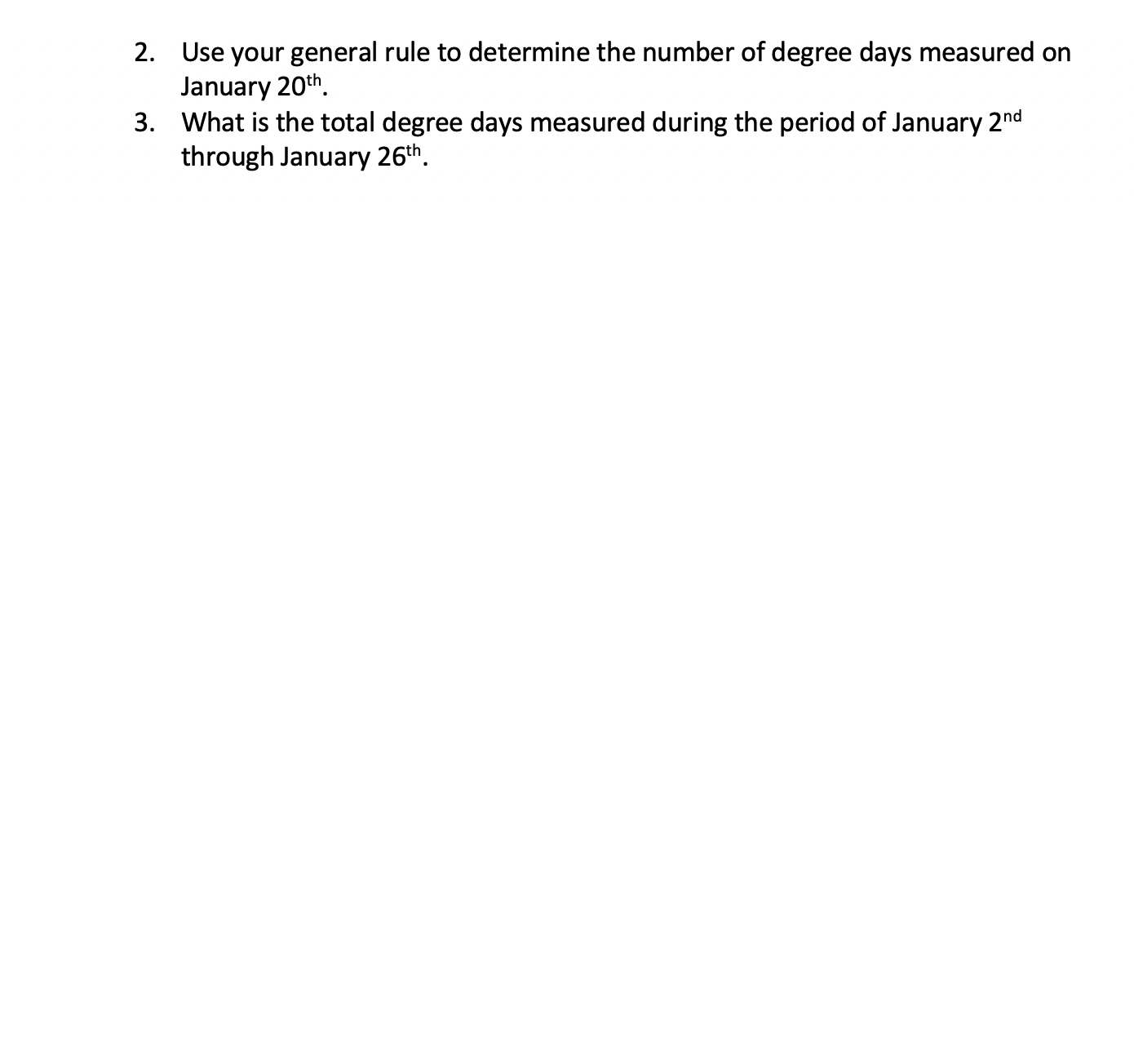
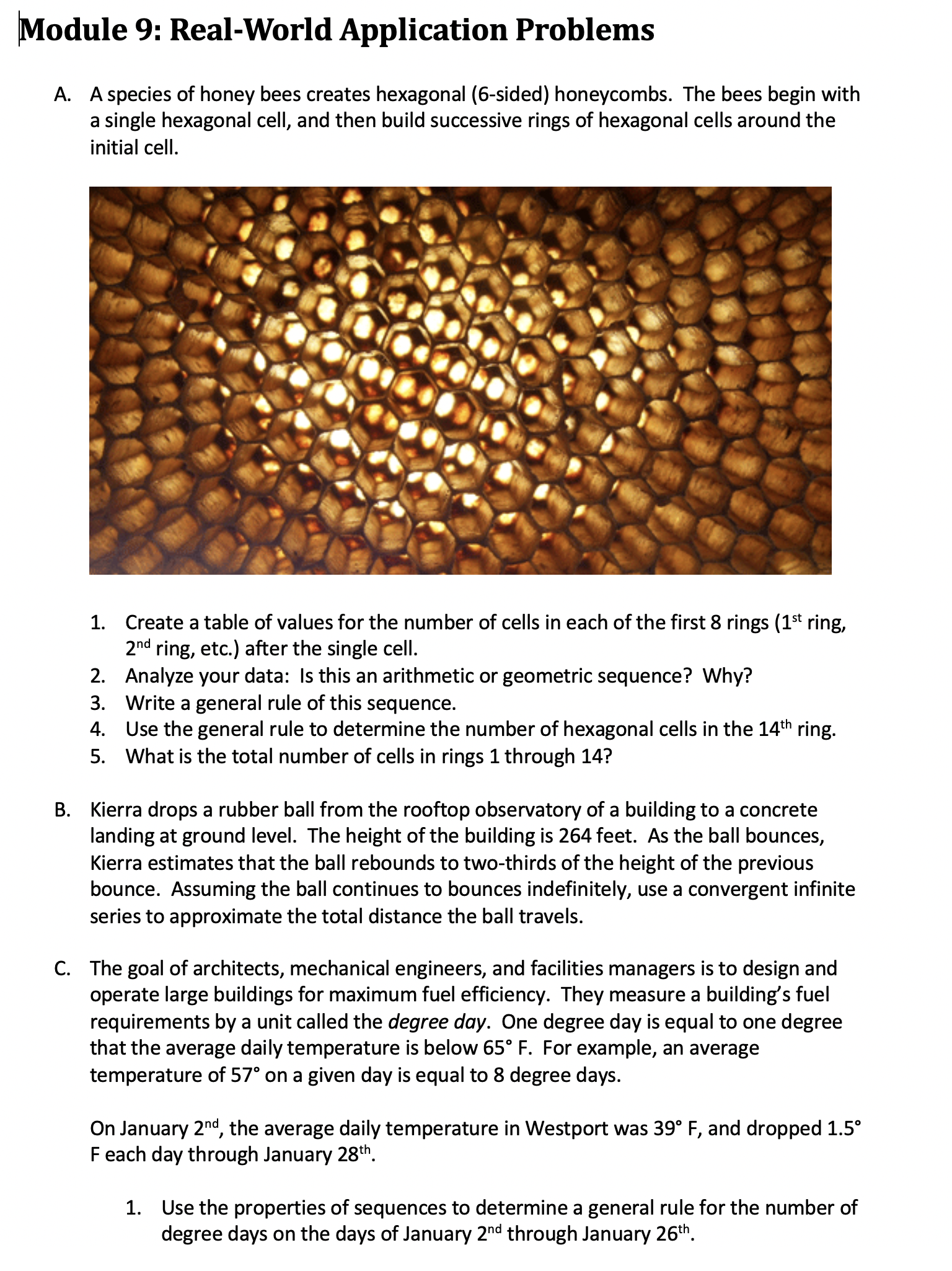
Module 9: Real-World Application Problems A. A species of honey bees creates hexagonal (6-sided) honeycombs. The bees begin with a single hexagonal cell, and then build successive rings of hexagonal cells around the initial cell. 1. Create a table of values for the number of cells in each of the first 8 rings (1St ring, 2'1d ring, etc.) after the single cell. 2. Analyze your data: Is this an arithmetic or geometric sequence? Why? 3. Write a general rule of this sequence. 4. Use the general rule to determine the number of hexagonal cells in the 14th ring. 5. What is the total number of cells in rings 1 through 14? B. Kierra drops a rubber ball from the rooftop observatory of a building to a concrete landing at ground level. The height of the building is 264 feet. As the ball bounces, Kierra estimates that the ball rebounds to two-thirds of the height of the previous bounce. Assuming the ball continues to bounces indefinitely, use a convergent infinite series to approximate the total distance the ball travels. C. The goal of architects, mechanical engineers, and facilities managers is to design and operate large buildings for maximum fuel efciency. They measure a building' 5 fuel requirements by a unit called the degree day. One degree day is equal to one degree that the average daily temperature is below 65 F. For example, an average temperature of 57 on a given day is equal to 8 degree days. On January 2"\2. Use your general rule to determine the number of degree days measured on January 20th. 3. What is the total degree days measured during the period of January 2nd through January 26th

Step by Step Solution

There are 3 Steps involved in it

1 Expert Approved Answer
Step: 1 Unlock blur-text-image

Question Has Been Solved by an Expert!

Get step-by-step solutions from verified subject matter experts

Step: 2 Unlock
Step: 3 Unlock

Students Have Also Explored These Related Mathematics Questions!