







Question: please help! need ASAP thank you General guidelines To write a good case report, you need to Understand the information presented in the case and
please help! need ASAP thank you 
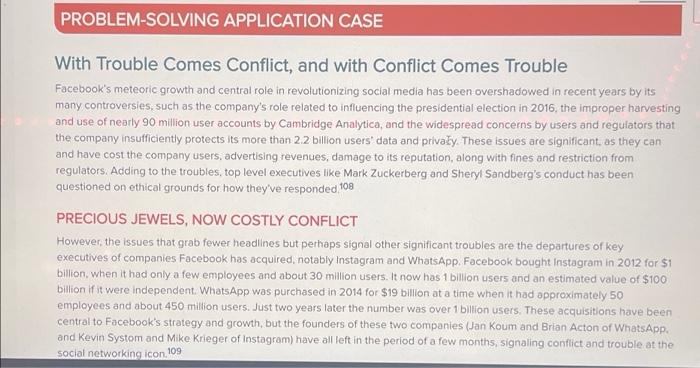
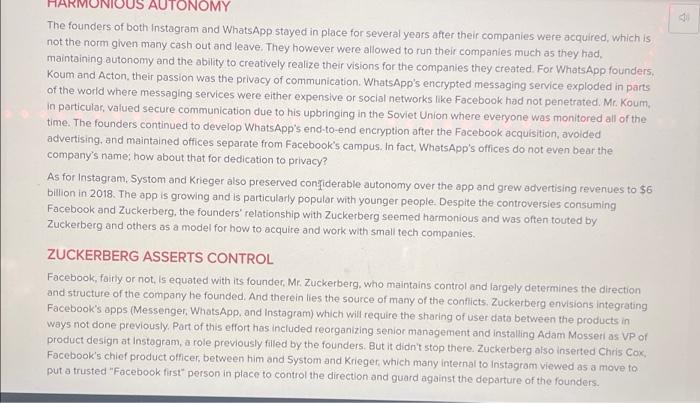
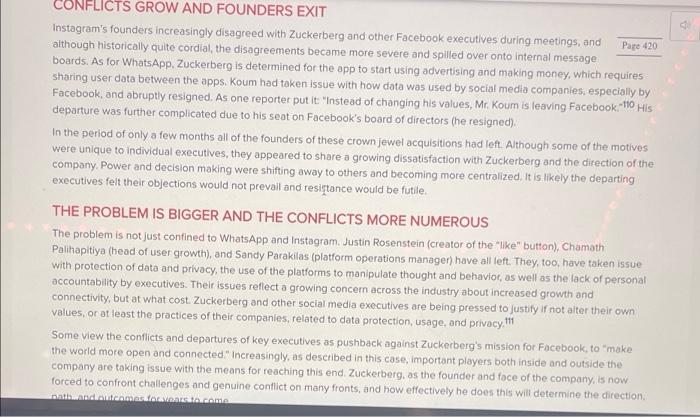
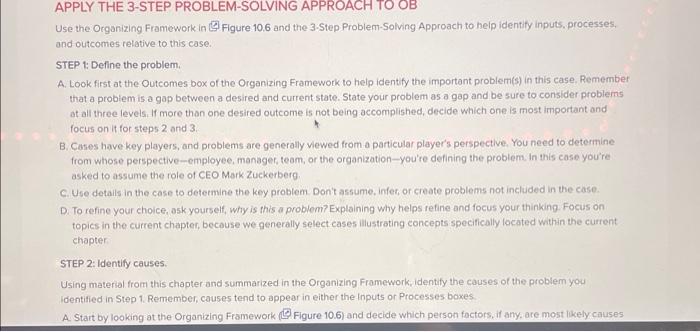
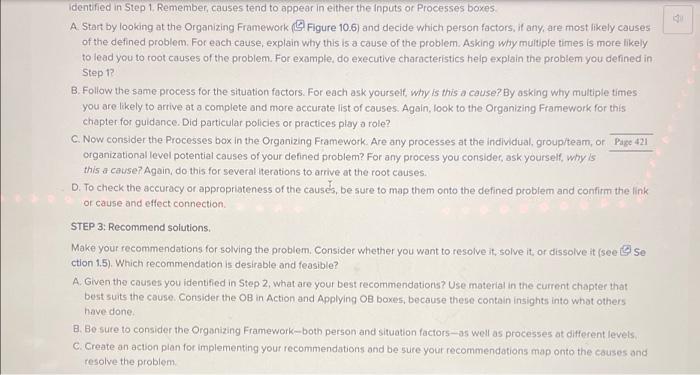
General guidelines To write a good case report, you need to Understand the information presented in the case and incorporate relevant course material to identify, explain, and address the most important problem. Apply the three-step problem solving approach (page 21 of the textbook) Write clearly and convincingly Support your claims and statements with facts Demonstrate that you understand relevatn OB concepts Use proper grammar and punctuation . . . PROBLEM-SOLVING APPLICATION CASE With Trouble Comes Conflict, and with Conflict Comes Trouble Facebook's meteoric growth and central role in revolutionizing social media has been overshadowed in recent years by its many controversies, such as the company's role related to influencing the presidential election in 2016, the improper harvesting and use of nearly 90 million user accounts by Cambridge Analytica, and the widespread concerns by users and regulators that the company insufficiently protects its more than 2.2 billion users' data and privacy. These issues are significant, as they can and have cost the company users, advertising revenues, damage to its reputation, along with fines and restriction from regulators. Adding to the troubles, top level executives like Mark Zuckerberg and Sheryl Sandberg's conduct has been questioned on ethical grounds for how they've responded 108 PRECIOUS JEWELS, NOW COSTLY CONFLICT However , the issues that grab fewer headlines but perhaps signal other significant troubles are the departures of key executives of companies Facebook has acquired, notably Instagram and WhatsApp, Facebook bought Instagram in 2012 for $1 billion, when it had only a few employees and about 30 million users. It now has 1 billion users and an estimated value of $100 billion if it were independent. WhatsApp was purchased in 2014 for $19 billion at a time when it had approximately 50 employees and about 450 million users. Just two years later the number was over 1 billion users. These acquisitions have been centralto Facebook's strategy and growth, but the founders of these two companies (Jan Koum and Brian Acton of WhatsApp and Kevin Systom and Mike Krieger of Instagram) have all left in the period of a few months, signaling conflict and trouble at the social networking icon. 109 AUTONOMY The founders of both Instagram and WhatsApp stayed in place for several years after their companies were acquired, which is not the norm given many cash out and leave. They however were allowed to run their companies much as they had. maintaining autonomy and the ability to creatively realize their visions for the companies they created. For WhatsApp founders, Koum and Acton, their passion was the privacy of communication. WhatsApp's encrypted messaging service exploded in parts of the world where messaging services were either expensive or social networks like Facebook had not penetrated. Mr. Koum, in particular, valued secure communication due to his upbringing in the Soviet Union where everyone was monitored all of the time. The founders continued to develop WhatsApp's end-to-end encryption after the Facebook acquisition, avoided advertising, and maintained offices separate from Facebook's campus. In fact, WhatsApp's offices do not even bear the company's name; how about that for dedication to privacy? As for Instagram, Systom and Krieger also preserved confiderable autonomy over the app and grew advertising revenues to $6 billion in 2018. The app is growing and is particularly popular with younger people. Despite the controversies consuming Facebook and Zuckerberg, the founders' relationship with Zuckerberg seemed harmonious and was often touted by Zuckerberg and others as a model for how to acquire and work with small tech companies. ZUCKERBERG ASSERTS CONTROL Facebook, fairly or not, is equated with its founder, Mr. Zuckerberg, who maintains control and largely determines the direction and structure of the company he founded. And therein lies the source of many of the conflicts. Zuckerberg envisions Integrating Facebook's apps (Messenger, WhatsApp, and Instagram) which will require the sharing of user data between the products in ways not done previously, Part of this effort has included reorganizing senior management and installing Adam Mosseri as VP of product design at Instagram, a role previously filled by the founders. But it didn't stop there. Zuckerberg also inserted Chris Cox Facebook's chief product officer, between him and Systom and Krieger, which many internal to Instagram viewed as a move to put a trusted "Facebook first person in place to control the direction and guard against the departure of the founders. CONFLICTS GROW AND FOUNDERS EXIT Instagram's founders increasingly disagreed with Zuckerberg and other Facebook executives during meetings, and Page 420 although historically quite cordial, the disagreements became more severe and spilled over onto internal message boards. As for WhatsApp, Zuckerberg is determined for the app to start using advertising and making money, which requires sharing user data between the apps. Koum had taken issue with how data was used by social media companies, especially by Facebook, and abruptly resigned. As one reporter put it "instead of changing his values, Mr. Koum is leaving Facebook -110 His departure was further complicated due to his seat on Facebook's board of directors (he resigned). In the period of only a few months all of the founders of these crown jewel acquisitions had left. Although some of the motives were unique to individual executives, they appeared to share a growing dissatisfaction with Zuckerberg and the direction of the company, Power and decision making were shifting away to others and becoming more centralized. It is likely the departing executives felt their objections would not prevail and resitance would be futile. THE PROBLEM IS BIGGER AND THE CONFLICTS MORE NUMEROUS The problem is not just contined to WhatsApp and Instagram. Justin Rosenstein (creator of the "like" button), Chamoth Polihapitiya (head of user growth), and Sandy Parakilas (platform operations manager) have all left. They, too, have taken issue with protection of data and privacy, the use of the platforms to manipulate thought and behavior, as well as the lack of personal accountability by executives. Their issues reflect a growing concern across the industry about increased growth and connectivity, but at what cost. Zuckerberg and other social media executives are being pressed to justify if not alter their own values, or at least the practices of their companies related to data protection, usage, and privacy. 111 Some view the conflicts and departures of key executives as pushback against Zuckerberg's mission for Facebook, to make the world more open and connected." Increasingly, as described in this case, important players both inside and outside the company are taking issue with the means for reaching this end. Zuckerberg, as the founder and face of the company, is now forced to confront challenges and genuine conflict on many fronts, and how effectively he does this will determine the direction Dadionicama.com APPLY THE 3-STEP PROBLEM-SOLVING APPROACH TO OB Use the Organizing Framework in Figure 10,6 and the 3-Step Problem Solving Approach to help identity inputs, processes, and outcomes relative to this case. STEP 1: Define the problem A Look first at the outcomes box of the Organizing Framework to help identify the important problem(s) in this case, Remember that a problem is a gap between a desired and current state. State your problem as a gap and be sure to consider problems at all three levels. If more than one desired outcome is not being accomplished, decide which one is most important and focus on it for steps 2 and 3 B. Coses have key players, and problems are generally viewed from a particular player's perspective. You need to determine from whose perspective-employee, manager, toom, or the organization you're defining the problem. In this case you're asked to assume the role of CEO Mark Zuckerberg C. Uso details in the case to determine the key problem. Don't assume, infer, or create problems not included in the case D. To refine your choice, ask yourself, why is this a problem? Explaining why helps retine and focus your thinking. Focus on topics in the current chapter, because we generally select cases illustrating concepts specifically located within the current chapter STEP 2: Identify causes Using material from this chapter and summarized in the Organizing Framework, Identify the causes of the problem you identified in Step 1. Remember, causes tend to appear in either the inputs or Processes boxes A Start by looking at the Organizing Framework Figure 10.6) and decide which person factors, if any, are most likely causes Identified in Step 1. Remember, causes tend to appear in either the inputs or Processes boxes A Start by looking at the Organizing Framework Figure 10.6) and decide which person factors, if any, are most likely causes of the defined problem. For each cause, explain why this is a cause of the problem. Asking why multiple times is more likely to lead you to root causes of the problem. For example, do executive characteristics help explain the problem you defined in Step 12 B. Follow the same process for the situation factors. For each ask yourself, why is this a cause? By asking why multiple times you are likely to arrive at a complete and more accurate list of causes. Again, look to the Organizing Framework for this chapter for guidance. Did particular policies or practices play a role? C. Now consider the Processes box in the Organizing Framework. Are any processes at the Individual, group/team, or Page 421 organizational level potential causes of your defined problem? For any process you consider, ask yourself, why is this a cause?Again, do this for several iterations to arrive at the root causes. D. To check the accuracy or appropriateness of the causes, be sure to map them onto the defined problem and confirm the link or cause and effect connection STEP 3: Recommend solutions Make your recommendations for solving the problem. Consider whether you want to resolve it, solve it or dissolve it (see se ction 1.5). Which recommendation is desirable and feasible? A. Given the causes you identified in Step 2, what are your best recommendations? Use material in the current chapter that best suits the cause. Consider the OB in Action and Applying OB boxes, because these contain insights into what others have done B. Be sure to consider the Organizing Framework-both person and situation factors as well as processes at different levels C. Create an action plan for implementing your recommendations and be sure your recommendations map onto the causes and resolve the
Step by Step Solution
There are 3 Steps involved in it
1 Expert Approved Answer
Step: 1 Unlock

Question Has Been Solved by an Expert!
Get step-by-step solutions from verified subject matter experts
Step: 2 Unlock
Step: 3 Unlock
 Study Help