



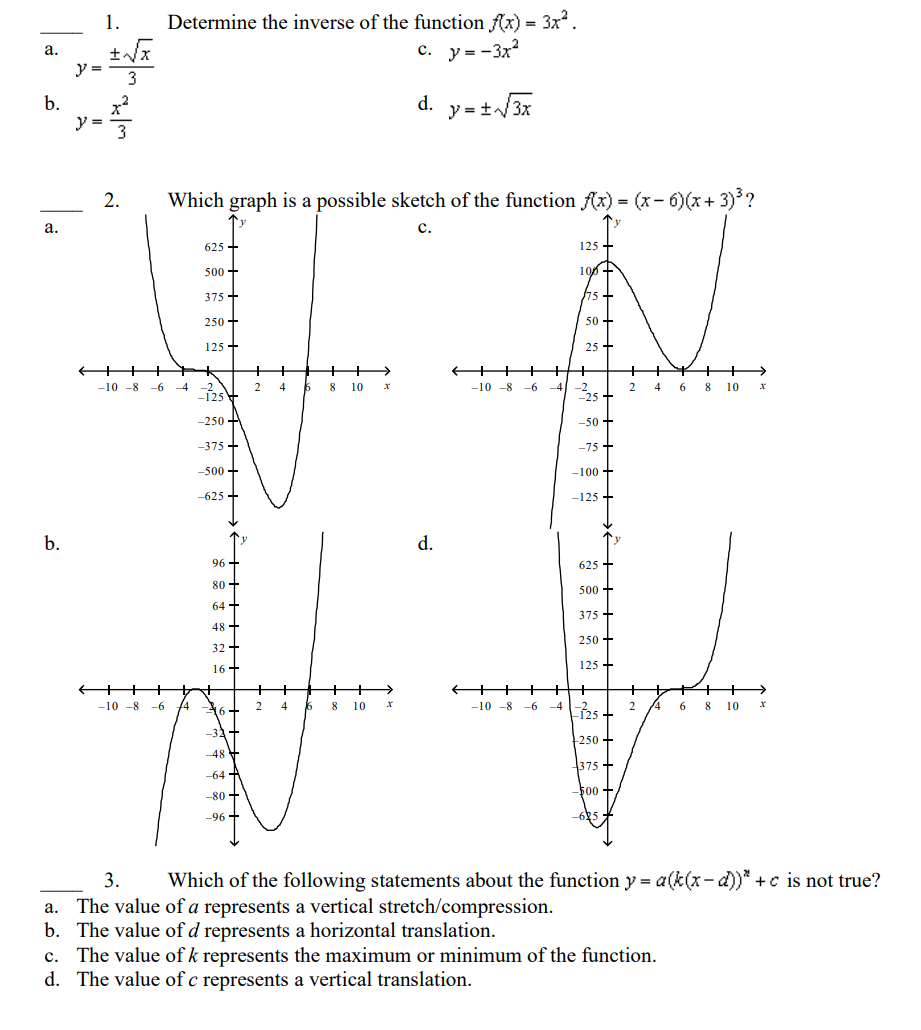
Question: please help no explanations needed just the answers in a rush sorry 1. Determine the inverse of the function f(x) = 3x2. a. 3 C.
please help
no explanations needed just the answers in a rush sorry
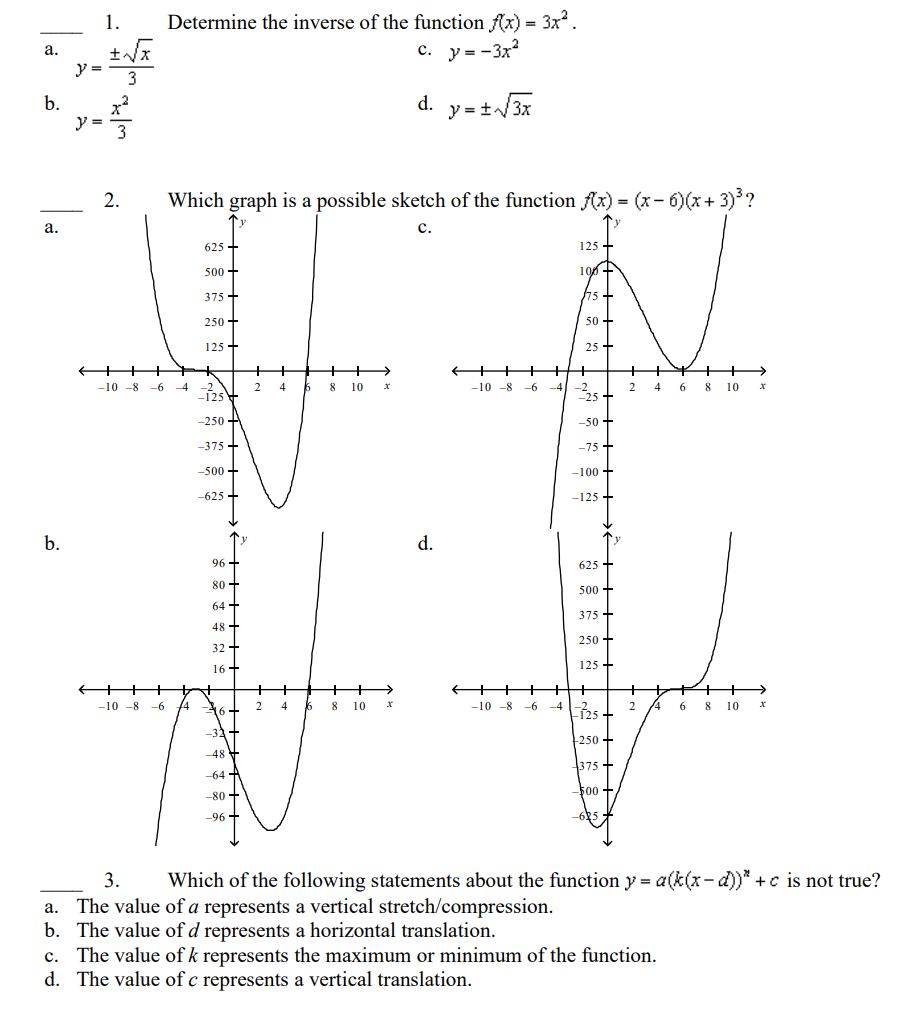
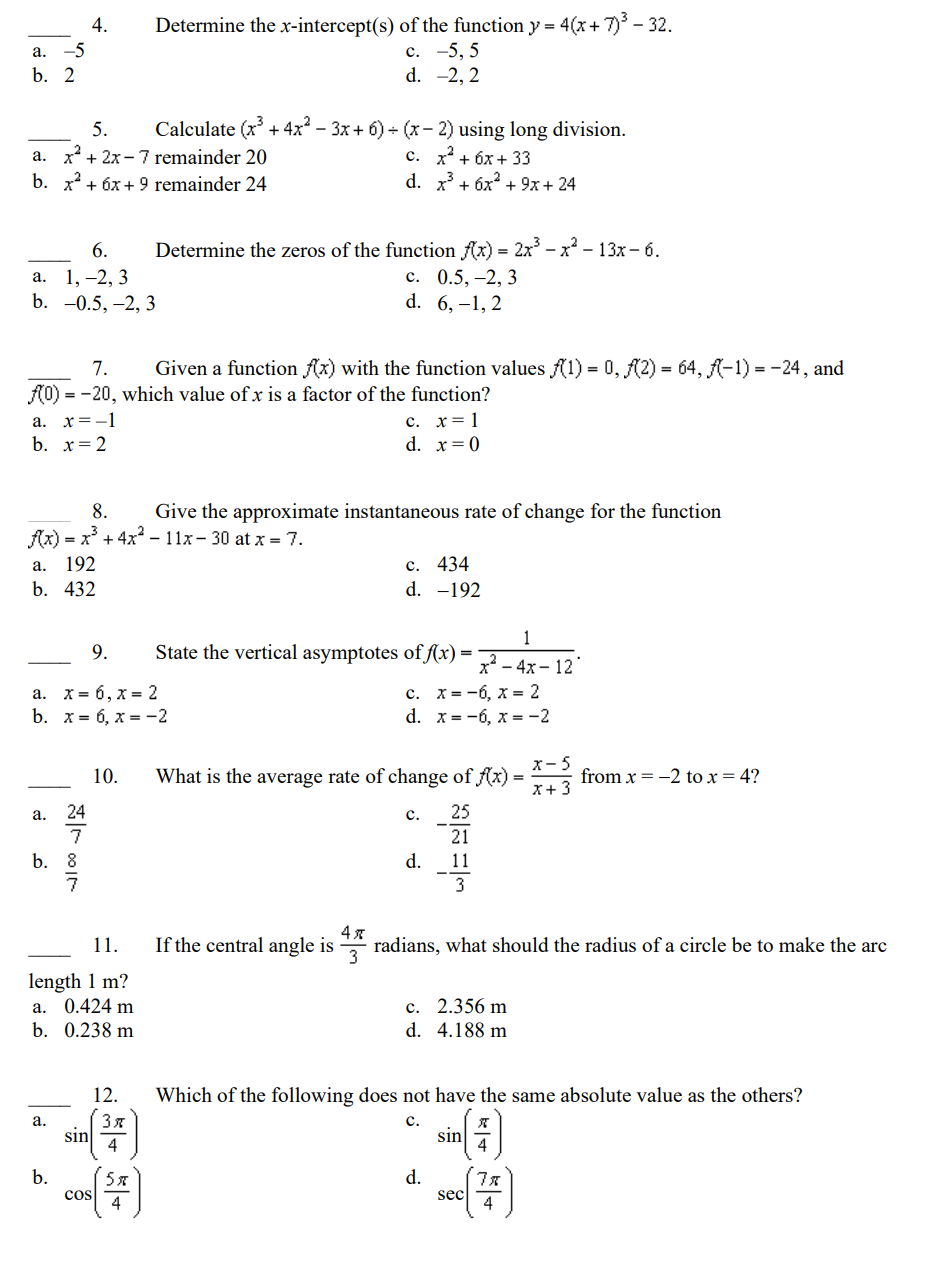
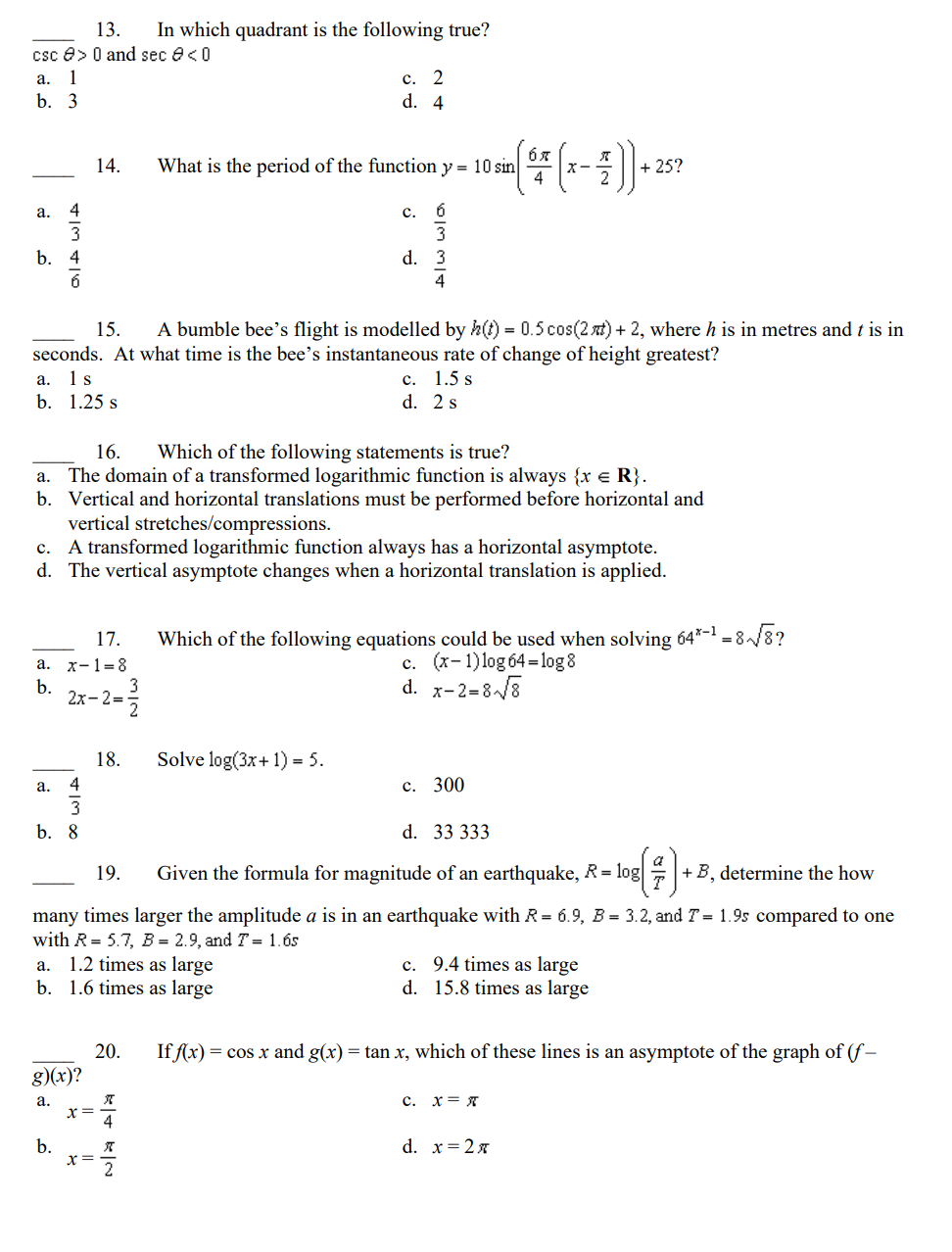
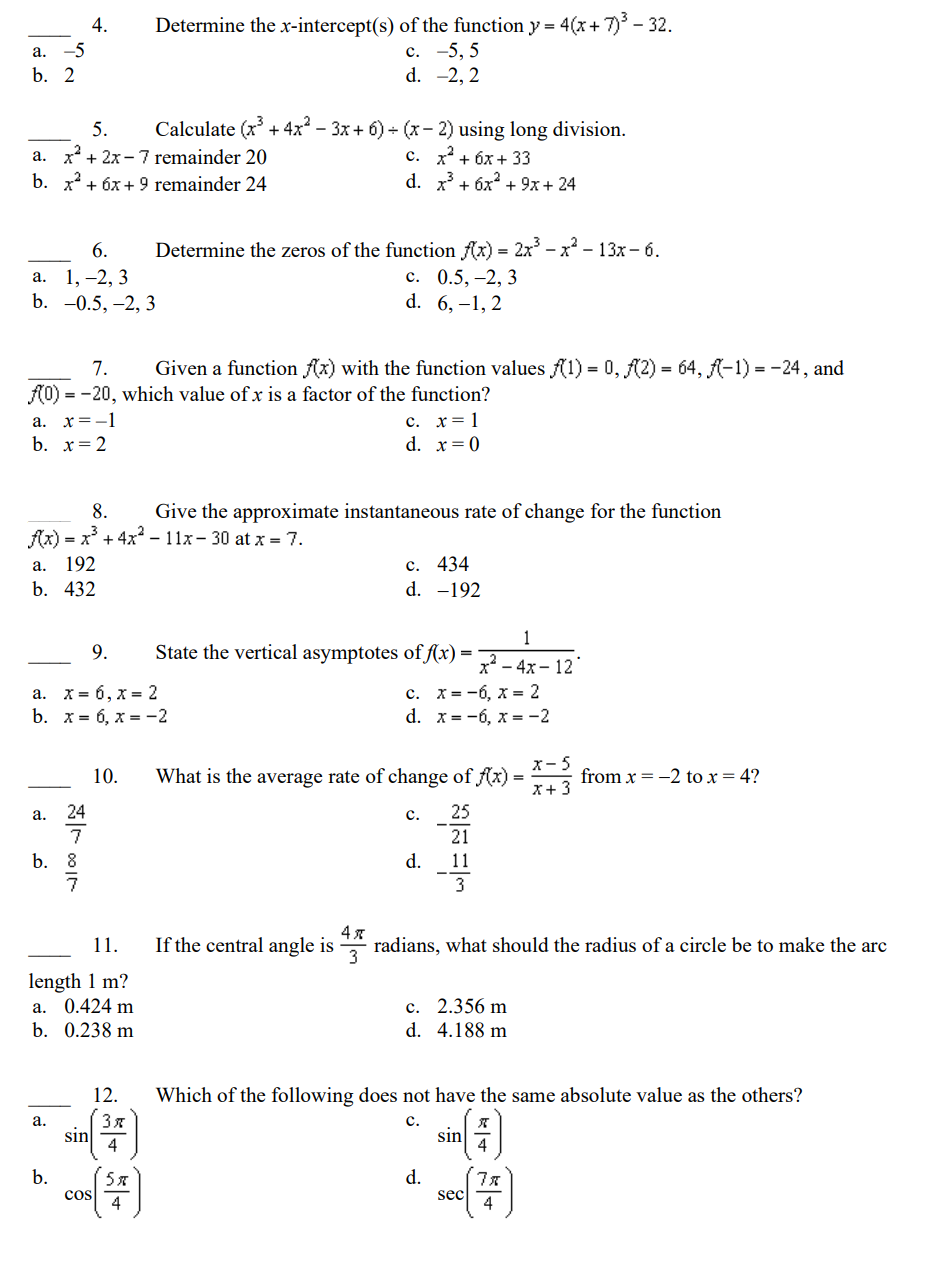
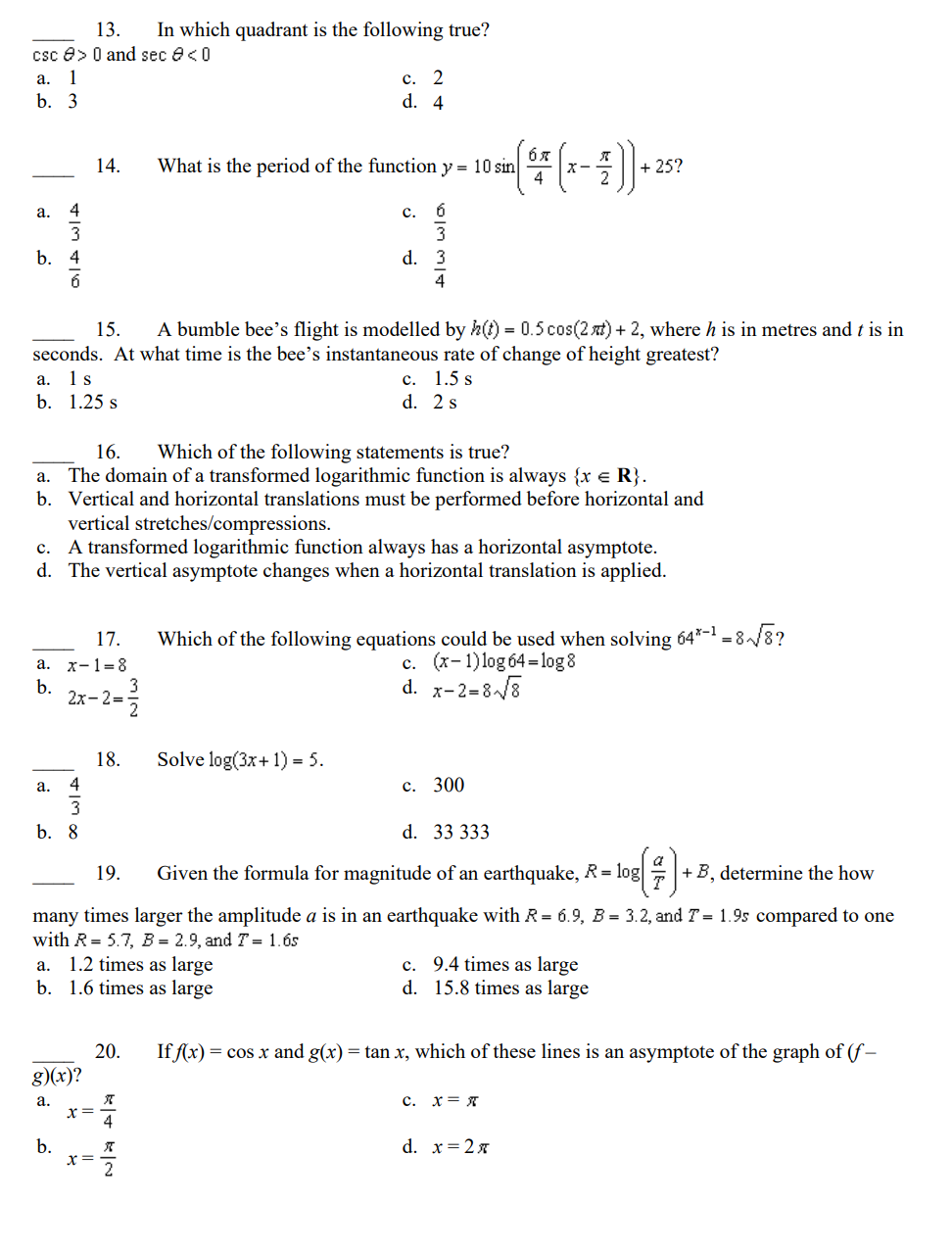
1. Determine the inverse of the function f(x) = 3x2. a. 3 C. y= -3x2 b w d. y=+ 3x 2. a. Ty Which graph is a possible sketch of the function f(x) = (x - 6)(x+ 3)3? 625 C. 500- 125 375 - 108 250 - 75 + 125 + 50 - 25 - -10 -8 -6 2 -125 + -8 -6 -2 2 -250- -25 + 10 -375 + -50 - -500+ -75 - 625- -100 - -125+ b. 96 + d. 80- 625 - 64+ 500 + 48 - 375+ 32- 250- 16+ 125 - -10 -8 -6 + + 8 10 -10 -8 - -4 -34+ 2 8 10 48 -250 - -64 4 1375 - 80 -96 . 500 - 3. Which of the following statements about the function y = a(k(x - d))* + c is not true? a. The value of a represents a vertical stretch/compression. b. The value of d represents a horizontal translation. c. The value of k represents the maximum or minimum of the function. d. The value of c represents a vertical translation.4. Determine the x-intercept(s) of the function y = 4(x + 7)3 - 32. a. c. -5, 5 b. 2 d. -2, 2 5. Calculate (x' + 4x2 - 3x + 6) + (x - 2) using long division. a. x' + 2x -7 remainder 20 C. x' + 6x + 33 b. x' + 6x + 9 remainder 24 d. x3 + 6x + 9x + 24 6. Determine the zeros of the function f(x) = 2x3 - x2 - 13x -6. a. 1, -2, 3 c. 0.5, -2, 3 b. -0.5, -2, 3 d. 6, -1, 2 7. Given a function f(x) with the function values A(1) = 0, A(2) = 64, A(-1) = -24, and f(0) = -20, which value of x is a factor of the function? a. x=-1 c. x= 1 b. x = 2 d. x=0 8. Give the approximate instantaneous rate of change for the function Ax) = x + 4x- 11x - 30 at x = 7. a. 192 C. 434 b. 432 d. -192 9. State the vertical asymptotes of f(x) = x2 - 4x - 12 a. x = 6, x = 2 C. X= -6, x = 2 b. x = 6, x = -2 d. x = -6, x = -2 10. What is the average rate of change of f(x) = * - 5 X+3 from x = -2 to x = 4? a. 24 C. 25 21 b. | 00 d. 11 11. If the central angle is - radians, what should the radius of a circle be to make the arc length 1 m? a. 0.424 m c. 2.356 m b. 0.238 m d. 4.188 m 12. Which of the following does not have the same absolute value as the others? a. 3x C. sin 4 sin b. d. 7 x COS sec 413. In which quadrant is the following true? 050 6: U and sec 9': El a. 1 c. 2 b. 3 d. 4 14. What is the period ofthe function y = IDsin[64r [x g ]] + 25'? a. i c. E 3 3 b. i d. E 6 4 15. A bumble bee's ight is modelled by M!) = 0.5 503(2 In?) + 2, where h is in metres and t is in seconds. At what time is the bee's instantaneous rate of change of height greatest? a. ls c. 1.55 b. 1.255 d. 23 16. Which of the following statements is true? a. The domain of a transformed logarithmic function is always {at e R}. b. Vertical and horizontal translations must be performed before horizontal and vertical stretches/compressions. c. A transformed logarithmic function always has a horizontal asymptote. d. The vertical asymptote changes when a horizontal translation is applied. 17. Which of the following equations could be used when solving 64"1 = Build? a. x1=3 c. (xl)log64=log8 13' 2X2= 51- x2=8J 2 18. Solve log(3x+ l) = 5. c. 300 Wmlh d. 33 333 19. Given the formula for magnitude of an earthquake, R =1Ug[%] + 3, determine the how many times larger the amplitude at is in an earthquake with R = 6.9, B = 3. 2, and T = 1.93 compared to one WithR= 5.7, B= 2.9.and T=1.6.5' a. 1.2 times as large c. 9.4 times as large b. 1.6 times as large d. 15.8 times as large 20. 1f x) : cos x and g(x) : tan x, which of these lines is an asymptote of the graph of (f 100? a. _:r c x=rr It b. _!r d. x=23r *3
Step by Step Solution
There are 3 Steps involved in it

Get step-by-step solutions from verified subject matter experts