







Question: Please help! Please solve with matlab please solve by matlab Please solve by hand % system values: m = 100; % (kg) mass k =
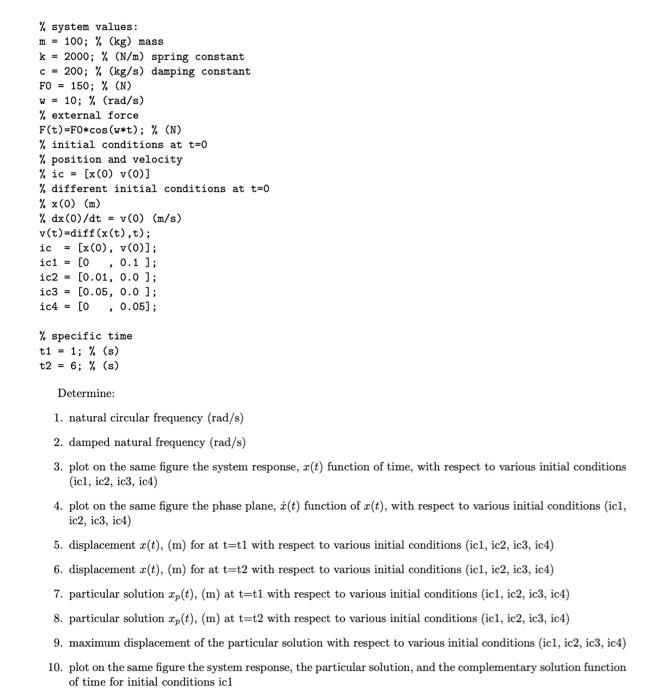
% system values: m = 100; % (kg) mass k = 2000; % (N/m) spring constant c = 200; % (kg/s) damping constant FO = 150; % (N) w = 10; % (rad/s) % external force F(t)=F0*cos(v*t); % (N) % initial conditions at t=0 % position and velocity % ic = (x(0) (0)] % different initial conditions at t=0 % x(0) (m) % dx(0)/dt = v(0) (m/s) v(t)-diff(x(t),t); ic = (x(0), v(0)]; ici = [O , 0.1]; ic2 - [0.01, 0.0); ic3 = [0.05, 0.0); ic4 = [ 0,0.05]; % specific time t1 = 1; % (s) t2 = 6; % (s) Determine: 1. natural circular frequency (rad/s) 2. damped natural frequency (rad/s) 3. plot on the same figure the system response, 3(t) function of time, with respect to various initial conditions (iel, ic2, ic3, ic) 4. plot on the same figure the phase plane, i(t) function of e(t), with respect to various initial conditions (icl, ic2, ic3, ict) 5. displacement (t), (m) for at t=t1 with respect to various initial conditions (icl, ic2, ic3, ic4) 6. displacement (t), (m) for at t=t2 with respect to various initial conditions (icl, ic2, ic3, ic4) 7. particular solution z(t), (m) at t=t1 with respect to various initial conditions (icl, ic2, ic3, ic4) 8. particular solution 2pt), (m) at tt2 with respect to various initial conditions (iel, ic2, ic3, ic4) 9. maximum displacement of the particular solution with respect to various initial conditions (icl, ic2, ic3, ich) 10. plot on the same figure the system response, the particular solution, and the complementary solution function of time for initial conditions icl % system values: m = 100; % (kg) mass k = 2000; % (N/m) spring constant c. 200; % (kg/s) damping constant FO = 150; % (N) w = 10; % (rad/s) % external force F(t)=F0*cos(w*t); % (N) % initial conditions at t=0 % position and velocity % ic = [x(0) (0)] % different initial conditions at t=0 % x(0) (m) % dx (0)/dt = v(0) (m/s) v(t)-diff(x(t),t); ic = (x(0), v(0)]; ici = [O 0.1); ic2 - (0.01, 0.0); ic3 = [0.05, 0.0); ic4 = [0, 0.05); % specific time t1 = 1; % (s) t2 = 6; % (s) Determine: 1. natural circular frequency (rad/s) 2. damped natural frequency (rad/s) 3. plot on the same figure the system response, 3(t) function of time, with respect to various initial conditions (icl, ie2, ic3, ic) 4. plot on the same figure the phase plane, i(t) function of e(t), with respect to various initial conditions (icl, ic2, ic3, ict) 5. displacement o(t), (m) for at t=tl with respect to various initial conditions (icl, ic2, ic3, ic4) 6. displacement (t), (m) for at t=t2 with respect to various initial conditions (icl, ic2, ic3, 104) 7. particular solution z(t), (m) at t=t1 with respect to various initial conditions (icl, ic2, ic3, ic4) 8. particular solution 2p(t), (m) at t=t2 with respect to various initial conditions (iel, ic2, ic3, ic4) 9. maximum displacement of the particular solution with respect to various initial conditions (icl, ic2, ic3, ic4) 10. plot on the same figure the system response, the particular solution, and the complementary solution function of time for initial conditions icl % system values: m = 100; % (kg) mass k = 2000; % (N/m) spring constant c = 200; % (kg/s) damping constant FO = 150; % (N) w = 10; % (rad/s) % external force F(t)=F0*cos(v*t); % (N) % initial conditions at t=0 % position and velocity % ic = (x(0) (0)] % different initial conditions at t=0 % x(0) (m) % dx(0)/dt = v(0) (m/s) v(t)-diff(x(t),t); ic = (x(0), v(0)]; ici = [O , 0.1]; ic2 - [0.01, 0.0); ic3 = [0.05, 0.0); ic4 = [ 0,0.05]; % specific time t1 = 1; % (s) t2 = 6; % (s) Determine: 1. natural circular frequency (rad/s) 2. damped natural frequency (rad/s) 3. plot on the same figure the system response, 3(t) function of time, with respect to various initial conditions (iel, ic2, ic3, ic) 4. plot on the same figure the phase plane, i(t) function of e(t), with respect to various initial conditions (icl, ic2, ic3, ict) 5. displacement (t), (m) for at t=t1 with respect to various initial conditions (icl, ic2, ic3, ic4) 6. displacement (t), (m) for at t=t2 with respect to various initial conditions (icl, ic2, ic3, ic4) 7. particular solution z(t), (m) at t=t1 with respect to various initial conditions (icl, ic2, ic3, ic4) 8. particular solution 2pt), (m) at tt2 with respect to various initial conditions (iel, ic2, ic3, ic4) 9. maximum displacement of the particular solution with respect to various initial conditions (icl, ic2, ic3, ich) 10. plot on the same figure the system response, the particular solution, and the complementary solution function of time for initial conditions icl % system values: m = 100; % (kg) mass k = 2000; % (N/m) spring constant c. 200; % (kg/s) damping constant FO = 150; % (N) w = 10; % (rad/s) % external force F(t)=F0*cos(w*t); % (N) % initial conditions at t=0 % position and velocity % ic = [x(0) (0)] % different initial conditions at t=0 % x(0) (m) % dx (0)/dt = v(0) (m/s) v(t)-diff(x(t),t); ic = (x(0), v(0)]; ici = [O 0.1); ic2 - (0.01, 0.0); ic3 = [0.05, 0.0); ic4 = [0, 0.05); % specific time t1 = 1; % (s) t2 = 6; % (s) Determine: 1. natural circular frequency (rad/s) 2. damped natural frequency (rad/s) 3. plot on the same figure the system response, 3(t) function of time, with respect to various initial conditions (icl, ie2, ic3, ic) 4. plot on the same figure the phase plane, i(t) function of e(t), with respect to various initial conditions (icl, ic2, ic3, ict) 5. displacement o(t), (m) for at t=tl with respect to various initial conditions (icl, ic2, ic3, ic4) 6. displacement (t), (m) for at t=t2 with respect to various initial conditions (icl, ic2, ic3, 104) 7. particular solution z(t), (m) at t=t1 with respect to various initial conditions (icl, ic2, ic3, ic4) 8. particular solution 2p(t), (m) at t=t2 with respect to various initial conditions (iel, ic2, ic3, ic4) 9. maximum displacement of the particular solution with respect to various initial conditions (icl, ic2, ic3, ic4) 10. plot on the same figure the system response, the particular solution, and the complementary solution function of time for initial conditions icl
Step by Step Solution
There are 3 Steps involved in it

Get step-by-step solutions from verified subject matter experts
 Study Help