







Question: please help Problem 2 [40 points] Assume that a commuter travels by light rail to work. The commuter has two options for accessing a light
![please help Problem 2 [40 points] Assume that a commuter travels by](https://dsd5zvtm8ll6.cloudfront.net/si.experts.images/questions/2024/10/6716394679f77_70167163945f15aa.jpg)
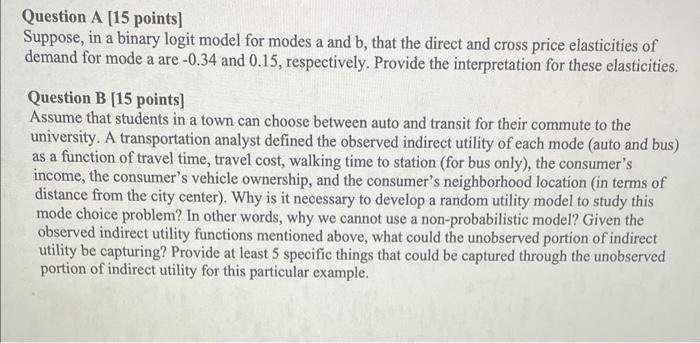
Problem 2 [40 points] Assume that a commuter travels by light rail to work. The commuter has two options for accessing a light rail station: by auto (A) and by bus (B). Assume that the observed indirect utility of each mode CE401/501 (auto and bus) depends on travel time, travel cost, the consumer's income, the consumer's vehicle ownership, and the consumer's neighborhood location (in terms of distance from the city center). (a) In addition, assume that travel time has the same impact on the utility of the two modes. The same holds for travel cost. Set up the two equations for the observed indirect utilities for the two modes (auto and bus). Constant(s) should be included. Use the bus option as the normalizing alternative. Use appropriate symbols for the variables and the parameters that need to be estimated. [Be careful - if the same symbol is used in both equations, it means that it reflects the exact same variable or parameter]. Explain which variables are alternative specific or generic. Also, provide the total number of parameters that we will need to estimate. (b) Now assume that travel time does not have the same impact on the utility of the two modes. The same holds for travel cost. Set up the two equations for the observed indirect utilities for the two modes (auto and bus). Constant(s) should be included. Use the bus option as the normalizing alternative. Use appropriate symbols for the variables and the parameters that need to be estimated. [Be careful - if the same symbol is used in both equations, it means that it reflects the exact same variable or parameter]. Explain which variables are alternative specific or generic. Also, provide the total number of parameters that we will need to estimate. Question A [ 15 points] Suppose, in a binary logit model for modes a and b, that the direct and cross price elasticities of demand for mode a are 0.34 and 0.15, respectively. Provide the interpretation for these elasticities. Question B [15 points] Assume that students in a town can choose between auto and transit for their commute to the university. A transportation analyst defined the observed indirect utility of each mode (auto and bus) as a function of travel time, travel cost, walking time to station (for bus only), the consumer's income, the consumer's vehicle ownership, and the consumer's neighborhood location (in terms of distance from the city center). Why is it necessary to develop a random utility model to study this mode choice problem? In other words, why we cannot use a non-probabilistic model? Given the observed indirect utility functions mentioned above, what could the unobserved portion of indirect utility be capturing? Provide at least 5 specific things that could be captured through the unobserved portion of indirect utility for this particular example. Problem 2 [40 points] Assume that a commuter travels by light rail to work. The commuter has two options for accessing a light rail station: by auto (A) and by bus (B). Assume that the observed indirect utility of each mode CE401/501 (auto and bus) depends on travel time, travel cost, the consumer's income, the consumer's vehicle ownership, and the consumer's neighborhood location (in terms of distance from the city center). (a) In addition, assume that travel time has the same impact on the utility of the two modes. The same holds for travel cost. Set up the two equations for the observed indirect utilities for the two modes (auto and bus). Constant(s) should be included. Use the bus option as the normalizing alternative. Use appropriate symbols for the variables and the parameters that need to be estimated. [Be careful - if the same symbol is used in both equations, it means that it reflects the exact same variable or parameter]. Explain which variables are alternative specific or generic. Also, provide the total number of parameters that we will need to estimate. (b) Now assume that travel time does not have the same impact on the utility of the two modes. The same holds for travel cost. Set up the two equations for the observed indirect utilities for the two modes (auto and bus). Constant(s) should be included. Use the bus option as the normalizing alternative. Use appropriate symbols for the variables and the parameters that need to be estimated. [Be careful - if the same symbol is used in both equations, it means that it reflects the exact same variable or parameter]. Explain which variables are alternative specific or generic. Also, provide the total number of parameters that we will need to estimate. Question A [ 15 points] Suppose, in a binary logit model for modes a and b, that the direct and cross price elasticities of demand for mode a are 0.34 and 0.15, respectively. Provide the interpretation for these elasticities. Question B [15 points] Assume that students in a town can choose between auto and transit for their commute to the university. A transportation analyst defined the observed indirect utility of each mode (auto and bus) as a function of travel time, travel cost, walking time to station (for bus only), the consumer's income, the consumer's vehicle ownership, and the consumer's neighborhood location (in terms of distance from the city center). Why is it necessary to develop a random utility model to study this mode choice problem? In other words, why we cannot use a non-probabilistic model? Given the observed indirect utility functions mentioned above, what could the unobserved portion of indirect utility be capturing? Provide at least 5 specific things that could be captured through the unobserved portion of indirect utility for this particular example
Step by Step Solution
There are 3 Steps involved in it

Get step-by-step solutions from verified subject matter experts
 Study Help