







Question: Please help Problem 2 The relationships between position, velocity, and acceleration are great examples of the ideas we are studying in calculus. Much of calculus
Please help
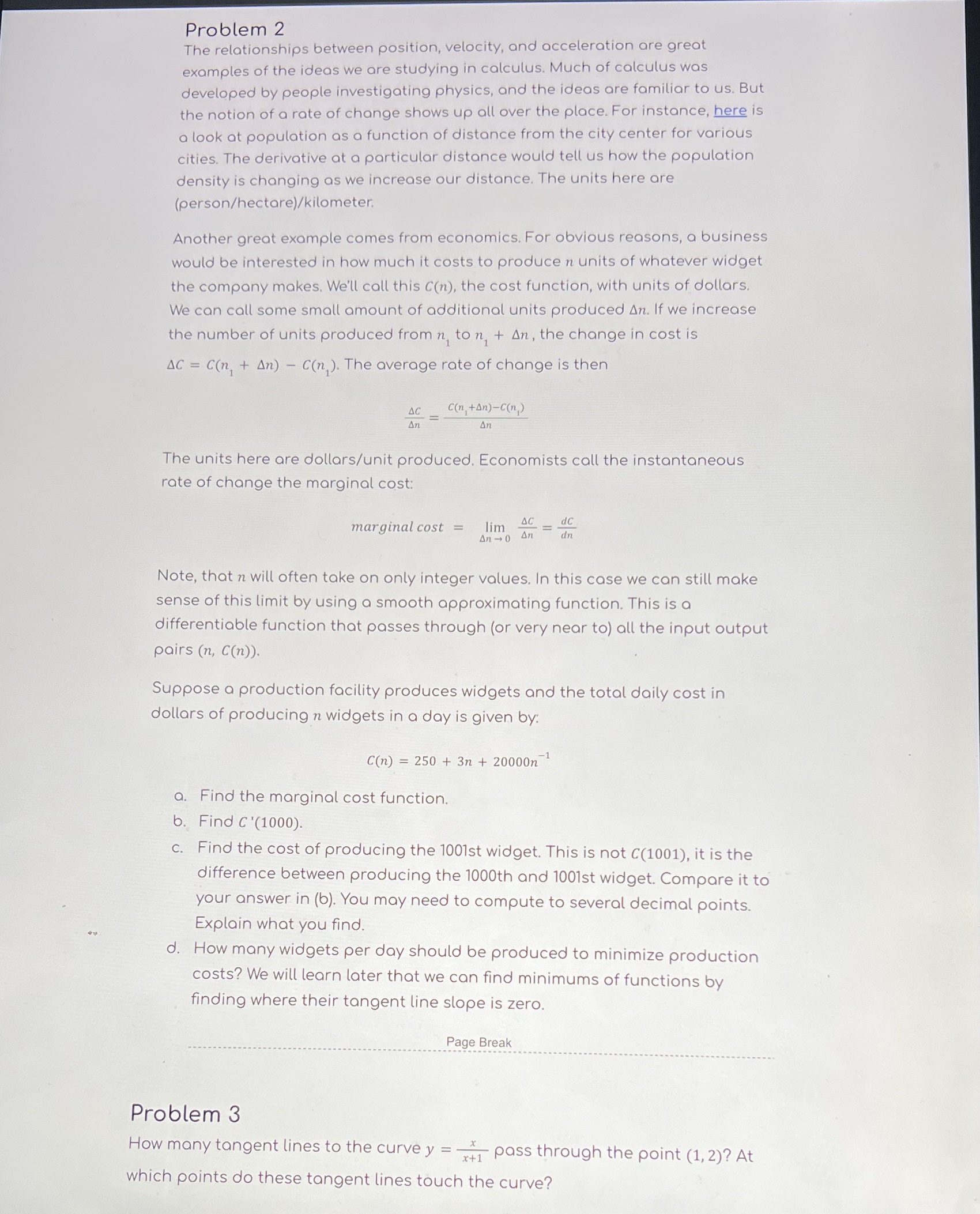
Problem 2 The relationships between position, velocity, and acceleration are great examples of the ideas we are studying in calculus. Much of calculus was developed by people investigating physics, and the ideas are familiar to us. But the notion of a rate of change shows up all over the place. For instance, here is a look at population as a function of distance from the city center for various cities. The derivative at a particular distance would tell us how the population density is changing as we increase our distance. The units here are (person/hectare)/kilometer. Another great example comes from economics. For obvious reasons, a business would be interested in how much it costs to produce n units of whatever widget the company makes. We'll call this C(n), the cost function, with units of dollars. We can call some small amount of additional units produced An. If we increase the number of units produced from n, to n, + An, the change in cost is AC = C(n, + An) - C(n,). The average rate of change is then AC C(n, +An)-C(n,) An An The units here are dollars/unit produced. Economists call the instantaneous rate of change the marginal cost: marginal cost = lim Ac dc An - 0 An dn Note, that n will often take on only integer values. In this case we can still make sense of this limit by using a smooth approximationg function. This is a differentiable function that passes through (or very near to) all the input output pairs (n, C(n)). Suppose a production facility produces widgets and the total daily cost in dollars of producing n widgets in a day is given by: C(n) = 250 + 3n + 20000n a. Find the marginal cost function. b. Find C'(1000). c. Find the cost of producing the 1001st widget. This is not C(1001), it is the difference between producing the 1000th and 1001st widget. Compare it to your answer in (b). You may need to compute to several decimal points. Explain what you find. d. How many widgets per day should be produced to minimize production costs? We will learn later that we can find minimums of functions by finding where their tangent line slope is zero. Page Break Problem 3 How many tangent lines to the curve y = x+1 pass through the point (1, 2)? At which points do these tangent lines touch the curve
Step by Step Solution
There are 3 Steps involved in it

Get step-by-step solutions from verified subject matter experts
 Study Help