







Question: Please help Problem 3 Let a particle move in a straight line (say along x-axis) with acceleration a (t) = k t where k is
Please help
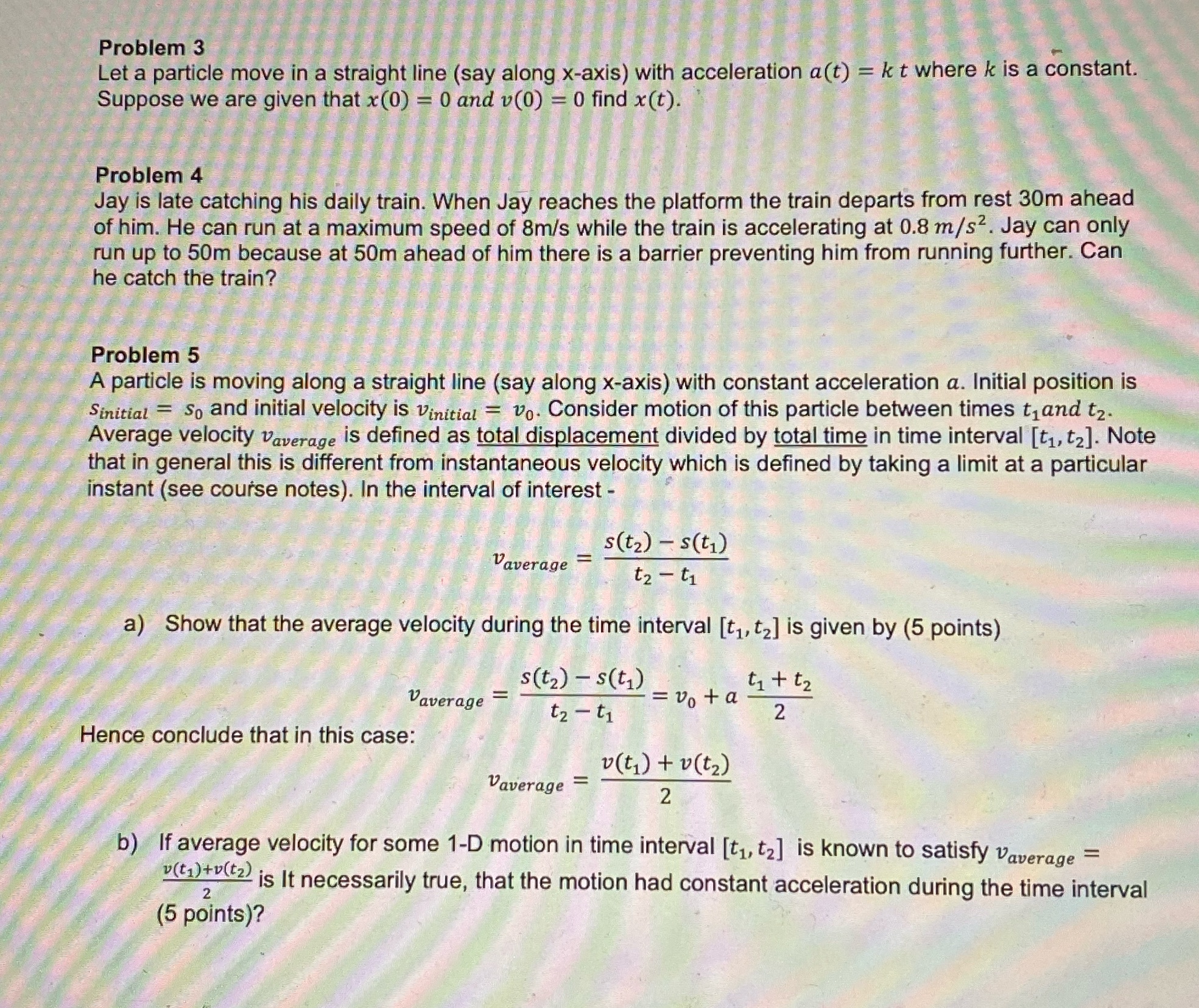
Problem 3 Let a particle move in a straight line (say along x-axis) with acceleration a (t) = k t where k is a constant. Suppose we are given that x(0) = 0 and v(0) = 0 find x(t). Problem 4 Jay is late catching his daily train. When Jay reaches the platform the train departs from rest 30m ahead of him. He can run at a maximum speed of 8m/s while the train is accelerating at 0.8 m/s2. Jay can only run up to 50m because at 50m ahead of him there is a barrier preventing him from running further. Can he catch the train? Problem 5 A particle is moving along a straight line (say along x-axis) with constant acceleration a. Initial position is Sinitial = So and initial velocity is Vinitial = Vo. Consider motion of this particle between times tand t2. Average velocity Vaverage is defined as total displacement divided by total time in time interval [t1, t2]. Note that in general this is different from instantaneous velocity which is defined by taking a limit at a particular instant (see course notes). In the interval of interest - s(t2) - s(t1 ) Vaverage t2 - t1 a) Show that the average velocity during the time interval [t,, t2] is given by (5 points) s(t2) - s(t1 ) t1 + tz Vaverage = vo ta t2 - t1 2 Hence conclude that in this case: v(t1 ) + v(t2) Vaverage 2 b) If average velocity for some 1-D motion in time interval [t1, t2] is known to satisfy Vaverage = 2 v(ti)+(t2) is It necessarily true, that the motion had constant acceleration during the time interval (5 points)
Step by Step Solution
There are 3 Steps involved in it

Get step-by-step solutions from verified subject matter experts
 Study Help