







Question: Please help Question 16 3 pts A monopolist has two sets of customers. The inverse demand for Group 1 is described ov P22X. For Group
Please help
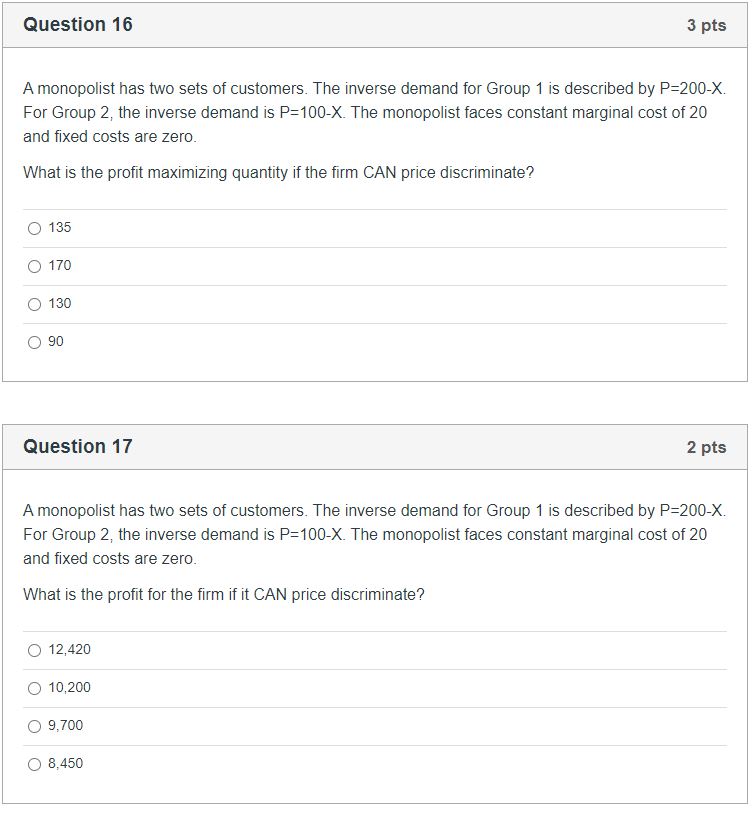
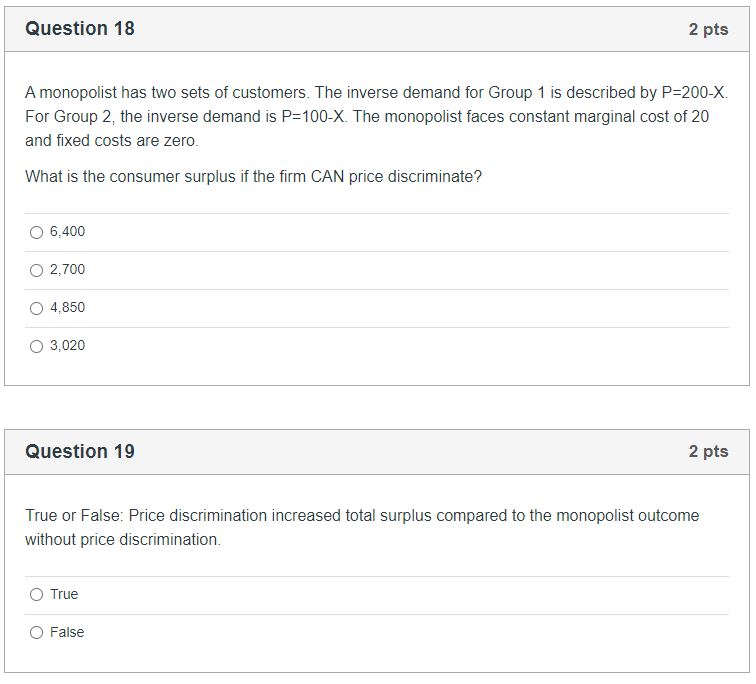
Question 16 3 pts A monopolist has two sets of customers. The inverse demand for Group 1 is described ov P22X. For Group 2. the inverse demand is P21GDX. The monopolist faces constant marginal cost of 2G and xed costs are zero. What is the prot maximizing quantity if the rm CAN price discriminate? D 135 {3: 1m 0 13o ciao Question 1? 2 pts A monopolist has two sets of customers. The inverse demand for Group 1 is described by P=2DX. For Group 2. the inverse demand is P21GGX. The monopolist faces constant marginal cost of 2D and xed costs are zero. What is the prot for the rm if it CAN price discriminate\"? {3: 12,420 D 1o,2oo 0 9,?03 (3 3,45o Question 18 2 pts A monopolist has two sets of customers. The inverse demand for Group 1 is described by P=2-X. For Group 2, the inverse demand is P21DDX. The monopolist faces constant marginal cost of 2D and xed costs are zero. What is the consumer surplus if the rm CAN price discriminate? D EAIJD D 2,?oo D aeao C} 3,o2o Question 19 2 pts True or False: Price discrimination increased total surplus compared to the monopolist outcome without pn'ce discrimination. C) True 0 False
Step by Step Solution
There are 3 Steps involved in it

Get step-by-step solutions from verified subject matter experts
 Study Help