







Question: please help Question 2. Can simple activity coefficient model be used to fit quaternary VLE data? It is of interest to see what capabilities exist
please help
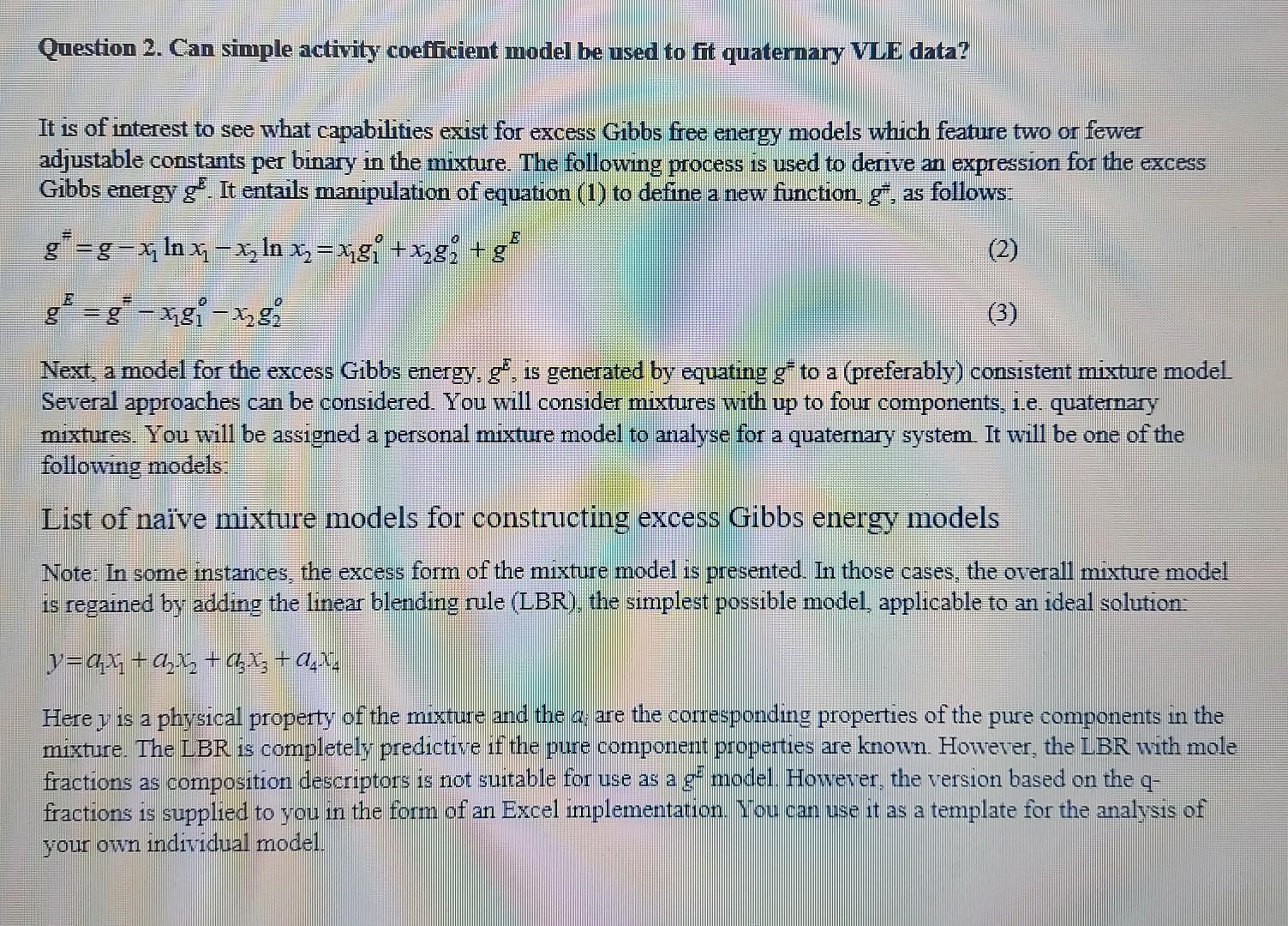



Question 2. Can simple activity coefficient model be used to fit quaternary VLE data? It is of interest to see what capabilities exist for excess Gibbs free energy models which feature two or fewer adjustable constants per binary in the mixture. The following process is used to derive an expression for the excess Gibbs energy of. It entails manipulation of equation (1) to define a new function, gt, as follows: g* =g-x In x4 xz In xz=xg+x3g2 + (2) E g g = g* xg -xzgi (3) Next, a model for the excess Gibbs energy.g, is generated by equating gf to a (preferably) consistent mixture model Several approaches can be considered. You will consider mixtures with up to four components, i.e. quaternary mixtures. You will be assigned a personal mixture model to analyse for a quaternary system It will be one of the following models: List of nave mixture models for constructing excess Gibbs energy models Note: In some instances, the excess form of the mixture model is presented. In those cases, the overall mixture model is regained by adding the linear blending rule (LBR), the simplest possible model, applicable to an ideal solution: = axy + a,X, + ; + a4x4 Here y is a physical property of the mixture and the a: are the corresponding properties of the pure components in the mixture. The LBR is completely predictive if the ure component properties are known. However, the LBR with mole fractions as composition descriptors is not suitable for use as a g model. However, the version based on the q- fractions is supplied to you in the form of an Excel implementation. You can use it as a template for the analysis of your own individual model. Model 3: Bernstein polynomial (Additive model for excess properties) - g = AX (1-x) + 1x2 (1-x2) + A3xz(1 - xz) + 4X: (1= x;) The binary form of this excess model is equivalent to the binary form of the quadratic Scheffe polynomial. (c) Determine the infinite dilution activity coefficients of the activity coefficient model for binary mixtures. (2) (d) Model specific questions: See Table below (6) Model 3: Bernstein polynomial (Additive model for excess properties) Model specific question: Consider a binary mixture described by this model. Does the model form nng a bell? Discuss the implications of the following scenarios: A = 0, A>and Aand A
Step by Step Solution
There are 3 Steps involved in it

Get step-by-step solutions from verified subject matter experts
 Study Help