







Question: please help Question 7 Evaluate the likely effects on the UK's current account of the balance of payments of changes in consumption, investment and the
please help
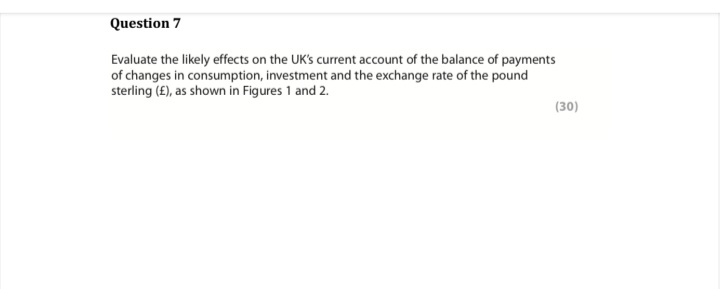
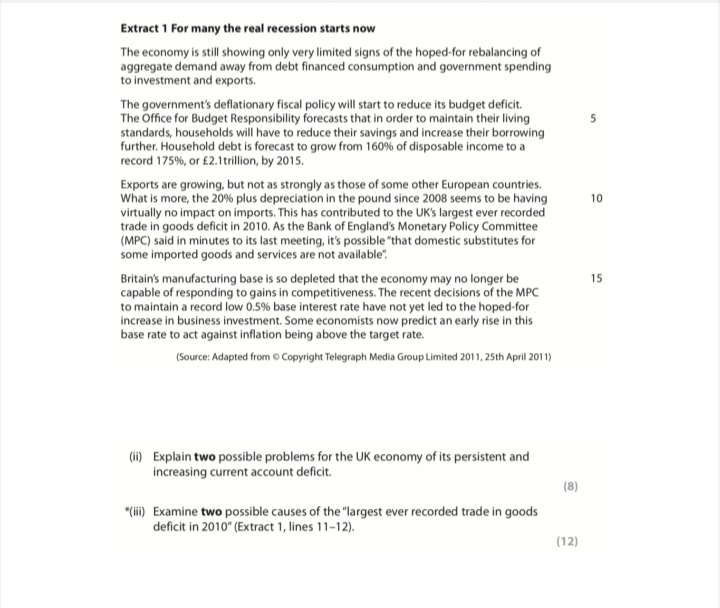
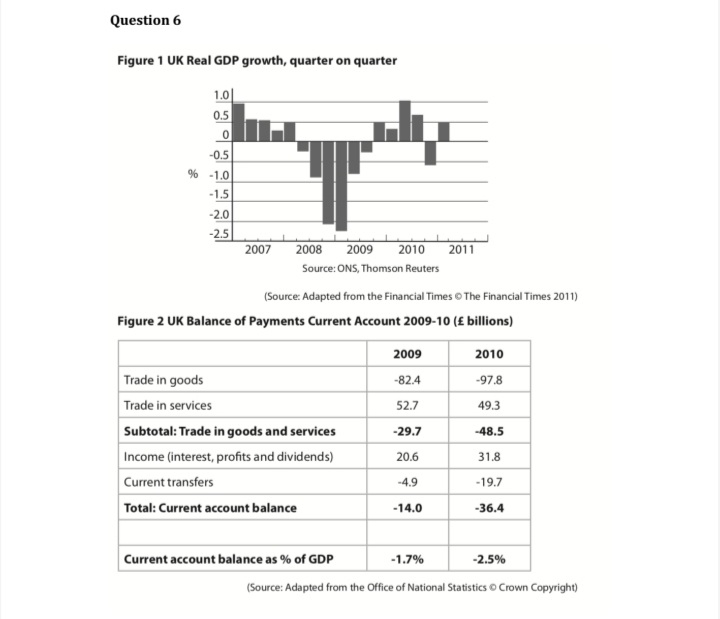
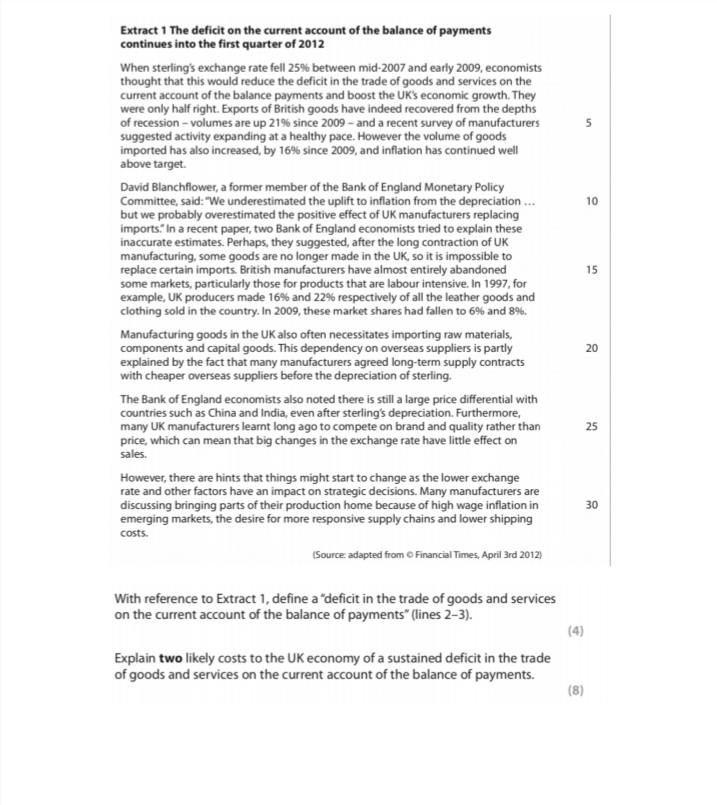
Question 7 Evaluate the likely effects on the UK's current account of the balance of payments of changes in consumption, investment and the exchange rate of the pound sterling (f), as shown in Figures 1 and 2. (30)Extract 1 For many the real recession starts now The economy is still showing only very limited signs of the hoped-for rebalancing of aggregate demand away from debt financed consumption and government spending to investment and exports. The government's deflationary fiscal policy will start to reduce its budget deficit. The Office for Budget Responsibility forecasts that in order to maintain their living standards, households will have to reduce their savings and increase their borrowing further. Household debt is forecast to grow from 160% of disposable income to a record 175%, or E2.1trillion, by 2015. Exports are growing, but not as strongly as those of some other European countries. What is more, the 20% plus depreciation in the pound since 2008 seems to be having 10 virtually no impact on imports. This has contributed to the UK's largest ever recorded trade in goods deficit in 2010. As the Bank of England's Monetary Policy Committee (MPC) said in minutes to its last meeting, it's possible "that domestic substitutes for some imported goods and services are not available". Britain's manufacturing base is so depleted that the economy may no longer be 15 capable of responding to gains in competitiveness. The recent decisions of the MPC to maintain a record low 0.5% base interest rate have not yet led to the hoped-for Increase in business investment. Some economists now predict an early rise in this base rate to act against inflation being above the target rate. (Source: Adapted from @ Copyright Telegraph Media Group Limited 2011, 25th April 201 1) (ii) Explain two possible problems for the UK economy of its persistent and increasing current account deficit. (8) "(iii) Examine two possible causes of the "largest ever recorded trade in goods deficit in 2010" (Extract 1, lines 11-12). (12)Question 6 Figure 1 UK Real GDP growth, quarter on quarter 1.0 0.5 0 -0.5 9% -1.0 -1.5 -2.0 -2.5 2007 2008 2009 2010 2011 Source: ONS, Thomson Reuters (Source: Adapted from the Financial Times @ The Financial Times 2011) Figure 2 UK Balance of Payments Current Account 2009-10 (E billions) 2009 2010 Trade in goods -82.4 -97.8 Trade in services 52.7 49.3 Subtotal: Trade in goods and services -29.7 48.5 Income (interest, profits and dividends) 20.6 31.8 Current transfers 4.9 -19.7 Total: Current account balance -14.0 -36.4 Current account balance as % of GDP -1.7% -2.5% (Source: Adapted from the Office of National Statistics . Crown Copyright)Extract 1 The deficit on the current account of the balance of payments continues into the first quarter of 2012 When sterling's exchange rate fell 25% between mid-2007 and early 2009, economists thought that this would reduce the deficit in the trade of goods and services on the current account of the balance payments and boost the UK's economic growth. They were only half right. Exports of British goods have indeed recovered from the depths of recession - volumes are up 21% since 2009 - and a recent survey of manufacturers suggested activity expanding at a healthy pace. However the volume of goods imported has also increased, by 16% since 2009, and inflation has continued well above target. David Blanchflower, a former member of the Bank of England Monetary Policy Committee, said: "We underestimated the uplift to inflation from the depreciation ... 10 but we probably overestimated the positive effect of UK manufacturers replacing imports." In a recent paper, two Bank of England economists tried to explain these inaccurate estimates. Perhaps, they suggested, after the long contraction of UK manufacturing, some goods are no longer made in the UK, so it is impossible to replace certain imports. British manufacturers have almost entirely abandoned 15 some markets, particularly those for products that are labour intensive. In 1997, for example, UK producers made 16% and 22% respectively of all the leather goods and clothing sold in the country. In 2009, these market shares had fallen to 6% and 8%. Manufacturing goods in the UK also often necessitates importing raw materials, components and capital goods. This dependency on overseas suppliers is partly 20 explained by the fact that many manufacturers agreed long-term supply contracts with cheaper overseas suppliers before the depreciation of sterling. The Bank of England economists also noted there is still a large price differential with countries such as China and India, even after sterling's depreciation. Furthermore, many UK manufacturers learnt long ago to compete on brand and quality rather than 25 price, which can mean that big changes in the exchange rate have little effect on sales. However, there are hints that things might start to change as the lower exchange rate and other factors have an impact on strategic decisions. Many manufacturers are discussing bringing parts of their production home because of high wage inflation in 30 emerging markets, the desire for more responsive supply chains and lower shipping costs. (Source: adapted from @ Financial Times, April 3rd 2012) With reference to Extract 1, define a "deficit in the trade of goods and services on the current account of the balance of payments" (lines 2-3). (4) Explain two likely costs to the UK economy of a sustained deficit in the trade of goods and services on the current account of the balance of payments. (8)
Step by Step Solution
There are 3 Steps involved in it

Get step-by-step solutions from verified subject matter experts
 Study Help