Question: PLEASE HELP. read the case and respond to this question - Analyse the convertible prefered stock-Class A and Class B issue and provide all calculations
PLEASE HELP. read the case and respond to this question
- Analyse the convertible prefered stock-Class A and Class B issue and provide all calculations
PLEASE the analysis must be in this format
State the issue
The debt
The equity
Recommendation
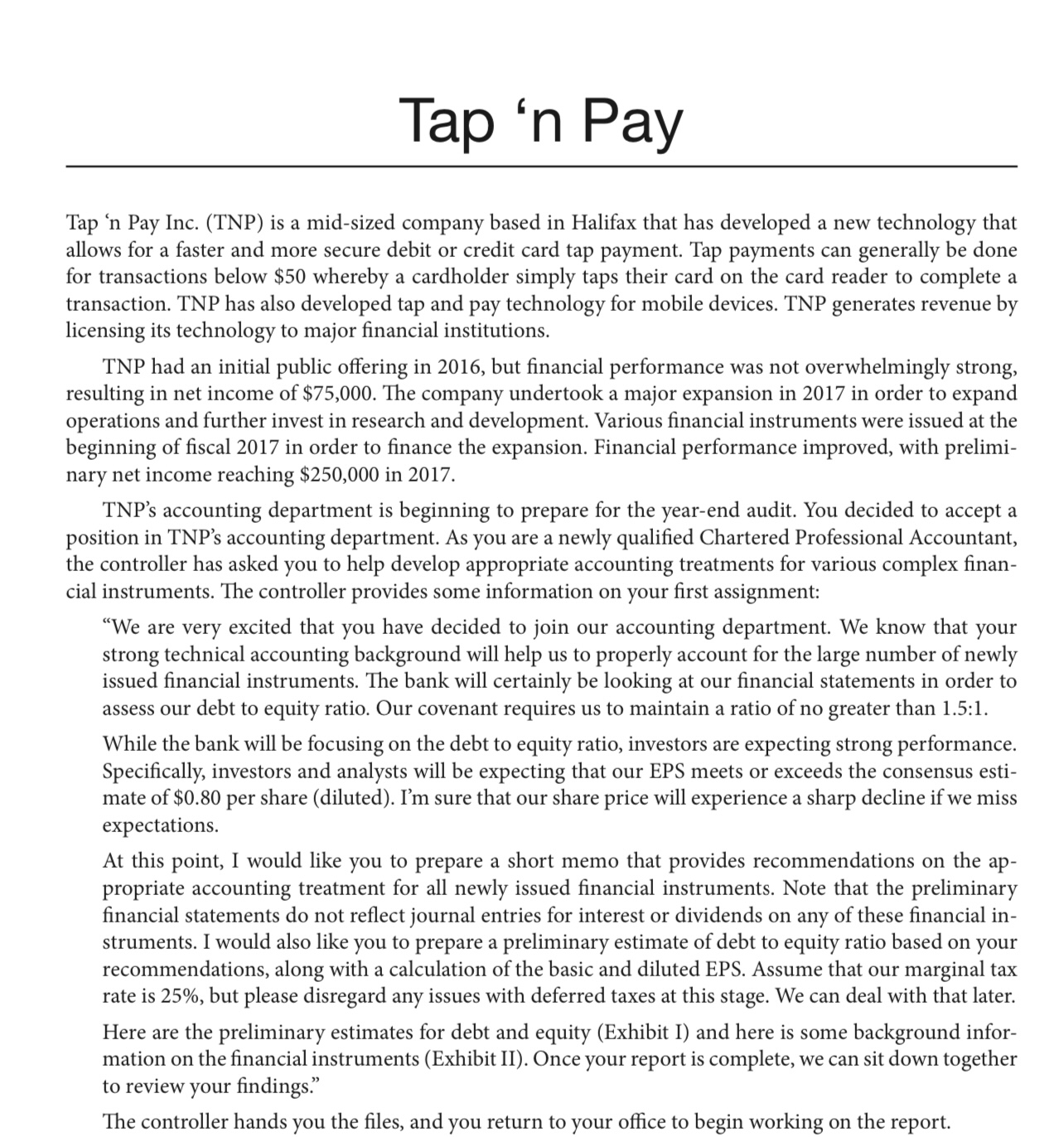
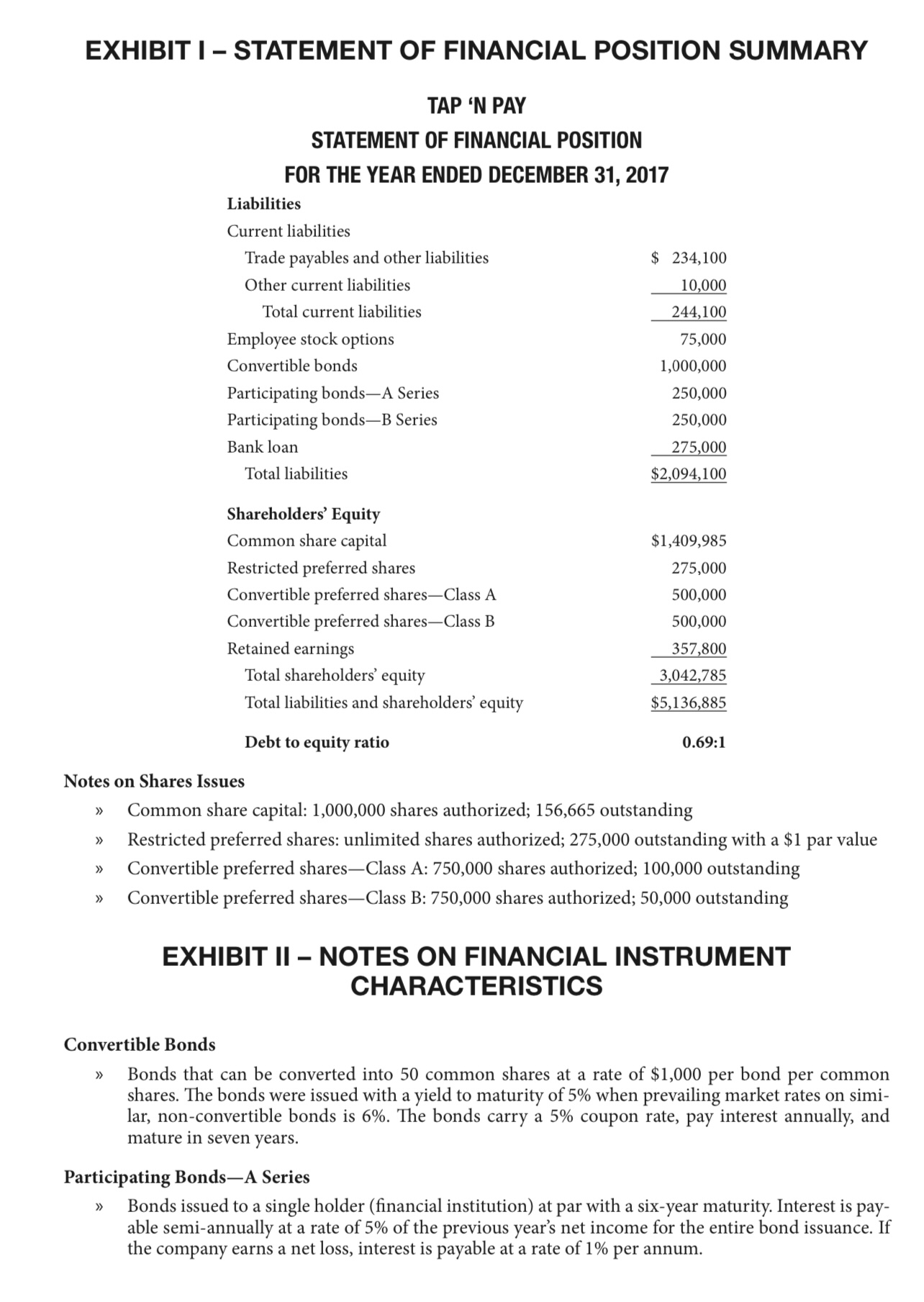
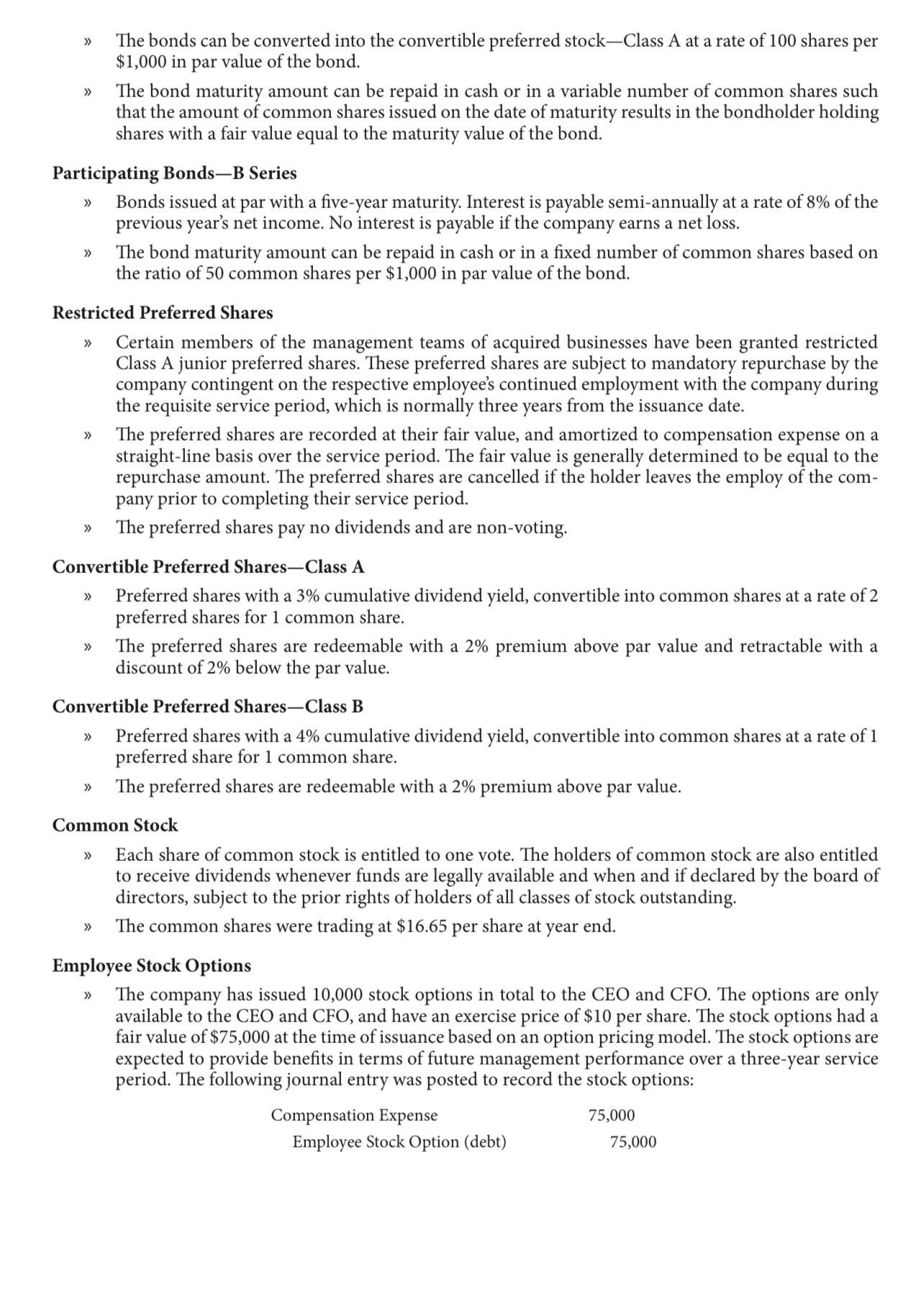
Tap 'n Pay Tap 'n Pay Inc. (TNP) is a mid-sized company based in Halifax that has developed a new technology that allows for a faster and more secure debit or credit card tap payment. Tap payments can generally be done for transactions below $50 whereby a cardholder simply taps their card on the card reader to complete a transaction. TNP has also developed tap and pay technology for mobile devices. TNP generates revenue by licensing its technology to major financial institutions. TNP had an initial public offering in 2016, but financial performance was not overwhelmingly strong, resulting in net income of $75,000. The company undertook a major expansion in 2017 in order to expand operations and further invest in research and development. Various financial instruments were issued at the beginning of fiscal 2017 in order to finance the expansion. Financial performance improved, with prelimi- nary net income reaching $250,000 in 2017. INP's accounting department is beginning to prepare for the year-end audit. You decided to accept a position in TNP's accounting department. As you are a newly qualified Chartered Professional Accountant, the controller has asked you to help develop appropriate accounting treatments for various complex finan- cial instruments. The controller provides some information on your first assignment: "We are very excited that you have decided to join our accounting department. We know that your strong technical accounting background will help us to properly account for the large number of newly issued financial instruments. The bank will certainly be looking at our financial statements in order to assess our debt to equity ratio. Our covenant requires us to maintain a ratio of no greater than 1.5:1. While the bank will be focusing on the debt to equity ratio, investors are expecting strong performance. Specifically, investors and analysts will be expecting that our EPS meets or exceeds the consensus esti- mate of $0.80 per share (diluted). I'm sure that our share price will experience a sharp decline if we miss expectations. At this point, I would like you to prepare a short memo that provides recommendations on the ap- propriate accounting treatment for all newly issued financial instruments. Note that the preliminary financial statements do not reflect journal entries for interest or dividends on any of these financial in- struments. I would also like you to prepare a preliminary estimate of debt to equity ratio based on your recommendations, along with a calculation of the basic and diluted EPS. Assume that our marginal tax rate is 25%, but please disregard any issues with deferred taxes at this stage. We can deal with that later. Here are the preliminary estimates for debt and equity (Exhibit I) and here is some background infor- mation on the financial instruments (Exhibit II). Once your report is complete, we can sit down together to review your findings." The controller hands you the files, and you return to your office to begin working on the report.EXHIBIT I - STATEMENT OF FINANCIAL POSITION SUMMARY TAP 'N PAY STATEMENT OF FINANCIAL POSITION FOR THE YEAR ENDED DECEMBER 31, 2017 Liabilities Current liabilities Trade payables and other liabilities $ 234,100 Other current liabilities 10,000 Total current liabilities 244,100 Employee stock options 75,000 Convertible bonds 1,000,000 Participating bondsA Series 250,000 Participating bondsB Series 250,000 Bank loan 275,000 Total liabilities $2,094,100 Shareholders' Equity Common share capital $1,409,985 Restricted preferred shares 275,000 Convertible preferred sharesClass A 500,000 Convertible preferred sharesClass B 500,000 Retained earnings 357,800 Total shareholders' equity 3,042,785 Total liabilities and shareholders' equity $5,136,885 Debt to equity ratio 0.69:1 Notes on Shares Issues Common share capital: 1,000,000 shares authorized; 156,665 outstanding >> Restricted preferred shares: unlimited shares authorized; 275,000 outstanding with a $1 par value >> Convertible preferred share57Class A: 750,000 shares authorized; 100.000 outstanding >> Convertible preferred sharesClass B: 750,000 shares authorized; 50,000 outstanding EXHIBIT II - NOTES ON FINANCIAL INSTRUMENT CHARACTERISTICS Convertible Bonds >> Bonds that can be converted into 50 common shares at a rate of $1,000 per bond per common shares. The bonds were issued with a yield to maturity of 5% when prevailing market rates on simi- lar, non-convertible bonds is 6%. The bonds carry a 5% coupon rate, pay interest annually, and mature in seven years. Participating BondsA Series >> Bonds issued to a single holder (nancial institution) at par with a six-year maturity. Interest is pay- able semi-annually at a rate of 5% of the previous year's net income for the entire bond issuance. If the company earns a net loss, interest is payable at a rate of 1% per annum. )3 The bonds can be converted into the convertible preferred stockClass A at a rate of 100 shares per $1,000 in par value of the bond. )3 The bond maturity amount can be repaid in cash or in a variable number of common shares such that the amount of common shares issued on the date ofmaturity results in the bondholder holding shares with a fair value equal to the maturity value of the bond. Participating BondsB Series Bonds issued at par with a ve-year maturity. Interest is payable semi-annually at a rate of 8% of the previous year's net income. No interest is payable if the company earns a net loss. The bond maturity amount can be repaid in cash or in a xed number of common shares based on the ratio of 50 common shares per $1,000 in par value of the bond. Restricted Preferred Shares Certain members of the management teams of acquired businesses have been granted restricted Class A junior preferred shares. These preferred shares are subject to mandatory repurchase by the company contingent on the respective employee's continued employment with the company during the requisite service period, which is normally three years from the issuance date. The preferred shares are recorded at their fair value, and amortized to compensation expense on a straight-line basis over the service period. The fair value is generally determined to be equal to the repurchase amount. The preferred shares are cancelled if the holder leaves the employ of the com- pany prior to completing their service period. )3 The preferred shares pay no dividends and are non-voting. Convertible Preferred SharesClass A )3 Preferred shares with a 3% cumulative dividend yield, convertible into common shares at a rate of 2 preferred shares for 1 common share. )3 The preferred shares are redeemable with a 2% premium above par value and retractable with a discount of 2% below the par value. Convertible Preferred SharesClass B )3 Preferred shares with a 4% cumulative dividend yield, convertible into common shares at a rate of 1 preferred share for 1 common share. >> The preferred shares are redeemable with a 2% premium above par value. Common Stock )3 Each share of common stock is entitled to one vote. The holders of common stock are also entitled to receive dividends whenever funds are legally available and when and if declared by the board of directors, subject to the prior rights of holders of all classes of stock outstanding. The common shares were trading at $16.65 per share at year end. Employee Stock Options The company has issued 10,000 stock options in total to the CEO and CFO. The options are only available to the CEO and CFO, and have an exercise price of $10 per share. The stock options had a fair value of $75,000 at the time of issuance based on an option pricing model. The stock options are expected to provide benets in terms of future management performance over a three-year service period. The following journal entry was posted to record the stock options: Compensation Expense 75,000 Employee Stock Option (debt) 75,000
Step by Step Solution
There are 3 Steps involved in it
1 Expert Approved Answer
Step: 1 Unlock
Question Has Been Solved by an Expert!
Get step-by-step solutions from verified subject matter experts
Step: 2 Unlock
Step: 3 Unlock
Students Have Also Explored These Related Finance Questions!









 Study Help