







Question: please help Requirements 1. Calculate the partial-productivity ratios for materials and conversion (capacity costs) for 2020 , and compare them to a benchmark for 2019
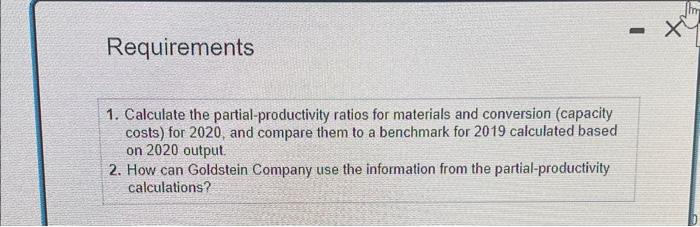
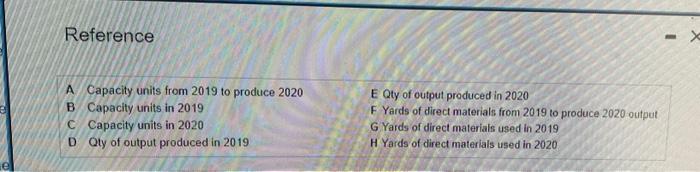
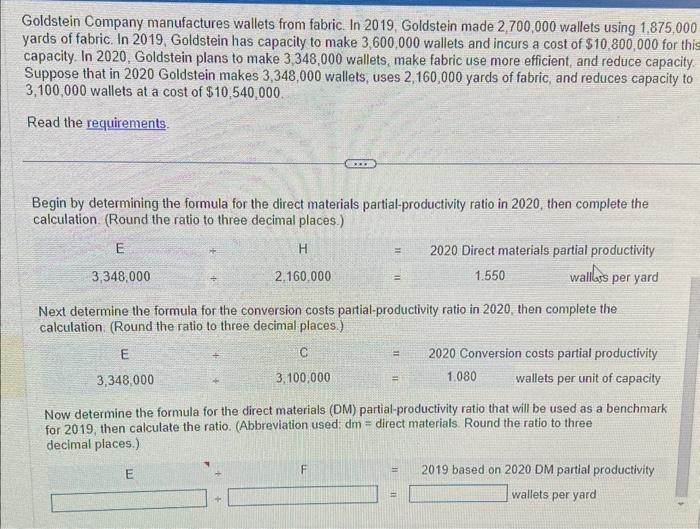
Requirements 1. Calculate the partial-productivity ratios for materials and conversion (capacity costs) for 2020 , and compare them to a benchmark for 2019 calculated based on 2020 output. 2. How can Goldstein Company use the information from the partial-productivity calculations? A Capacity units from 2019 to produce 2020 E Qty of output produced in 2020 B Capacity units in 2019 F Yards of direct materials from 2019 to produce 2020 -outpet C Capacity units in 2020 G Yards of direct materials used in 2019 D Qty of output produced in 2019 H Yards of direct materials used in 2020 Goldstein Company manufactures wallets from fabric. In 2019, Goldstein made 2,700,000 wallets using 1,875,000 yards of fabric. In 2019, Goldstein has capacily to make 3,600,000 wallets and incurs a cost of $10,800,000 for thi capacity. In 2020, Goldstein plans to make 3,348,000 wallets, make fabric use more efficient, and reduce capacity Suppose that in 2020 Goldstein makes 3,348,000 wallets, uses 2,160,000 yards of fabric, and reduces capacity to 3,100,000 wallets at a cost of $10,540,000. Read the requirements. Begin by determining the formula for the direct materials partial-productivity ratio in 2020 , then complete the calculation. (Round the ratio to three decimal places.) Next determine the formula for the conversion costs partial-productivity ratio in 2020 , then complete the calculation. (Round the ratio to three decimal places) Now determine the formula for the direct materials (DM) partial-productivity ratio that will be used as a benchmark for 2019, then calculate the ratio. (Abbreviation used dm = direct materials. Round the ratio to three decimal places.)
Step by Step Solution
There are 3 Steps involved in it

Get step-by-step solutions from verified subject matter experts
 Study Help